🪐 Dwarf Planets Compared: Size and Orbits
🌌 What It Is
Dwarf planets are fascinating celestial bodies that orbit our Sun and share many characteristics with true planets, yet they differ in significant ways. Unlike the eight major planets, dwarf planets have not cleared their orbital paths of other debris. This unique characteristic is key to their classification.
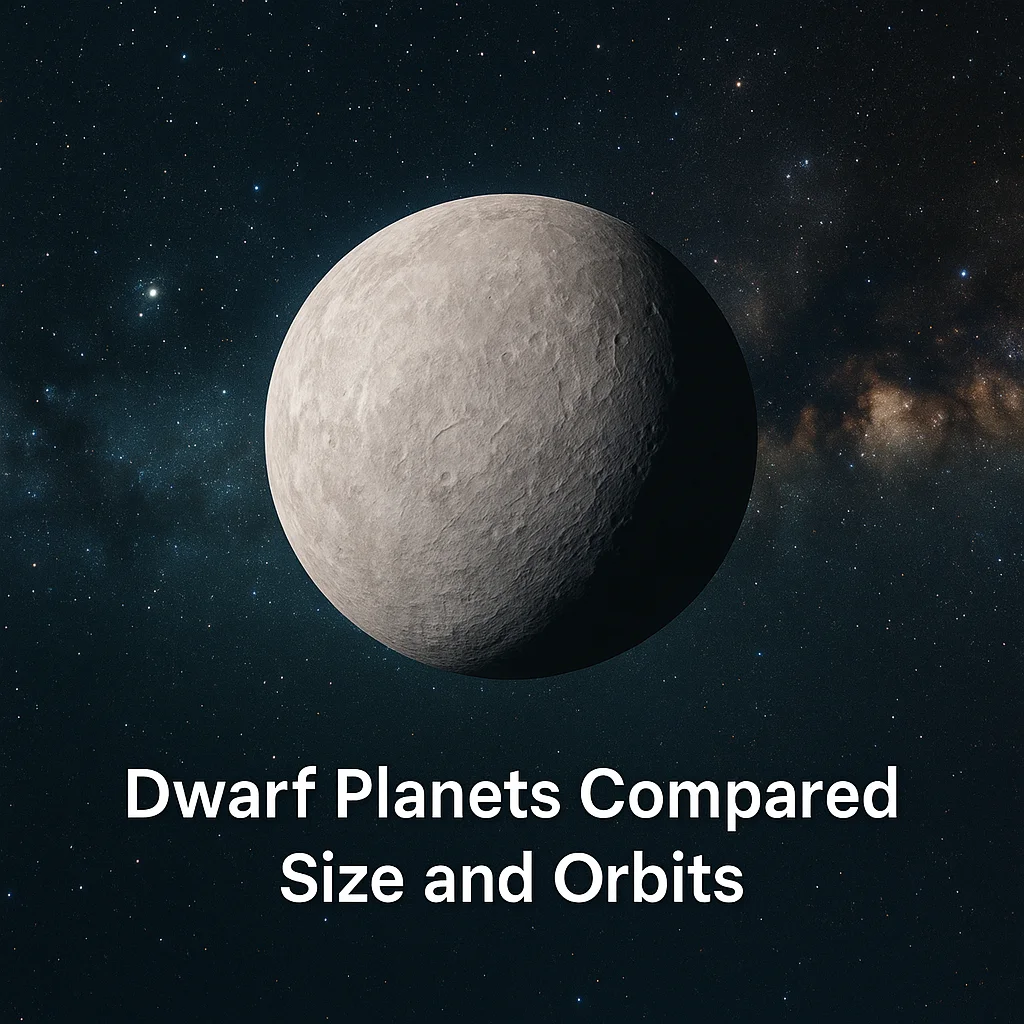
In the realm of astronomy, dwarf planets are neither fully-fledged planets nor mere asteroids. They stand on their own, offering a glimpse into the diversity of celestial objects that populate our solar system.
In this article, you'll learn about the sizes, orbits, and many captivating aspects of these intriguing bodies.
📍 Where It Is and How Far Away
Dwarf planets can be found in various regions of our solar system. The most famous, Pluto, resides in the Kuiper Belt, a distant and mysterious region beyond Neptune. This area is populated with icy bodies and is known as the birthplace of many comets.
To grasp the distance of these objects from Earth, consider that Pluto is on average about 4.8 billion kilometers away, a journey that light traveling at 300,000 kilometers per second takes over four hours to complete.
This remoteness means dwarf planets receive significantly less sunlight than Earth, resulting in cold, frozen surfaces and unique thermal environments.
🧱 Size, Mass, and Gravity (Made Simple)
Dwarf planets vary in size but are generally smaller than Earth's Moon. Pluto, for instance, is about two-thirds the diameter of our Moon and has a surface area roughly equal to Russia.
Despite their small size, dwarf planets can have a considerable mass. However, their low gravity means standing on one would be a different experience than on Earth. If you weigh 100 kilograms on Earth, you'd only weigh about 7 kilograms on Pluto.
This difference in gravity is due to their smaller mass and size, which means you could leap great distances, much like astronauts did on the lunar surface.
🌡️ Atmosphere and Weather
The atmosphere of a dwarf planet, if present, is usually thin and tenuous. Pluto's atmosphere consists of nitrogen, methane, and carbon monoxide, but this atmosphere expands and contracts as it moves closer or farther from the Sun.
Unlike Earth, weather patterns on dwarf planets are not as dynamic. Slow atmospheric changes can occur due to the weak solar heating they receive.
Such atmospheres are very different from what we are used to and they demonstrate how distance from the Sun influences the environment of a celestial body.
🪨 Surface and Interior
The surfaces of dwarf planets are intriguing and diverse. Pluto, for instance, has vast plains, towering ice mountains, and potentially icy volcanoes. These features result from impacts, sublimation, and other geologic processes.
The interiors of these bodies differ depending on their composition. Some, like Pluto, might have a rocky core surrounded by a mantle of water ice.
This diversity in surface and interior structures offers clues about the evolutionary history and past activity of these distant worlds.
🌀 Rotation, Orbit, and Seasons
Dwarf planets often have peculiar rotations and orbits. Pluto takes about 24 Earth hours to complete a rotation, remarkably similar to Earth, yet its year is 248 Earth years long.
These orbits are generally more elliptical and inclined compared to the major planets, leading to unique seasonal changes. For instance, at times, one hemisphere can be in a prolonged daylight while the other remains dark.
Seasons on these worlds are heavily influenced by their tilt and elongated orbits.
🧲 Magnetic Field and Radiation
Most dwarf planets lack a significant magnetic field. Pluto is thought to have no global magnetic field due to its small size and lack of a dynamic interior.
This absence of a magnetic field means dwarf planets do not experience auroras or have radiation belts like giant planets.
The lack of a substantial magnetic presence also means that spacecraft must rely on instruments to determine the composition and behavior of these distant worlds rather than magnetic readings.
🌙 Moons, Rings, and Neighbors
Some dwarf planets have their own moons, with Pluto being the most notable, hosting five known moons including Charon, which is almost half its size.
The gravitational interactions between Pluto and Charon create interesting dynamics, as they are tidally locked, meaning they always show the same face to each other.
Unlike the giant planets, dwarf planets do not have elaborate ring systems, but their moons and the possibility of smaller moons or particles can make them just as intriguing.
🔭 How We Know (Missions and Observations)
Our knowledge of dwarf planets has significantly advanced due to both telescopic observations and space missions. NASA's New Horizons mission, for instance, provided stunning data and images of Pluto and its moons.
Telescopes like the Hubble Space Telescope have peered deep into the solar system, identifying and characterizing dwarf planets, contributing greatly to our understanding of these remote worlds.
Such missions and observations help scientists gather data on composition, temperature, surface features, and atmospheres.
❓ Common Questions and Misconceptions
Is Pluto still a planet? Pluto was reclassified to a dwarf planet in 2006 by the International Astronomical Union.
Can you stand on a dwarf planet? Yes, those with solid surfaces like Pluto, but gravity would be much weaker.
Are dwarf planets habitable? No, they are too cold and lack the atmosphere and liquid water needed for life as we know it.
Why is Pluto smaller than some moons? Dwarf planets vary in size; some moons have grown larger due to different formation processes.
Does Pluto have a magnetic field? No, it does not have a global magnetic field like Earth or Jupiter.
Are there dwarf planets beyond Pluto? Yes, several have been identified, such as Eris, Haumea, Makemake, and Ceres in the asteroid belt.
📌 Summary
- Dwarf planets are solar system objects that haven't cleared their orbits.
- They are located beyond Neptune and in the asteroid belt.
- They are smaller than Earth's Moon, with less gravity.
- Atmospheres, if present, are thin and expand with solar distance.
- They have varied surfaces with ice, rock, and potential volcanoes.
- Long orbits and unique seasons due to tilt and distance.
- Lack significant magnetic fields, impacting space weather understanding.
- Some have moons; none have prominent rings.
- Explored through missions like New Horizons and telescopic observations.
- Pluto's status change has popularized the category of dwarf planets.