🪐 Eris Facts for Beginners
🌌 What It Is
Eris is a distant celestial body in our Solar System, known as a dwarf planet. It falls into the category of trans-Neptunian objects, meaning it resides beyond the orbit of Neptune. Discovered in 2005, Eris played a significant role in redefining how we classify planets due to its similarities with Pluto.
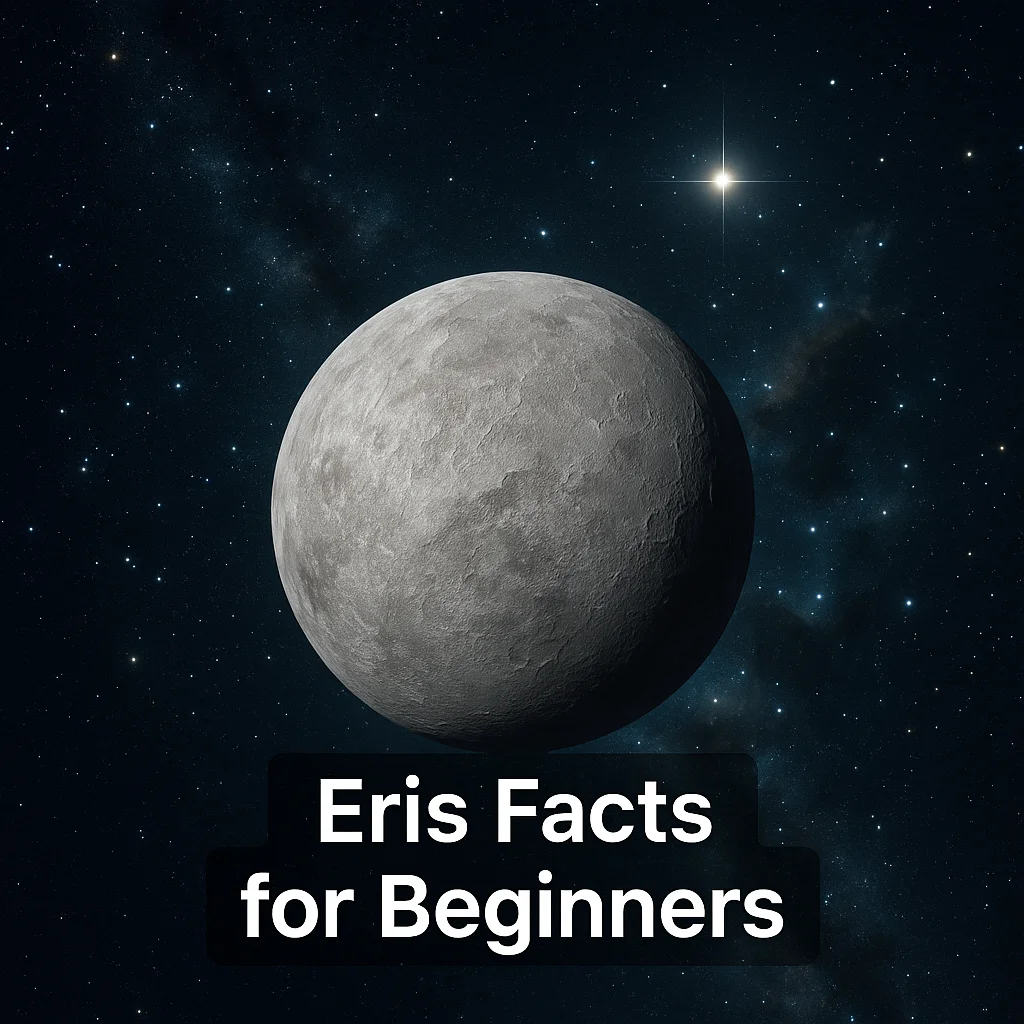
Eris is not a planet like Earth or Mars but is classified as a dwarf planet according to the International Astronomical Union. This means it shares some characteristics with the nine traditional planets but does not clear its orbit of other debris.
In this article, we'll explore what makes Eris unique and why it’s an intriguing object for astronomers and space enthusiasts alike.
📍 Where It Is and How Far Away
Eris is situated in a region of the Solar System known as the scattered disc, which is a distant part of the Kuiper Belt. It orbits the Sun from much farther away than Earth, at a distance that varies due to its elliptical orbit.
The average distance from Eris to the Sun is about 96 Astronomical Units (AU). To put this in perspective, one AU is the average distance from Earth to the Sun, around 93 million miles or 150 million kilometers. This means Eris is roughly 96 times farther from the Sun than we are.
Because of its great distance, Eris receives very little sunlight, making it extremely cold compared to planets like Earth. The temperature on Eris is much too cold to support life as we know it, with its surface temperatures probably lower than -400 degrees Fahrenheit.
🧱 Size, Mass, and Gravity (Made Simple)
Eris is similar in size to Pluto, which was once considered the ninth planet. Its diameter is roughly 1,445 miles, or about 2,326 kilometers, making it one of the largest known dwarf planets in the Solar System.
In terms of mass, Eris is slightly more massive than Pluto. This extra mass contributes to a stronger gravitational pull than some of the other smaller objects in the distant Solar System.
Despite its larger mass, the surface gravity on Eris is still weak compared to Earth. If you could stand on Eris (which you can't, due to its surface conditions), you would weigh significantly less because its gravitational pull is lower than that of our home planet.
🌡️ Atmosphere and Weather
Eris has a very thin atmosphere, primarily composed of frozen gases that thicken slightly when it is closest to the Sun. When Eris ventures farther away on its elliptical path, these gases freeze and settle back onto the surface.
Due to its distance from the Sun, Eris lacks significant weather patterns or atmospheric phenomena that we see on planets closer to the Sun, like Earth or even Mars.
Sunlight barely reaches this icy world, making Eris incredibly cold and keeping its atmospheric activity minimal. The brief warming periods when it approaches the Sun do not significantly alter its frozen terrain or atmosphere.
🪨 Surface and Interior
The surface of Eris is extraordinarily icy and bright, reflecting much of the limited sunlight that reaches it. This high reflectivity is due to the presence of frozen methane and nitrogen, making Eris one of the most reflective objects in the Solar System.
While we haven't been able to probe its interior, scientists suspect that Eris may have a rocky core beneath a thick mantle of ice. This is similar to the structure hypothesized for Pluto and other icy bodies in the outer Solar System.
The lack of geological activity meant the surface is likely covered with impact craters, a testament to billions of years of cosmic impacts from other space debris.
🌀 Rotation, Orbit, and Seasons
Orbiting the Sun once every 558 Earth years, Eris takes a long time to complete a single circuit. Its distant location causes these long orbital periods, typical of objects in the scattered disc.
Eris rotates on its axis similarly to Earth, with a day lasting about 25.9 hours. This is only slightly longer than a day on Earth, giving Eris a similar rotation period to Earth's day-night cycle.
Due to its slight axial tilt, the concept of seasons is not as pronounced as it is on Earth. However, its elongated orbit means the distance from the Sun varies significantly, which results in temperature changes over long periods as it moves closer and farther from the Sun.
🧲 Magnetic Field and Radiation
Currently, little is known about Eris's magnetic field, largely due to its distance and the challenges in observing such detail in distant dwarf planets. Unlike Earth, it's unlikely Eris has a significant magnetic field because it lacks an active core.
Without a substantial magnetic field, Eris would not have magnetically induced phenomena like auroras. Its position also reduces its exposure to solar and cosmic radiation compared to the planets closer to the Sun.
This absence of a magnetic field means that any spacecraft visiting Eris would need to rely on other navigation and protection methods to handle the space environment.
🌙 Moons, Rings, and Neighbors
Eris has one known moon, Dysnomia, which orbits it at a distance that allows scientists to study the dwarf planet's mass and other characteristics by observing the moon's motion.
The presence of this moon suggests that Eris, like many other Kuiper Belt objects, may have formed through collisions or the capture of passing celestial bodies.
No rings have been observed around Eris, a feature consistent with other dwarf planets; this lack of rings is typical for celestial bodies in its region of space.
🔭 How We Know (Missions and Observations)
Most of what we know about Eris comes from ground-based telescopes and the Hubble Space Telescope. These observations help determine its size, reflectivity, and orbit.
The discovery of Eris led to greater interest in the outer Solar System, prompting several missions aimed at these distant realms, such as NASA’s New Horizons mission to Pluto and the Kuiper Belt.
Data obtained from both optical and radio telescopes provide insights into Eris’s composition and help astronomers refine models of its potential atmospheric and surface conditions.
❓ Common Questions and Misconceptions
Is Eris a star? No, Eris is a dwarf planet not a star. Stars emit their own light through nuclear fusion; Eris does not.
Can you stand on Eris? Technically you could stand on its hard, icy surface, but the extreme cold and distance from Earth make this impossible with current technology.
Is Eris habitable? No, due to its extreme cold and thin atmosphere, Eris cannot support life as we know it.
Why is Eris not classified as a full-fledged planet? Like Pluto, Eris hasn't cleared its orbit of other debris, which is a criterion for the planetary classification by the IAU.
Why is Eris so reflective? Eris’s surface is covered in ice, including frozen methane and nitrogen, which are very reflective materials.
Does Eris have weather like Earth? No, Eris lacks significant atmospheric weather due to its thin atmosphere and distant position from the Sun.
📌 Summary
- Eris is a dwarf planet in the scattered disc region of the Solar System.
- Located about 96 AU from the Sun, Eris resides far beyond Neptune.
- It’s slightly more massive than Pluto, affecting its gravity.
- The thin atmosphere is mainly composed of frozen gases.
- Eris has an icy surface with high reflectivity due to methane and nitrogen ice.
- It takes 558 Earth years to orbit the Sun, with a day lasting about 25.9 hours.
- Lacks a significant magnetic field, limiting magnetic phenomena like auroras.
- Features one known moon, Dysnomia, but no ring system.
- Most knowledge comes from telescope observations, without direct spacecraft visits.
- A memorable fact is Eris's role in redefining planet classification in our Solar System.