🪐 Haumea Facts for Beginners
🌌 What It Is
Haumea is one of the known dwarf planets in our Solar System. Unlike the eight primary planets, which orbit the Sun in a relatively tidy way, Haumea belongs to a collection of smaller celestial bodies that primarily reside in the outer regions of the Solar System. These bodies, including Pluto and Eris, are often found in the Kuiper Belt, a region of space beyond the orbit of Neptune filled with icy remnants from the formation of the Solar System.
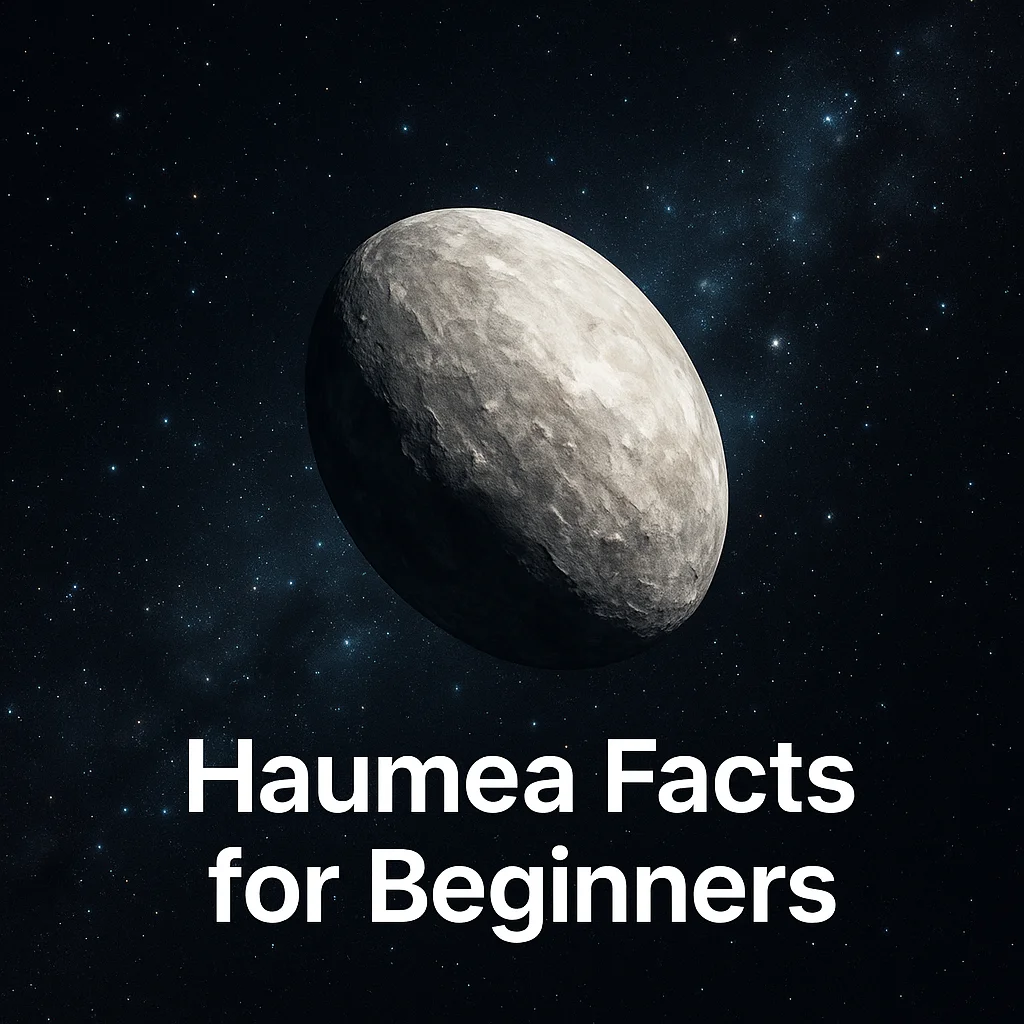
Classified as a dwarf planet, Haumea is an intriguing object due to its unique features. It doesn’t quite fit the standard definition of a planet, as it hasn't cleared its neighboring region of other objects, but it does orbit the Sun and has enough mass for its gravity to shape it into an elongated, ellipsoid form.
Through this article, you'll gain a clearer understanding of Haumea's location, characteristics, and behavior. By learning about Haumea, you'll also grasp why astronomers find this dwarf planet so fascinating and what distinguishes it from other celestial bodies.
📍 Where It Is and How Far Away
Haumea resides in the Kuiper Belt, a vast, doughnut-shaped region of space beyond Neptune. This area is teeming with icy bodies and remnants from the early Solar System. Haumea, along with other dwarf planets in this region, offers clues about the formation of our planetary system.
The distance between Haumea and the Sun is vast compared to the inner planets. On average, it is about 43 astronomical units (AU) from the Sun. To put this in perspective, one AU is the average distance from the Earth to the Sun, approximately 93 million miles (150 million kilometers). Therefore, Haumea is over 4 billion miles away from the Sun.
Given its location, sunlight reaching Haumea is much fainter than on Earth. This distance also means that Haumea receives much less warmth from the Sun, making it an extremely frigid environment.
🧱 Size, Mass, and Gravity (Made Simple)
Haumea is somewhat smaller than Pluto, making it one of the less massive known dwarf planets. Its unique shape, which is notably elongated like an American football, is a result of its rapid rotation. If we visualize it with the full disk visible, you can see the entire dwarf planet in frame, demonstrating its stretched appearance.
The mass of Haumea, although much less than that of the Earth, is sufficient to maintain its partial gravitational control over its environment, which allows it to retain at least two known moons. Its gravity, while weaker than Earth's, is enough to slightly influence the smaller bodies in its vicinity.
Astronomically speaking, standing on Haumea would feel quite different from standing on Earth due to its gravity. If you could stand there, you would experience a fraction of the pull you feel here, making you feel much lighter.
🌡️ Atmosphere and Weather
Haumea's atmosphere, if it exists, is extremely thin and composed mainly of exotic ices like methane and nitrogen. These conditions differ greatly from the substantial and complex atmosphere seen on planets like Earth or Jupiter.
Because of its great distance from the Sun and its composition, Haumea doesn’t experience weather patterns similar to Earth's. It lacks clouds and storms as seen on planets with thicker atmospheres. Instead, any weather-related phenomena would likely be subtle and related to evaporation and deposition of surface ices.
Understanding its atmosphere, or lack thereof, helps us comprehend why temperature variations are minimal. Even the sunlight that reaches Haumea’s surface does little to warm it significantly, maintaining a consistently cold environment.
🪨 Surface and Interior
Haumea's surface is primarily composed of water ice, giving it a bright, reflective appearance. This outer layer of ice suggests that the surface is resistant to space weathering. When visualized, the whole object should be centered with its entire surface characteristics evident, providing a clear view of its icy exterior.
The internal structure of Haumea is less well understood, but it is believed to have a rocky interior surrounded by a shell of ice. This composition contributes to its slightly stretched shape, helping balance the forces exerted by its rapid spin.
Surface features include craters from impacts with other Kuiper Belt objects, reshaped over time by gravitational interactions and rotational forces. These interactions keep Haumea an object of interest for scientists exploring the dynamics and evolution of distant celestial bodies.
🌀 Rotation, Orbit, and Seasons
Haumea's rotation is one of the fastest known of any large object in the Solar System. It completes a full rotation, or "day," in just about four hours. This rapid spin causes its elongated shape and affects gravitational pull across its surface.
The orbit of Haumea around the Sun takes approximately 285 Earth years, which means a single Haumean year stretches across many human generations. Given this lengthy orbit and the dwarf planet's position in the Kuiper Belt, it experiences minimal seasonal changes.
No significant tilt in its rotational axis suggests that any seasonal variations would be induced more by its orbit rather than its axial position. This relatively consistent exposure to sunlight contributes to its enduring ice-covered exterior.
🧲 Magnetic Field and Radiation
While Haumea's magnetic field is not well-documented, it's understood that any field would be significantly weaker than Earth's. Typically, a magnetic field influences how a planet interacts with solar wind, but Haumea's distance and size imply minimal solar interaction.
Radiation levels near Haumea would be less intense compared to inner planets due to its vast distance from the Sun. The lack of atmospheric protection means higher energy particles from space might reach its surface.
Understanding the magnetic characteristics, or lack thereof, helps in planning any potential future missions and in understanding their effect on surface and interior changes over time.
🌙 Moons, Rings, and Neighbors
Haumea has two known moons, Hiʻiaka and Namaka. These moons, when seen in context with Haumea’s full disk visible, offer insights into the gravitational influences within the Kuiper Belt. They likely formed from icy debris created in a collision during the early Solar System's history.
Researchers have found evidence suggesting the presence of a ring system around Haumea, which is unusual but not unique among dwarf planets. This ring could be composed of debris that travels along a path around the planet, maintained by Haumea's gravity.
Interactions between Haumea, its moons, and its ring system provide valuable information on the dynamic processes occurring in remote parts of our Solar System.
🔭 How We Know (Missions and Observations)
Haumea has been primarily studied through telescopic observations. Powerful ground-based telescopes, as well as space observatories, have captured images and collected data about its size, shape, and orbit. Observing from a distance, these instruments provide spectra revealing the presence of ice.
No spacecraft have visited Haumea yet, but studies from observatories like the Hubble Space Telescope continue to refine our understanding. These observations help astronomers identify not only physical characteristics but also dynamic processes shaping Haumea's evolution.
As technology advances, future missions could provide more in-depth exploration, allowing direct measurements and detailed views of this fascinating dwarf planet.
❓ Common Questions and Misconceptions
Is Haumea a star? No, Haumea is far too small and lacks the necessary characteristics to be a star.
Can you stand on Haumea? Haumea's solid, icy surface makes standing theoretically possible, although its low gravity would make it feel quite different from Earth.
Is Haumea habitable? No, its conditions are too extreme for life as we know it.
Why does Haumea look different from usual planets? Its rapid rotation gives it a unique elongated shape.
Does Haumea have a thick atmosphere? No, any atmosphere would be thin, composed mainly of frozen gases.
Why is Haumea in the Kuiper Belt? It is one of many remnants from the Solar System's formation.
Do we plan to visit Haumea? Future missions may target Haumea for close-up exploration.
📌 Summary
- Haumea is a dwarf planet in the Kuiper Belt.
- Located 43 AU from the Sun, it is part of the distant Solar System.
- Haumea has a unique elongated shape due to rapid rotation.
- Poorly developed atmosphere, mostly icy surface.
- Composed of a rocky core and icy exterior.
- Fast rotation (4-hour day) and long orbit (285-year year).
- Poorly defined magnetic field influenced by distance and size.
- Has two moons and possibly a ring system.
- Studied via telescopes with potential for future missions.
- Notable for its rapid rotation and ice-covered surface.