🪐 Kuiper Belt Objects: A Simple Overview
🌌 What It Is
The Kuiper Belt is a distant region of our Solar System, located beyond the orbit of Neptune. It is home to a multitude of small icy bodies, remnants from the formation of the Solar System. These bodies are known as Kuiper Belt Objects (KBOs).
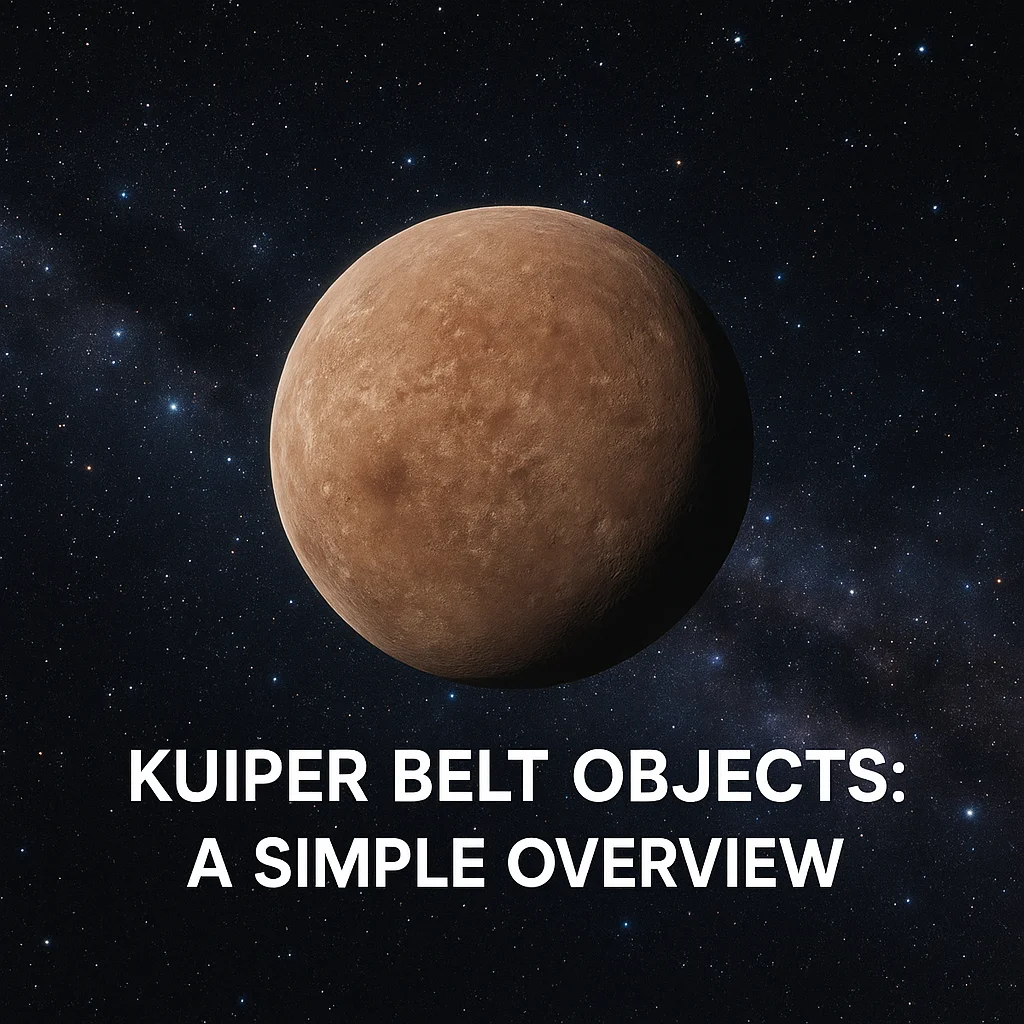
KBOs are similar to asteroids but are composed largely of ice rather than rock. Some of these objects are quite large, such as Pluto, which was reclassified from a planet to a dwarf planet in 2006. While they might not be planet-sized, they offer a wealth of information about the early Solar System.
In this article, you will learn about the location, characteristics, and significance of Kuiper Belt Objects. We will discuss their size, surface features, weather patterns, and more to provide a comprehensive understanding of these fascinating celestial bodies.
📍 Where It Is and How Far Away
The Kuiper Belt is situated in the outermost region of our Solar System, starting at about 30 astronomical units (AU) from the Sun and extending out to about 55 AU. An astronomical unit is the average distance from the Earth to the Sun, approximately 93 million miles or 150 million kilometers.
Because the Kuiper Belt is so far from the Sun, the objects there receive much less sunlight than planets like Earth. This results in frigid temperatures, with most KBOs existing in an almost perpetual winter.
The vast distance also means that it takes sunlight many hours to reach the Kuiper Belt, significantly dimming its intensity compared to what we experience on Earth. This also explains the icy compositions of these objects, which are preserved in the cold vacuum of space.
🧱 Size, Mass, and Gravity (Made Simple)
Kuiper Belt Objects vary in size, with the largest being hundreds of kilometers in diameter. Pluto, the most famous KBO, measures about 2,377 kilometers across, making it roughly two-thirds the size of Earth's Moon.
Despite their size, KBOs have much less mass compared to planets like Earth or even the Moon, because they are mostly made of ice. This also means that gravity on these objects is weak. If you were to stand on a large KBO, you would weigh much less than you do on Earth.
Gravity on KBOs is typically insufficient to hold an atmosphere, contributing to their stark, barren surfaces. The weak gravitational pull allows for unusual surface features, influenced more by the objects' internal compositions than by erosional forces common on planets closer to the Sun.
🌡️ Atmosphere and Weather
Most Kuiper Belt Objects lack an atmosphere. However, some, like Pluto, have thin atmospheres made of nitrogen, methane, and carbon monoxide. This atmosphere is transient; it can sublimate into space as the object moves closer to the Sun in its orbit.
No traditional weather patterns like those on Earth exist in the Kuiper Belt. The extremely low temperatures and lack of a substantial atmosphere mean that wind and precipitation are virtually nonexistent. Instead, any atmospheric gases can create temporary, localized phenomena like haze.
Because of these conditions, KBOs do not experience weather as we know it. The surface temperatures are consistently cold, and the environment is very stable over long periods.
🪨 Surface and Interior
The surfaces of Kuiper Belt Objects can be quite varied, with some having smooth regions and others being heavily cratered. Craters are primarily caused by collisions with other small objects, a common occurrence in this dense region of the Solar System.
The interiors of KBOs likely consist of a mix of water ice, ammonia, and a rock core. These materials suggest that KBOs are remnants from the early Solar System, preserving conditions from the time of their formation.
Surface features are shaped by a combination of impacts and possible cryovolcanism, where subsurface ices are expelled to form new surface layers. These processes give us clues about the internal structures of these icy bodies.
🌀 Rotation, Orbit, and Seasons
Each Kuiper Belt Object follows an elliptical orbit around the Sun. These orbits can be quite varied, with some KBOs taking more than 200 years to complete one journey around the Sun.
The rotation periods of KBOs also vary, with some spinning rapidly and others taking days to complete a single rotation. This rotation affects how sunlight is distributed across their surfaces, influencing temperature variations.
Seasons in the Kuiper Belt are gradual, unlike the rapid changes experienced on Earth. KBOs with significant axial tilts experience minor seasonal changes in temperature and sunlight over their long orbits.
🧲 Magnetic Field and Radiation
Kuiper Belt Objects generally lack significant magnetic fields due to their small sizes and icy compositions. A magnetic field requires a conductive fluid moving within the object, which is absent in these icy bodies.
As a result, KBOs do not have auroras, like those on Earth or the gas giants. The lack of a magnetic field also means they do not protect themselves from cosmic radiation, which can affect their surfaces over time.
The absence of a magnetic field poses minimal issues for spacecraft and instruments as these objects are studied primarily through passive observation rather than close-proximity exploration.
🌙 Moons, Rings, and Neighbors
Some Kuiper Belt Objects have their own moons. Pluto, for instance, has five known moons, with Charon being the largest. These moons are believed to have formed from collisions and gravitational capture.
KBOs do not have ring systems like those found around planets such as Saturn. The gravitational forces within the Kuiper Belt do not support the formation of stable ring systems.
Neighboring objects in the Kuiper Belt can have gravitational interactions that affect their orbits, leading to resonances or shifts over time. These interactions add complexity to the dynamics of the region and are of great interest to astronomers.
🔭 How We Know (Missions and Observations)
The study of Kuiper Belt Objects relies heavily on both ground-based and space-based telescopes. These provide images and spectra that help scientists identify the compositions and motions of KBOs.
One of the most famous missions to explore the Kuiper Belt was NASA's New Horizons, which flew past Pluto in 2015 and continues to study other KBOs. It has provided invaluable data about these distant worlds and their environments.
Data collected from these observations include images capturing the entire object in frame, as well as spectra revealing the chemical signatures of surface materials, enhancing our understanding of the origins and evolutions of KBOs.
❓ Common Questions and Misconceptions
Is it a planet? While some KBOs were once considered planets, they are now classified as dwarf planets or minor bodies.
Can you stand on it? If it is large enough, you could theoretically stand on a KBO, but the gravity would be weak.
Is it habitable? The cold, airless environments of KBOs make them inhospitable to life as we know it.
Why is it that color? KBOs can appear red or blue depending on surface compositions and exposure to radiation.
Do they have atmospheres? Thin atmospheres exist on some KBOs, like Pluto, but most have none.
Are there rings? No, KBOs do not have rings like the gas giants do.
📌 Summary
- The Kuiper Belt is a distant region of icy objects beyond Neptune.
- It lies 30 to 55 AU from the Sun, in the outer Solar System.
- KBOs are mostly made of ice and have weak gravity.
- Most have no significant atmosphere or weather.
- Surfaces are formed by impacts and possible cryovolcanism.
- Orbits and rotations are varied; seasons are slow.
- Generally lack magnetic fields and radiation belts.
- Some, like Pluto, have moons but no ring systems.
- Knowledge from telescopes and missions like New Horizons.
- Pluto is the most famous KBO, once considered a planet.