🪐 New Horizons Mission: What We Learned About Pluto
🌌 What It Is
Pluto is a fascinating object in our Solar System that was once considered the ninth planet, but it was reclassified as a dwarf planet in 2006. It falls into the category of trans-Neptunian objects, which are bodies located beyond the orbit of Neptune. As a dwarf planet, it doesn’t dominate its orbit the way the main planets do.
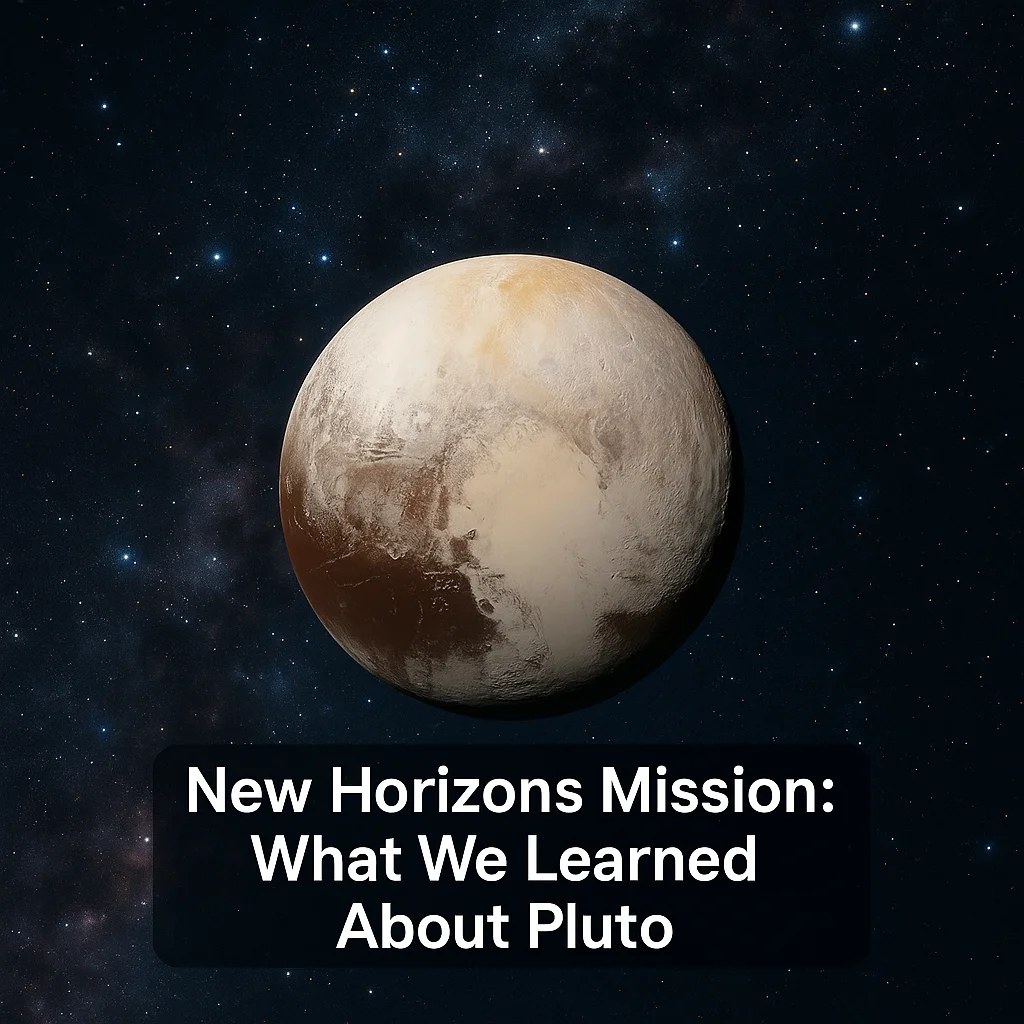
Despite being reclassified, Pluto remains a subject of great interest due in part to its unique characteristics and its position in the Kuiper Belt, a region filled with icy bodies and remnants from the Solar System's formation. This article aims to explore what we've learned about Pluto thanks to the New Horizons mission.
By reading on, you'll discover facts about Pluto's location, size, atmosphere, and much more, providing a comprehensive understanding of this distant world.
📍 Where It Is and How Far Away
Pluto is located in the Kuiper Belt, a vast region of icy bodies and dwarf planets that orbits the Sun beyond Neptune. It is an extraordinary part of our Solar System with fascinating dynamic interactions.
The average distance from the Earth to Pluto is about 3.7 billion miles, which translates to around 39 astronomical units (AU). One AU is the average distance from the Earth to the Sun, about 93 million miles, so Pluto is far and colder compared to the inner planets.
Due to its great distance from the Sun, the light and heat Pluto receives are significantly diminished. This results in a very cold environment, with surface temperatures plunging to extreme lows.
🧱 Size, Mass, and Gravity (Made Simple)
Pluto is smaller and less massive than Earth's Moon. It has a diameter of about 1,473 miles, meaning you could line up nearly two Plutos side by side to match the width of the United States.
The mass of Pluto is just 0.2% of Earth's, and its surface gravity is only about 6% of ours. To put it simply, if you weigh 100 pounds on Earth, you’d feel like you weigh a mere 6 pounds on Pluto.
Despite its small size, Pluto’s gravitational pull allows it to maintain a thin atmosphere and keep a cluster of moons in orbit around it.
🌡️ Atmosphere and Weather
Pluto has a tenuous atmosphere that primarily consists of nitrogen, with traces of methane and carbon monoxide. This atmosphere is thin and spread out, much like a fog rather than a thick blanket like Earth's atmosphere.
The weather on Pluto is extreme due to its distance from the Sun. When closer to the Sun in its orbit, the atmosphere can expand as the surface warms slightly. Conversely, when far away, the atmosphere can freeze and collapse onto the surface due to decreasing temperatures.
This dynamic creates frost and possibly sublimation, where the surface ice turns directly into gas, further contributing to the planet’s unique atmospheric conditions.
🪨 Surface and Interior
Pluto’s surface is a complex mosaic of light and dark regions, including vast plains, towering mountains, and deep canyons. The surface is primarily made up of nitrogen ice, with traces of methane and carbon dioxide.
One of the most recognizable features is Sputnik Planitia, a heart-shaped plain made of nitrogen and methane ice, hinting at a fascinating geological history. Craters, cracks, and mountain ranges suggest that Pluto’s surface is geologically active and possibly reshaped over time.
Scientists hypothesize Pluto has a differentiated interior, potentially with a rocky core, a mantle of ice, and a crust of frozen nitrogen.
🌀 Rotation, Orbit, and Seasons
Pluto has an unusual or complicated orbit that takes 248 Earth years to complete one journey around the Sun. Unlike the more circular orbits of the other planets, Pluto follows an elliptical path.
Its rotation is slow, taking about 6.4 Earth days to complete one rotation, which means Pluto's day is much longer than ours. Additionally, Pluto's axis is tilted, causing extreme seasonal changes over its long year.
This tilt is responsible for Pluto experiencing periods of 20 years of daylight or darkness at the poles, each resulting in dramatic temperature changes and atmospheric dynamics.
🧲 Magnetic Field and Radiation
Scientists believe Pluto does not have a significant magnetic field. Since magnetic fields are generated by movements within a planet's core, Pluto's icy nature makes it unlikely to have the churning molten metals that Earth has.
The lack of a substantial magnetic field means Pluto doesn't have radiation belts like larger planets, affecting how it interacts with solar wind.
Without a strong magnetic defense, solar particles can interact directly with its atmosphere, potentially stripping away some gases over time.
🌙 Moons, Rings, and Neighbors
Pluto has five known moons, with Charon being the largest and most influential. In fact, Charon is so large compared to Pluto that they are often referred to as a double dwarf planet system.
The other moons—Nix, Hydra, Kerberos, and Styx—are much smaller and have irregular shapes. These moons may have formed from debris after a celestial collision.
Unlike the giant planets like Saturn, Pluto does not have rings, which is typical for bodies of its size and location in the Kuiper Belt.
🔭 How We Know (Missions and Observations)
The New Horizons mission by NASA, launched in 2006, significantly advanced our understanding of Pluto. As it sailed past Pluto in 2015, it captured detailed images and data, giving scientists an unprecedented view of its complex surface.
Telescopes on Earth have complemented spacecraft data by observing Pluto's atmosphere and overall composition. Observations from facilities like the Hubble Space Telescope have been instrumental in discovering Pluto's moons.
The combination of images, spectral data, and other measurements has provided insights into Pluto’s geological activity, atmosphere, and interactions with solar radiation.
❓ Common Questions and Misconceptions
A common question is whether Pluto is still considered a planet. It's a dwarf planet, a category that reflects its characteristics and orbit.
Can you stand on Pluto? Yes, you could, thanks to its solid surface, but you’d need a spacesuit to survive the cold and vacuum.
Is Pluto habitable? No, its atmosphere and temperature are too extreme for known forms of life.
Why is Pluto that color? Its surface displays shades of brown and white, caused by different types of ice reflecting sunlight in various ways.
Does Pluto’s distance affect Earth significantly? No, its distance means its gravitational influence on Earth is negligible.
Could we colonize Pluto? Very unlikely, due to its harsh environment and extreme distance from Earth.
Is Pluto visible with a backyard telescope? Seeing Pluto requires sophisticated telescopes due to its small size and distance.
📌 Summary
- Pluto is a dwarf planet in the Kuiper Belt.
- It is about 3.7 billion miles from Earth, 39 AU away.
- Pluto is smaller than Earth's Moon with low gravity.
- Its thin atmosphere consists mainly of nitrogen.
- The surface features icy plains, mountains, and canyons.
- Pluto’s year lasts 248 Earth years; a day is 6.4 Earth days long.
- Lacks a significant magnetic field, limited solar protection.
- Has five moons, with Charon as the largest companion.
- Our knowledge comes primarily from the New Horizons mission.
- One memorable fact: a spacecraft took nearly a decade to reach it!