🪐 Pluto Facts for Beginners
🌌 What It Is
Pluto is a fascinating celestial body residing on the fringes of our Solar System. Once considered the ninth and most distant planet from the Sun, Pluto has been reclassified as a dwarf planet by the International Astronomical Union in 2006. This means Pluto shares its space with other similar-sized celestial bodies.
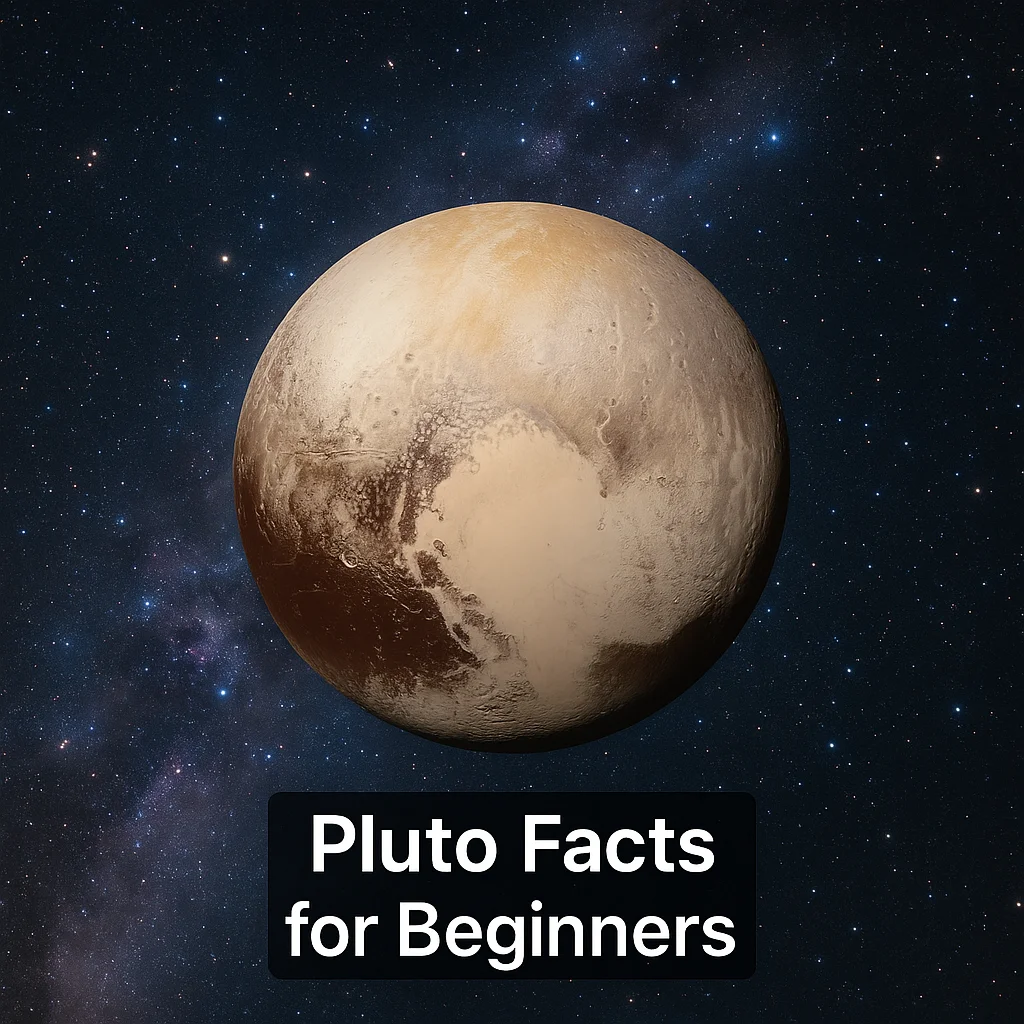
As a dwarf planet, Pluto finds itself among a special group of objects that include a mix of icy and rocky materials. It is part of the Kuiper Belt, a region filled with similarly frozen worlds. Our journey in this article will introduce you to Pluto's unique characteristics, its environment, and its place in our Solar System.
This section will guide you to understand Pluto's nature and history. Let’s dive into the intriguing details of this small, distant world and what it means to be a dwarf planet.
📍 Where It Is and How Far Away
Pluto is located in the Kuiper Belt, a region beyond the orbit of Neptune that is populated with many icy bodies. It is incredibly far from the Earth, orbiting at an average distance of about 3.7 billion miles from the Sun. To put it into perspective, this is roughly 39 astronomical units (AU), where one AU is the distance from the Earth to the Sun.
Given its great distance from the Sun, Pluto receives a minuscule amount of sunlight compared to Earth. This means that the dwarf planet has extremely low temperatures, making it an icy world with limited solar energy to warm up its surface.
The sunlight that reaches Pluto takes over five hours to travel from the Sun, illustrating how far it is. This also affects the temperatures and climatic conditions observed on the dwarf planet.
🧱 Size, Mass, and Gravity (Made Simple)
Pluto is relatively small, with a diameter of about 1,477 miles, making it about one-sixth the width of Earth. If Earth were the size of a basketball, Pluto would be comparable to a ping-pong ball. Despite its small size, Pluto has a complex surface and distinct characteristics.
The mass of Pluto is much lower than Earth’s, roughly 0.2% of Earth's mass. This results in weaker gravitational pull, meaning objects on Pluto weigh much less than they would on Earth. If you weigh 100 pounds on Earth, you would weigh only about 6 pounds on Pluto!
Pluto's reduced gravity and lack of dense atmosphere contribute to a landscape unlike any seen on the terrestrial planets of the inner solar system, affecting how structures like mountains or valleys are formed there.
🌡️ Atmosphere and Weather
Pluto has a thin and tenuous atmosphere primarily composed of nitrogen, with traces of methane and carbon monoxide. This fragile atmosphere freezes and falls to the surface in colder regions and then sublimates back into gas as temperatures rise, following Pluto's elliptical orbit.
Pluto’s weather is composed mostly of seasonal variations and temperature changes happen over long periods given its lengthy orbit. There are no storms or wind patterns as we experience them on Earth. However, temperature fluctuations can cause exotic frost patterns on the surface.
Due to the great distance from the Sun, Pluto’s atmosphere behaves differently than on Earth, and what is generally gaseous on our planet may be found in solid form on Pluto.
🪨 Surface and Interior
The surface of Pluto is a mosaic of light and dark regions composed primarily of ice and rock. It is also home to the largest known glacier in the Solar System, Sputnik Planitia, a vast ice-filled basin. Surface features like craters, mountains, and plains characterize Pluto, some towering up to 11,000 feet high, formed from water ice.
Pluto’s interior is believed to have a rocky core surrounded by a mantle of water ice. Between them lies a layer of various ices, including methane and nitrogen, shaping its distinct surface. Although there are no active tectonics like those on Earth, Pluto’s surface has been sculpted over time by sublimation and deposition processes.
What makes Pluto fascinating is the potential for a subsurface ocean beneath its icy crust, adding to the curiosity and mystery surrounding this distant world.
🌀 Rotation, Orbit, and Seasons
Pluto has an unconventional orbit taking 248 Earth years to complete a single loop around the Sun, always moving in a tilted, elliptical orbit. Because of this unusual path, there are considerable variations in its distance from the Sun over a single orbit.
The rotation period of Pluto is about 6.4 Earth days, which means a single day there is considerably longer than on Earth. This rotation is unique as it is retrograde, spinning in the opposite direction compared to most planets in our Solar System.
Due to its severe axial tilt, Pluto experiences extreme seasonal changes, with each season lasting over three decades. These prolonged seasons greatly influence the planet's atmospheric and surface conditions.
🧲 Magnetic Field and Radiation
Unlike the Earth, Pluto does not have a significant magnetic field. This lack means any magnetic interactions with the solar wind are limited. The absence of a strong magnetic field is partly due to its small size and frozen environment.
Radiation from the Sun affects Pluto minimally compared to planets closer to the Sun, but still influences its thin atmosphere. The relative lack of radiation compared to inner planets can also affect how easily its atmosphere can escape into space.
For spacecraft traveling to or observing Pluto, the absence of a magnetic field presents both challenges and unique opportunities to gather data unimpeded by magnetic interference.
🌙 Moons, Rings, and Neighbors
Pluto is known to have five moons, with Charon being the largest and most significant, roughly half the size of Pluto itself. Charon is so large compared to Pluto that the two bodies are often considered a double dwarf planet system.
The other four moons, smaller and irregularly shaped, are named Nix, Hydra, Kerberos, and Styx. These moons provide significant insights into the interactions and history within the Kuiper Belt.
There have been no rings detected around Pluto, which is not unusual given its size and distance from the Sun. Its moons, particularly Charon, have influenced its understanding of gravitational interactions in such small celestial systems.
🔭 How We Know (Missions and Observations)
The most significant mission to explore Pluto up close was NASA’s New Horizons spacecraft, which conducted a flyby in July 2015. This mission provided the first detailed images and data of Pluto and its moons, transforming our understanding of this distant world.
Before New Horizons, Pluto was primarily studied through telescopes. Limitations of these observations included difficulty in resolving detailed surface features due to Pluto's distance and size.
The data collected by New Horizons include images, spectra, and information regarding Pluto’s atmosphere, providing scientists with crucial insights into its composition, weather patterns, and geological features.
❓ Common Questions and Misconceptions
- No, Pluto is not a star; it is a dwarf planet.
- You cannot stand on Pluto as you would on Earth, given its lower gravity and cold, icy terrain.
- Pluto is not habitable due to its extreme cold and lack of a substantial atmosphere.
- The color of Pluto ranges from white and pale blue to shades of yellow and red due to various ices and tholins on its surface.
- Pluto does not produce its light; it reflects sunlight.
- It is not the most distant body in our Solar System but part of many in the Kuiper Belt.
- While no rings exist around Pluto, its moons make it a fascinating system.
- Pluto is part of our Solar System but differs significantly from terrestrial and gas giant planets.
- Pluto is named after the Roman god of the underworld, reflecting its dark and distant nature.
📌 Summary
- Pluto is a dwarf planet located in the Kuiper Belt.
- It orbits the Sun at an average distance of 39 AU.
- Small in size, with a markedly weaker gravity than Earth.
- Has a thin atmosphere primarily of nitrogen and methane.
- A complex surface with ice and rocky features and potential subsurface ocean.
- Takes 248 Earth years to orbit the Sun completely, with a 6.4-day rotation.
- Lacks a significant magnetic field, affecting its interaction with solar radiation.
- Five known moons, with Charon being the largest, no rings found.
- Explored by the New Horizons spacecraft, providing a wealth of new data.
- Fascinating for its intricate characteristics and as an exemplar of other Kuiper Belt objects.