🪐 Pluto vs Planet: Why It Was Reclassified
🌌 What It Is
Pluto was once considered the ninth planet in our Solar System. It's known as a "dwarf planet" today. But what is a dwarf planet? In simple terms, it's a certain kind of body in space that orbits the Sun, similar to planets like Earth and Jupiter, but with a few differences.
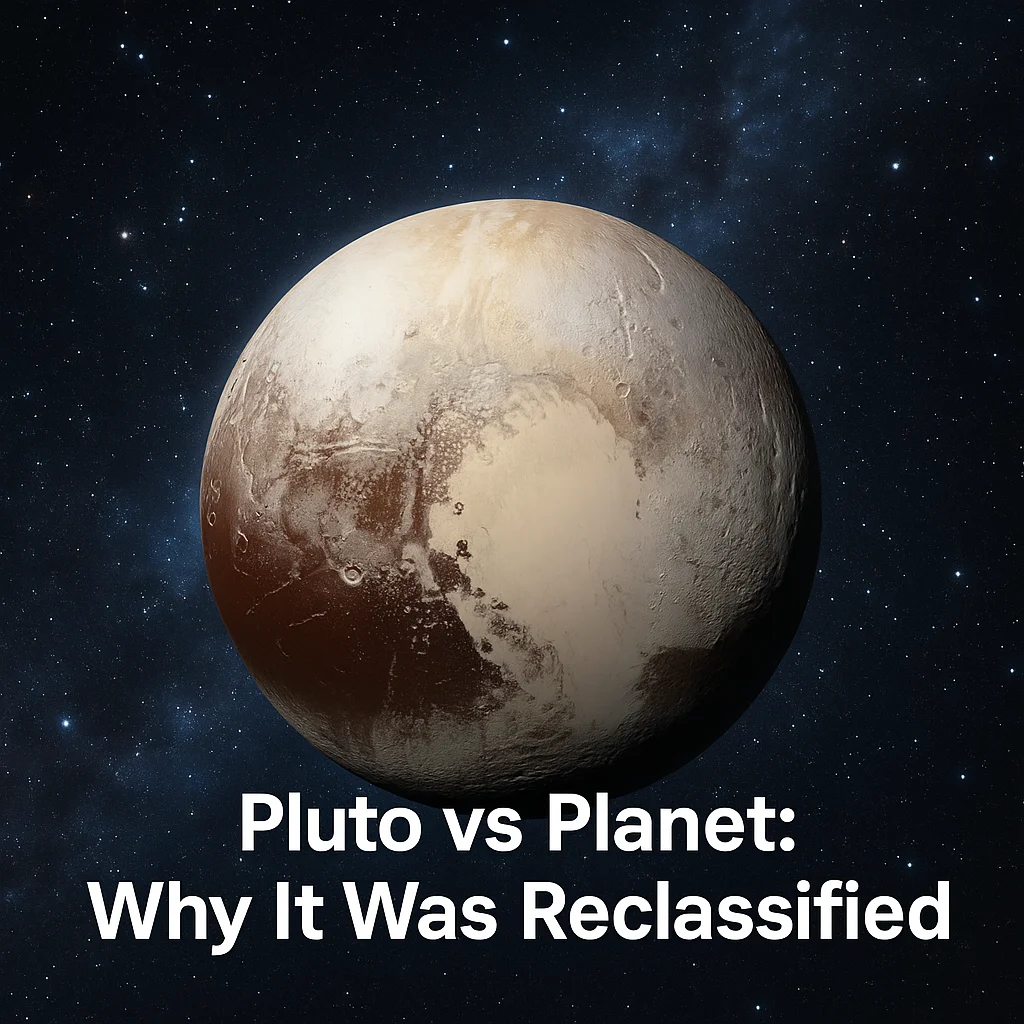
Planets are defined by several characteristics: they orbit the Sun, they have sufficient mass for their self-gravity to overcome rigid body forces and assume a nearly round shape, and they have cleared their orbit of other debris. Pluto meets the first two criteria but not the last. This distinction is essential to understanding why Pluto was reclassified.
In this article, we will explore why Pluto is not considered a planet anymore, where it resides in our Solar System, and several fascinating aspects of this distant world.
📍 Where It Is and How Far Away
Pluto resides in a region of space known as the Kuiper Belt, which is a doughnut-shaped zone of frozen bodies beyond the orbit of Neptune. This area is filled with small icy objects, making Pluto one of many similar bodies out there.
Pluto is about 39 astronomical units (AU) away from the Sun. An astronomical unit is the average distance from the Earth to the Sun, about 93 million miles. This means Pluto is approximately 3.6 billion miles from the Sun, giving it a very cold and dim environment compared to Earth.
Given its distant location, sunlight takes roughly 5.5 hours to reach Pluto. This means the warmth and light Pluto receives from the Sun are faint, resulting in extremely cold surface temperatures.
🧱 Size, Mass, and Gravity (Made Simple)
Pluto is much smaller than the eight major planets of our Solar System. For comparison, its diameter is only about 1,400 miles, which is roughly two-thirds the diameter of Earth's Moon. Despite its small size, Pluto is one of the largest known objects in the Kuiper Belt.
The mass of Pluto is only 0.2% that of Earth's, making its gravitational pull much weaker. If you could stand on Pluto's surface, you'd experience only 6.7% of the gravity you feel on Earth. In practical terms, this means you would weigh much less on Pluto.
Pluto's size and mass reflect its inability to clear other objects from its orbital path, which is one of the key reasons it doesn't qualify as a full-fledged planet.
🌡️ Atmosphere and Weather
The atmosphere of Pluto is thin, primarily composed of nitrogen, with traces of methane and carbon monoxide. Despite its thinness, this atmosphere can undergo surprising changes as it expands when Pluto is closer to the Sun and contracts as it moves farther away.
Pluto's weather conditions are affected by its distance from the Sun and its highly elliptical orbit. Temperatures on Pluto can dip as low as -375 degrees Fahrenheit. The extremely cold environment means any weather patterns are subtle and slow.
As Pluto moves away from the Sun, its atmosphere can freeze and fall to the surface as ice, a process that reverses as Pluto gets closer again, leading to sublimation and atmosphere reforming.
🪨 Surface and Interior
Pluto's surface is a patchwork of various ices, including nitrogen, methane, and water ice, giving it a reflective, bright appearance. Its surface is marked by mountains, plains, and craters, hinting at a complex geological history.
One of the most fantastic features on Pluto is the Sputnik Planitia, a heart-shaped glacier made of nitrogen ice. This feature suggests internal geological activity possibly driven by subsurface ocean or internal heat.
The interior of Pluto is thought to consist of a rocky core surrounded by water ice. The exact nature of its interior remains a subject of scientific study, as remote sensing provides limited insight.
🌀 Rotation, Orbit, and Seasons
Pluto’s orbit is highly elliptical, taking it almost 248 Earth years to complete a single orbit around the Sun. This elongated path causes drastic variations in its distance from the Sun and, consequently, in its temperatures.
A day on Pluto, or the time it takes to complete one rotation on its axis, is about 6.4 Earth days. This slow rotation contributes to a long twilight period between its day and night cycles.
Pluto's axis is tilted at an angle of 120 degrees relative to its orbit. This extreme tilt means that its poles can experience long periods of sunlight or darkness, leading to unique seasonal changes.
🧲 Magnetic Field and Radiation
Currently, there is no significant evidence that Pluto has a magnetic field. Its small size and cold environment suggest a core that's not active enough to generate one.
Without a strong magnetic field, Pluto lacks protection from cosmic and solar radiation. However, its distance from the Sun minimizes the effects of solar radiation compared to planets closer to the Sun.
This lack of a magnetic field and its distant, cold environment shape Pluto's interactions with solar winds and cosmic rays, which can affect its thin atmosphere over time.
🌙 Moons, Rings, and Neighbors
Pluto has five known moons: Charon, Styx, Nix, Kerberos, and Hydra. Charon is the largest, nearly half the size of Pluto, leading some to consider Pluto-Charon as a double dwarf planet system.
Charon's gravitational influence is profound, creating a barycenter (or common center of mass) that is outside both objects, causing them to orbit each other rather than one orbiting the other.
Pluto has no ring system, which is not entirely surprising given its size and location. The lack of rings and its unique moon system provide insights into the formation and evolution of objects in the Kuiper Belt.
🔭 How We Know (Missions and Observations)
Telescopes have played a crucial role in Pluto's study. Ground-based observations provided early insights, but limitations in resolution meant features couldn’t be clearly observed until recent advances.
The New Horizons mission, launched by NASA, was a game changer. In 2015, the spacecraft performed a flyby of Pluto, capturing high-resolution images and gathering valuable data about its atmosphere, surface, and moons.
New Horizons' data included images, temperature measurements, and atmospheric composition, reshaping our understanding of this distant object. The mission continues to send back data and broaden our knowledge of Pluto and the Kuiper Belt beyond.
❓ Common Questions and Misconceptions
Is Pluto a star? No, Pluto lacks the mass to ignite nuclear fusion, which is essential for a celestial body to be considered a star.
Can you stand on Pluto? Yes, you could theoretically stand on Pluto due to its solid surface, but the environment is extremely inhospitable.
Is Pluto habitable? Pluto is too cold and lacks the necessary conditions to support life as we know it.
Why is Pluto not considered a planet anymore? Pluto does not clear its orbit of other debris, which is a requirement for full planetary status as defined by the International Astronomical Union in 2006.
Why is it that color? Its surface reflects sunlight in a way that gives Pluto a brownish-red hue, primarily due to methane and nitrogen ices.
📌 Summary
- Pluto is a dwarf planet in the Kuiper Belt.
- It is located about 39 AU from the Sun.
- Pluto is small, with gravity much weaker than Earth's.
- Its atmosphere is thin, composed mostly of nitrogen.
- The surface features ices and mountainous regions.
- A Pluto day is 6.4 Earth days, with a complex orbital pattern.
- There is no significant magnetic field on Pluto.
- Pluto has five moons, the largest being Charon.
- Missions like New Horizons have given us detailed insights.
- Despite its reclassification, Pluto remains an object of immense scientific interest.