🪐 What Is the Kuiper Belt?
🌌 What It Is
The Kuiper Belt is a fascinating region in our Solar System that holds many mysteries and exciting discoveries. It is a large area beyond the orbit of Neptune, filled with small icy bodies. These objects are remnants from the early Solar System and offer insights into its formation and evolution.
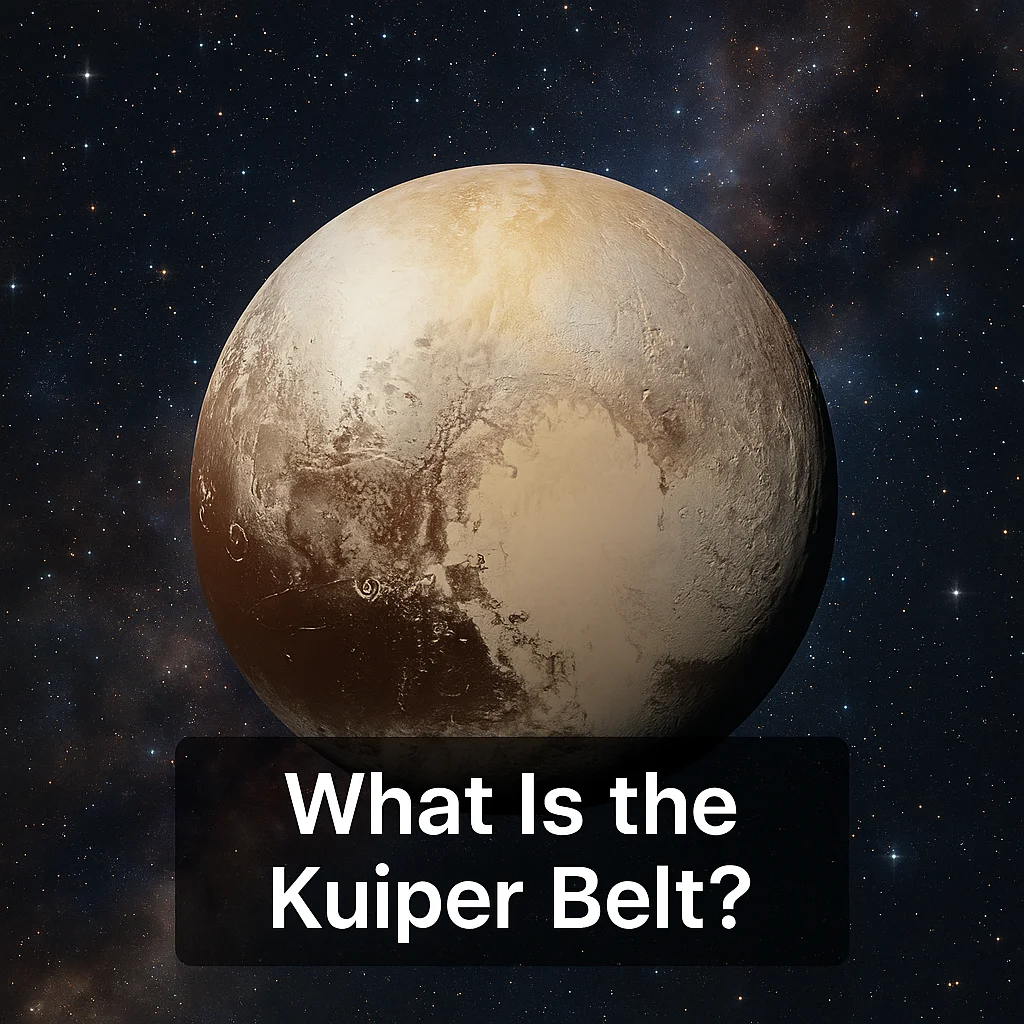
The Kuiper Belt is not classified as a planet, but rather as a region similar to an asteroid belt, albeit with icy rather than rocky objects. It serves as a laboratory for studying the composition of the early Solar System.
In this article, you'll learn about the Kuiper Belt's location, its size and mass, its weather conditions and more. We'll explore what makes this region unique and why it captivates astronomers around the world.
📍 Where It Is and How Far Away
Located beyond Neptune, the Kuiper Belt starts at about 30 astronomical units (AU) from the Sun and stretches out to around 50 AU. One astronomical unit is the average distance from Earth to the Sun, approximately 93 million miles (150 million kilometers). This makes the Kuiper Belt a far, cold region of our Solar System.
The Kuiper Belt is so far from the Sun that sunlight is quite weak there, affecting both the temperature and the formation of objects within the belt. It is similar to the asteroid belt between Mars and Jupiter, but much larger and filled with icy bodies.
Being so distant from the Sun, the Kuiper Belt is extremely cold. Temperatures in this region can drop to just a few degrees above absolute zero, or about -440 degrees Fahrenheit (-263 degrees Celsius).
🧱 Size, Mass, and Gravity (Made Simple)
The Kuiper Belt is immense in size, spanning around 20 AU. Despite its large size, the combined mass of all its objects is much less than that of Earth. It's believed to contain thousands of small icy bodies, and perhaps even larger than Pluto.
These icy bodies have weak gravitational pull due to their small size. If you were to stand on one of them, you would hardly feel any weight because their gravity is much weaker than Earth's.
The objects in the Kuiper Belt are primarily composed of frozen volatiles such as methane, ammonia, and water. This composition gives them low density and low gravity, making it quite different from the rocky asteroids found closer to the Sun.
🌡️ Atmosphere and Weather
The Kuiper Belt itself does not have an atmosphere, as it is not a single object but a region filled with many small bodies. Each of these objects may have tenuous atmospheres, especially when they come closer to the Sun in their orbits.
The objects in the Kuiper Belt do not experience weather in the way we understand it on Earth. However, as they approach the Sun, some gases may sublimate from the surface, creating temporary atmospheres or comas around them, akin to what we see in comets.
The severe cold temperatures and lack of atmosphere result in virtually no winds or storms. The primary drivers of any surface changes are due to the changes in distance from the Sun during their orbits.
🪨 Surface and Interior
While each Kuiper Belt object (KBO) is different, they share common characteristics due to their icy composition. Their surfaces are mostly icy and contain a mix of organic molecules and simple ices. Craters from impacts are common, showing a dynamic history.
The interior of these bodies is likely made up of a mix of rock and ice. Some larger KBOs might even have differentiated interiors with cores, but this is mostly speculative at this point due to our limited data.
Overall, the surfaces of Kuiper Belt objects are shaped by collisions and close encounters with other objects, as well as the slow but steady processes of sublimation and ice migration.
🌀 Rotation, Orbit, and Seasons
The rotation periods of Kuiper Belt objects vary greatly. Some might rotate on their axes in a matter of hours, while others take days. The orbits of these objects are also highly elliptical, meaning they can vary dramatically in distance from the Sun over time.
A year on a Kuiper Belt object can be very long, often hundreds of Earth years, due to their distant and extended orbits. Consequently, seasons would also be lengthy, but the changes would be subtle, given the weak sunlight.
Due to their small sizes, any axial tilt would have less of an impact on seasons than it does on Earth, where axial tilt significantly affects climates and weather patterns.
🧲 Magnetic Field and Radiation
Most Kuiper Belt objects are too small to have significant magnetic fields. However, the interactions within the belt and with the solar wind can create space weather phenomena that influence these objects.
Radiation levels in the Kuiper Belt can be quite high due to cosmic rays and solar wind particles. This radiation can alter the surface chemistry over time, contributing to the complex organic features observed in spectral analysis.
While magnetic fields might not be substantial, the radiation environment is of interest to scientists studying the effects of space weather on these icy bodies.
🌙 Moons, Rings, and Neighbors
Some Kuiper Belt objects have been found to have moons, similar to larger planets. Pluto, perhaps the most famous KBO, has several moons, including Charon, its largest.
Gravitational interactions among Kuiper Belt objects can lead to complex orbital patterns and resonances. These interactions can even lead to objects being propelled out of the belt, entering into the inner Solar System as comets.
Rings are not commonly associated with Kuiper Belt objects like they are with the giant planets. However, their lack of moons or rings remains a subject of research, with new discoveries eagerly awaited in this distant frontier.
🔭 How We Know (Missions and Observations)
Our understanding of the Kuiper Belt primarily comes from telescopic observations and data from space missions like the Hubble Space Telescope and the New Horizons mission, which famously flew by Pluto and continued to study other KBOs.
Telescopes measure the color, brightness, and spectra of objects, revealing their composition and surface properties. Data from spacecraft provide close-up images and measurements, offering unprecedented detail of these distant worlds.
Missions like New Horizons have been crucial, as they allow us to directly study these far-off regions, providing not just images but also crucial data on the atmosphere, composition, and surface features of KBOs.
❓ Common Questions and Misconceptions
Is the Kuiper Belt a planet? No, it's a region with many small icy bodies.
Can you stand on it? You can't stand on the Kuiper Belt itself, but some objects within it might be solid enough to stand on.
Is it habitable? The Kuiper Belt is too cold and lacks the necessary conditions for life as we know it.
Is the Kuiper Belt the same as the Oort Cloud? No, the Kuiper Belt is closer and composed of different materials compared to the Oort Cloud.
Did Pluto come from the Kuiper Belt? Pluto is considered a resident of the Kuiper Belt.
Is it a remnant of the early Solar System? Yes, the Kuiper Belt contains ancient bodies from the Solar System's formation.
Why is it that color? The color variations are due to different ice and organic materials on the surfaces.
Can it collide with Earth? The Kuiper Belt itself can't, but some objects from it could potentially become comets that could intersect Earth's orbit.
📌 Summary
- The Kuiper Belt is a region beyond Neptune with many small icy bodies.
- It extends 30 to 50 AU from the Sun, making it very cold and distant.
- Objects there are small, with less gravity compared to Earth.
- There's no atmosphere, but temporary comas can form when objects move closer to the Sun.
- Surfaces are icy with organic compounds, shaped by impacts and sublimation.
- Orbits are long, with subtle, lengthy seasons due to distance.
- Magnetic fields are negligible, but radiation alters surface chemistry over time.
- Some objects have moons; rings are uncommon due to small size and weak gravity.
- Knowledge is from telescopic observations and missions like New Horizons.
- Interesting fact: Pluto is one of the largest known Kuiper Belt objects.