🪐 How We Detect Exoplanets: Transit Method
🌌 What It Is
The transit method is one of the primary techniques astronomers use to detect exoplanets, which are planets located outside our Solar System. This method involves observing distant stars and monitoring their light emissions for periodic dips in brightness. Such dips may indicate that an exoplanet is passing in front of the star from our viewpoint, momentarily blocking some of its light.
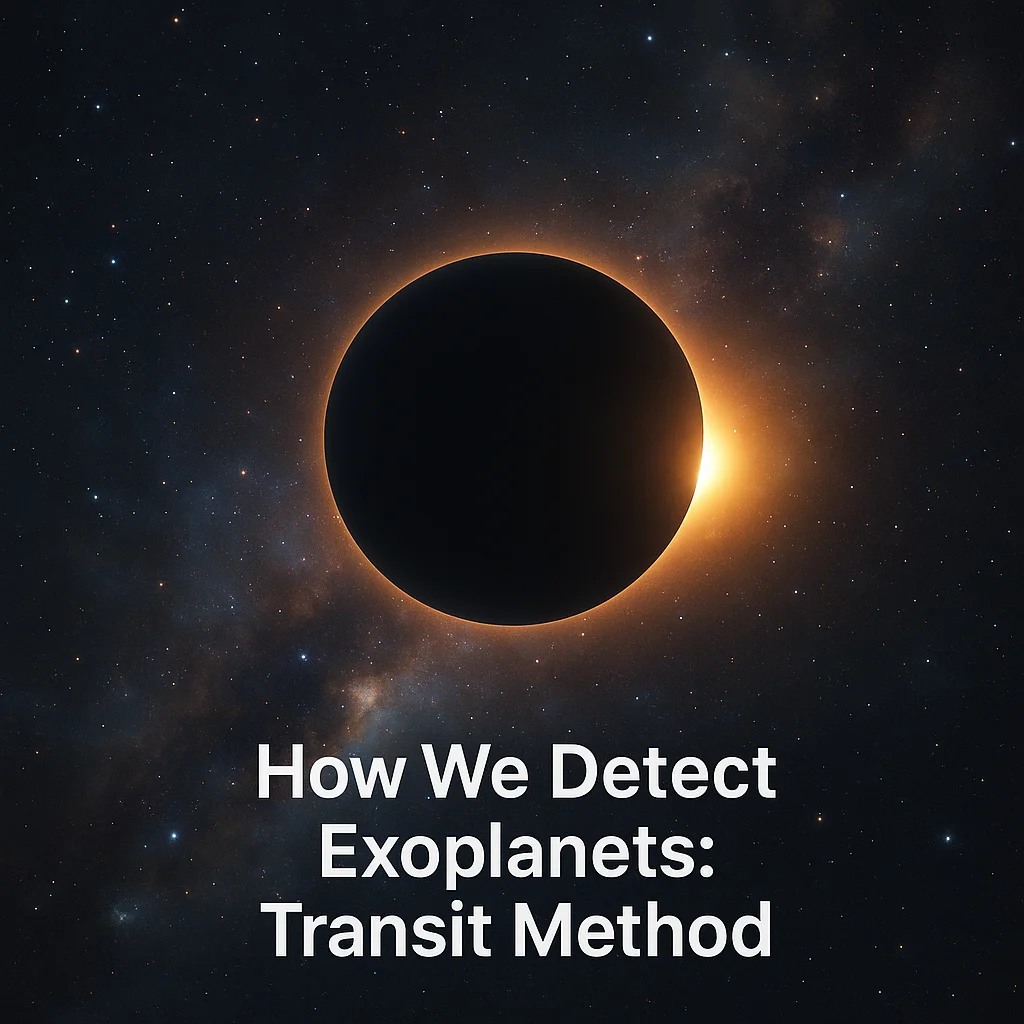
To understand the transit method, imagine a small ship crossing in front of a bright lighthouse. From a distance, the light from the lighthouse would dim slightly as the ship moves across the beam. Similarly, when an exoplanet transits, or passes in front of, its host star, we observe a temporary decrease in the light we receive from that star.
In this article, you'll learn how the transit method works, the challenges involved, and what it tells us about these distant worlds. The technique has been pivotal in expanding our knowledge of planets beyond our Solar System, providing invaluable data on their characteristics, composition, and orbits.
📍 Where It Is and How Far Away
Exoplanets exist in various locations throughout the galaxy and are typically found orbiting other stars. The distance from Earth to these planets can vary greatly, ranging from a few light-years to thousands of light-years. A light-year is the distance light travels in a year, approximately six trillion miles. This vast range is measured in several ways, including utilizing parallax and redshift techniques.
One example of a close exoplanet is Proxima Centauri b, which orbits the closest star to our Solar System, Proxima Centauri, only 4.24 light-years away. In contrast, many exoplanets are located much farther from us. Their discovery has expanded our understanding of the universe's immense scale.
The distance of these planets from their stars can also affect their environmental conditions. Planets closer to their stars may experience higher temperatures due to greater exposure to starlight, while those further away could be cooler.
🧱 Size, Mass, and Gravity (Made Simple)
The transit method can help estimate the size of an exoplanet, as the extent of the dip in starlight correlates with the planet’s size. A significant reduction in brightness might indicate a large planet, while a smaller dip would suggest a smaller body.
Mass and gravity are harder to measure directly from transits, but they are crucial in understanding the planet's composition and density. When combined with radial velocity data, scientists can make more precise estimates. If an exoplanet has substantial gravity, it indicates a potential rocky or gaseous composition with a stronger gravitational pull.
To visualize gravity differences, imagine standing on a trampoline. The larger a planet or star, the more it stretches the trampoline fabric, representing the gravitational influence.
🌡️ Atmosphere and Weather
The transit method also offers insight into the atmospheres of exoplanets. When a planet passes in front of its star, some starlight travels through its atmosphere, allowing scientists to analyze the light for the presence of specific gases.
Atmospheric composition can provide clues about weather patterns. For instance, a high concentration of specific gases might indicate active volcanic activity, while the presence of clouds could suggest potential for storms.
Weather on exoplanets varies widely, driven by factors such as distance from their star, atmospheric composition, and axial tilt. Observations often reveal diverse climates, ranging from extreme heat with powerful winds to below freezing temperatures.
🪨 Surface and Interior
The surface features of exoplanets remain largely mysterious, as direct observation from afar is challenging. For rocky planets, we infer surface characteristics through atmospheric data and orbiting speed.
Planets with solid surfaces may exhibit craters, mountains, or plains shaped by geological activity, while gas giants likely lack a defined surface, instead having thick layers of gas enveloping a denser core.
The interiors of exoplanets can be just as varied, with possibilities ranging from molten cores to solid metallic ones. Core composition influences magnetic fields and volcanic activities, contributing to atmospheric development.
🌀 Rotation, Orbit, and Seasons
Through the transit method, we can estimate the orbital period of an exoplanet—the time it takes to revolve around its star. This period is observed by noting the gap between transit events. For example, a shorter interval signifies a quicker orbit.
Rotation periods can be gauged by observing the planet's light changes over time. Some exoplanets may exhibit synchronous rotation, where one side always faces their star, resulting in extreme temperature differences.
Axial tilt influences seasons on these distant worlds, much like it does on Earth. Tilt can lead to significantly differing seasonal effects, particularly if the planet oscillates or tilts dramatically.
🧲 Magnetic Field and Radiation
Magnetic fields are crucial for protecting planets from stellar radiation and maintaining atmospheres. In exoplanets, their presence is typically speculated based on indirect evidence, like auroral emissions in starlight spectra.
Radiation can strip away atmospheres, making a planet less hospitable. A magnetic field acts much like Earth's magnetosphere, deflecting harmful charged particles. This protection is pivotal for potential life conditions.
Detection of magnetic fields involves examining anomalies in the star’s observed brightness that could indicate magnetic interaction with nearby planets. Understandably, these measurements are complex at vast distances.
🌙 Moons, Rings, and Neighbors
Currently, the existence of exomoons has been more of a theory than a confirmed fact since they are elusive to detect with the transit method alone. However, gravitational effects can suggest possible companions.
Rings, like those of Saturn, are harder to predict due to their influence on starlight being minimal and challenging to distinguish from other phenomena. Yet, they remain a tantalizing possibility.
Nearby planets in multi-star systems can affect each other's orbits through gravitational interactions. Studying these interactions helps deduce the presence of additional exoplanets that might not completely transit.
🔭 How We Know (Missions and Observations)
Telescopes such as NASA's Kepler and TESS (Transiting Exoplanet Survey Satellite) have been instrumental in discovering thousands of exoplanets using the transit method. These space telescopes observe large portions of the sky over time, capturing data on changes in starlight.
Ground-based observatories also contribute by validating findings and conducting follow-up observations to uncover more planetary details, like atmospheric composition and potential habitability.
The types of data collected include light curves, which are graphs showing light intensity over time, and spectral analysis, which breaks down light into its components to find specific atmospheric gases.
❓ Common Questions and Misconceptions
Is it a star? No, an exoplanet is a planet, not a star. It doesn’t emit its own light; we mainly detect it by how it affects its host star’s light.
Can you stand on it? It depends on the exoplanet's nature. Rocky planets might have a surface, but gas giants would not, presenting a challenge for "standing."
Is it habitable? Some exoplanets lie in the habitable zone, where liquid water could exist, but habitability requires more than water, including a suitable atmosphere.
Why is it that color? Colors seen from a distance stem from atmospheric composition and surface conditions, influenced by light spectrum reflected or absorbed.
How can tiny planets block light? Even small planets block enough light during transits to be detected by sensitive instruments, though larger planets create more noticeable changes.
Will we visit exoplanets soon? Current technology makes visiting exoplanets unfeasible due to their distance, but future advancements may change this prospect.
📌 Summary
- Transit method detects exoplanets by observing periodic dimming of stars.
- Exoplanets are scattered throughout the galaxy, varying greatly in distance from Earth.
- Estimations of size and mass help determine planet characteristics and gravity.
- Atmosphere analysis reveals gas composition and potential weather patterns.
- Surface features are inferred mainly through indirect observations and star interactions.
- Orbital period is calculated from the frequency of observed star brightness dips.
- Magnetic fields suggest planetary protection capabilities against radiation.
- Moons and rings remain elusive, but gravitational hints suggest possibilities.
- Space telescopes like Kepler and TESS have significantly contributed to discoveries.
- Common questions include confusion about planet characteristics and habitability.