🪐 Hot Jupiters Explained
🌌 What It Is
Hot Jupiters are a class of exoplanets that are similar in characteristics to Jupiter, the largest planet in our Solar System, but they orbit very close to their host stars. This close proximity results in much higher temperatures, hence the term "hot".
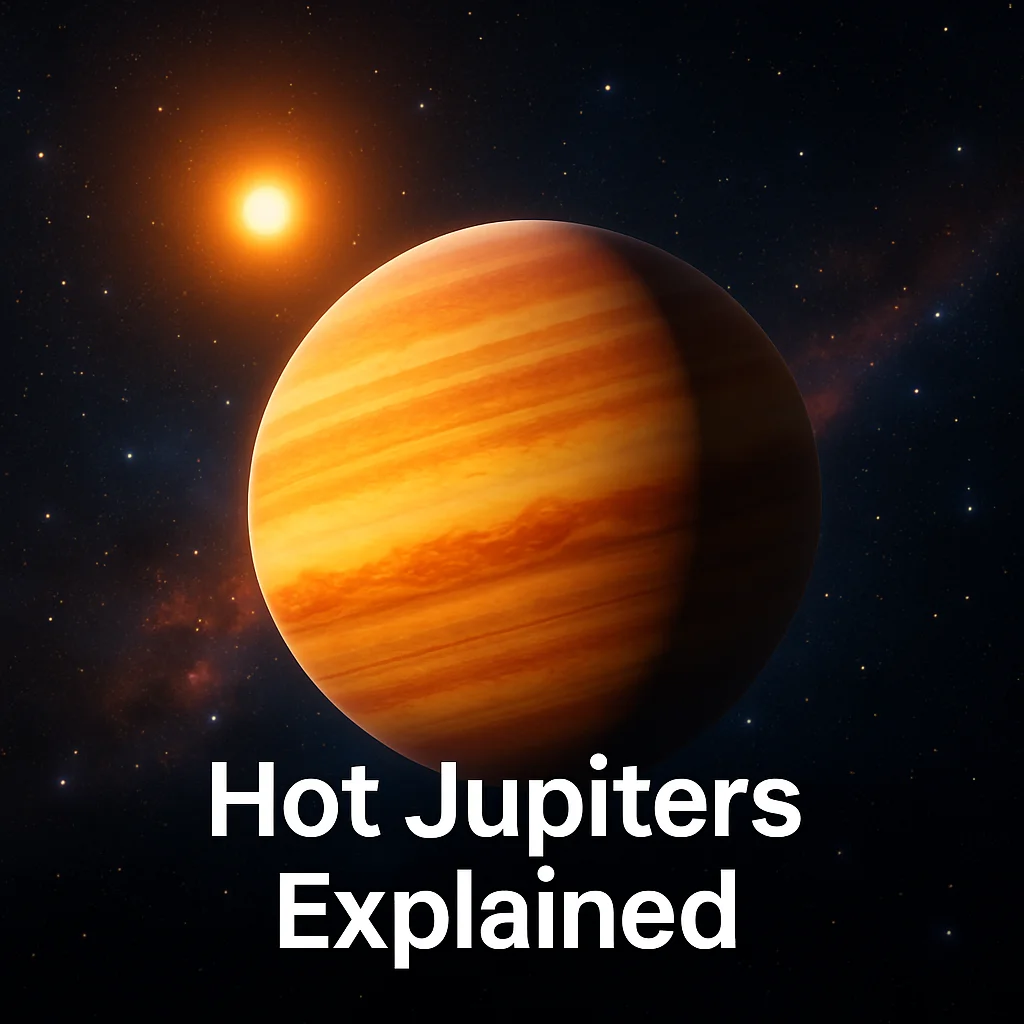
Unlike terrestrial planets, which are rocky, Hot Jupiters are gas giants made predominantly of hydrogen and helium. They are classified as gas giants, which means they lack a solid surface like Earth’s. In the broader context of planetary classifications, these planets give us insight into the diversity of planetary systems that exist.
In this article, you'll discover what makes Hot Jupiters unique, their position in space, and how they are studied by scientists. We’ll explore their physical properties, their atmospheres, and much more.
📍 Where It Is and How Far Away
Hot Jupiters are located outside our Solar System and are found orbiting other stars across the galaxy. Their proximity to their parent stars, often within a few million kilometers, makes them much closer than Earth is to the Sun.
When describing their distance in astronomical terms, these planets can be just a fraction of an Astronomical Unit (AU) from their star, where 1 AU is the average distance from the Earth to the Sun, about 150 million kilometers. Because of this, these planets receive a tremendous amount of solar radiation.
Their positions affect their temperatures notably, often causing extreme heating due to the intense and constant sunlight they receive, a factor that defines many of their other characteristics.
🧱 Size, Mass, and Gravity (Made Simple)
Hot Jupiters have masses that are similar to or greater than Jupiter, which is about 318 times the mass of Earth. Despite their mass, their proximity to a star can cause their atmospheres to expand, making them appear even larger.
These planets have strong gravitational fields due to their size and mass, but since they are gas giants, they don't have a true surface to "stand" on. The gas composition means there would be nothing solid to anchor oneself, like on Earth.
Gravity also plays a role in shaping their planetary systems, influencing potential moon orbits and even the formation of companion planets.
🌡️ Atmosphere and Weather
The atmospheres of Hot Jupiters are composed largely of hydrogen and helium, with various other molecules depending on the planet. The high temperatures influence not just the chemistry but also the dynamics within their atmospheres.
Weather patterns on these planets can be extremely violent, characterized by incredibly fast winds that can travel several kilometers per second, transporting heat and particles around the entire globe.
Because of the tidal lock caused by their proximity to their stars, one side of the planet remains perpetually hot from starlight, while the other side is much cooler, leading to extreme temperature contrasts.
🪨 Surface and Interior
Hot Jupiters are gas giants with no solid surface; hence, they don’t have land features like mountains or craters. Their "surface" is defined as the point where the atmospheric pressure is similar to that at Earth's sea level.
The interior structure of a Hot Jupiter may include a small rocky or metallic core surrounded by layers of compressed gases. As one moves deeper, gases like hydrogen can behave like liquid or even metallic under immense pressure.
This lack of a clear boundary between atmosphere and deeper layers contributes to some of the mysteries and challenges in studying these planets.
🌀 Rotation, Orbit, and Seasons
Hot Jupiters often have very short orbital periods, sometimes just a few days, due to their close proximity to their parent star, meaning their "year" is very short compared to Earth.
Most are thought to be tidally locked, meaning they show the same face to their parent star at all times, much like the Moon does to Earth. This results in one side being perpetually hot while the opposite side remains cooler.
Their lack of significant axial tilt generally means they do not experience seasons as planets like Earth or Mars do.
🧲 Magnetic Field and Radiation
Hot Jupiters can generate their own magnetic fields due to the motion of conducting materials (like metallic hydrogen) in their interiors. These fields can protect the planet from solar and cosmic radiation to some extent.
Interactions between the magnetic field and the solar wind can create intense auroras, akin to Earth's Northern and Southern Lights, but potentially more powerful because of the planet's proximity to its star.
Radiation from the host star can also strip away their atmospheres over time if the magnetic field isn't strong enough, highlighting a balancing act between atmospheric loss and protection.
🌙 Moons, Rings, and Neighbors
While Hot Jupiters could theoretically have moons, the strong gravitational influence of the nearby star might destabilize moon orbits, making them unlikely to retain large natural satellites for long periods.
Some Hot Jupiters may have rings, but these would likely be difficult to sustain due to similar gravitational influences from the star.
Their presence in a star system affects neighboring planets, shaping their orbits and occasionally contributing to complex gravitational interactions.
🔭 How We Know (Missions and Observations)
The discovery and study of Hot Jupiters is primarily through indirect means using ground-based and space telescopes. The transit method detects dips in starlight as the planet passes in front of its star.
Radial velocity measurements observe how a star "wobbles" due to a planet’s gravitational pull. Both techniques provide data on orbit, mass, and even atmospheric composition.
While direct missions to these distant worlds are not possible, ongoing space missions like those conducted by the Hubble and James Webb Space Telescopes continue to gather crucial data.
❓ Common Questions and Misconceptions
Is a Hot Jupiter actually a star? No, it’s a planet. Though it’s large, it doesn’t undergo nuclear fusion like stars do.
Can you stand on a Hot Jupiter? No, they are gas giants without a solid surface.
Is a Hot Jupiter habitable? Not likely, due to extreme temperatures and lack of a solid surface.
Why isn’t it called a planet like Earth? It is a planet, just a different kind, known as a gas giant.
Why are they called "Hot"? Because they orbit very close to their stars, generating high heat.
Do all stars have Hot Jupiters? Not all, but many stars are host to such planets, based on current observations.
📌 Summary
- Hot Jupiters are large gas giant exoplanets similar to Jupiter but much hotter.
- They are found orbiting other stars, often very close to them.
- They are massive with strong gravity, but no solid surface exists.
- These planets have thick atmospheres with fast winds and extreme heat.
- No solid surface; interiors likely have a small core surrounded by gases.
- Short orbital periods due to proximity; often tidally locked.
- Can have magnetic fields protecting against stellar radiation.
- Moons and rings are speculated but not commonly observed.
- Studied through telescopes using transit and radial velocity methods.
- A defining feature is their high temperatures due to close star proximity.