🪐 Mini-Neptunes Explained
🌌 What It Is
Mini-Neptunes are a fascinating category of planets found outside our Solar System. They are called "mini" because they are smaller than Neptune, which is a well-known gas giant located beyond the asteroid belt. Though smaller, mini-Neptunes still have a significant amount of gas enveloping them.
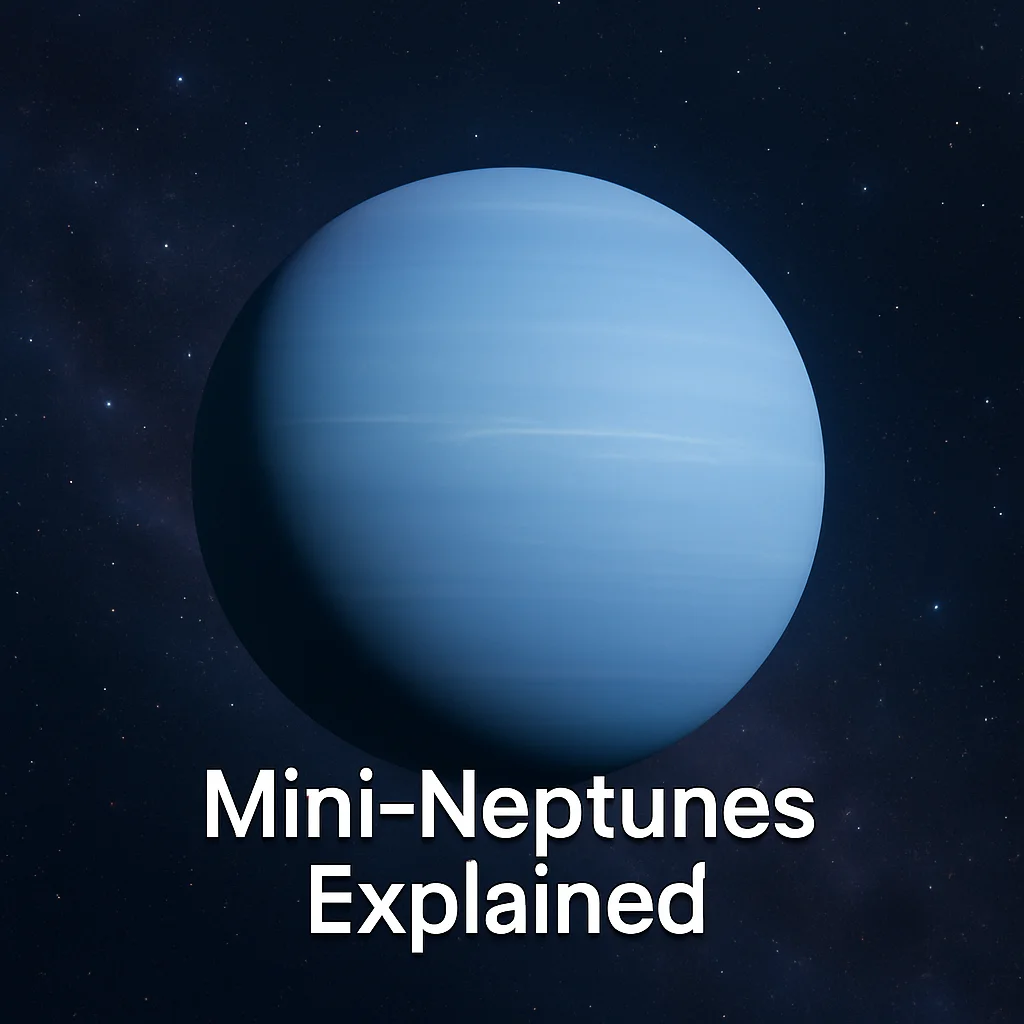
These planets are classified as gas or ice giants, much like Neptune and Uranus. They are composed primarily of hydrogen, helium, and volatiles such as water, ammonia, and methane. Unlike terrestrial planets like Earth, they lack a solid surface.
In this article, you'll learn what defines a mini-Neptune, where these intriguing planets are located, and how they provide valuable insights into planetary formation and composition in our galaxy.
📍 Where It Is and How Far Away
Mini-Neptunes are not found within our Solar System; instead, they orbit stars in other solar systems, known as exoplanets. These distant worlds can be located thousands of light-years away from Earth, often discovered via space telescopes like Kepler or TESS.
The distance of mini-Neptunes from their stars can vary significantly, from a fraction of the distance from Earth to the Sun to many times greater. This positioning affects their temperature and atmospheric conditions, receiving varying amounts of starlight.
Some mini-Neptunes orbit close to their parent stars, making them very hot, while others orbit further away, allowing them to remain cold and icy with minimal sunlight.
🧱 Size, Mass, and Gravity (Made Simple)
Mini-Neptunes are typically larger than Earth but smaller than the ice giants in our Solar System. They often range in radius from about 1.5 to 4 times that of Earth. Although they are smaller than Neptune, they are still massive compared to terrestrial planets.
The gravity on a mini-Neptune is tricky to conceptualize, as they do not have a solid surface to stand on. Instead, their gravity influences the thick, gaseous layer surrounding a dense core. If humans could visit, it might feel different due to the way atmosphere gathers and exerts pressure.
Despite their thick atmospheres, the exact surface gravity can vary widely depending on a mini-Neptune's specific size and mass, sometimes being comparable to or greater than that experienced on Earth.
🌡️ Atmosphere and Weather
The atmospheres of mini-Neptunes are rich in hydrogen and helium, along with other elements like water vapor, methane, and ammonia. This composition grants them characteristics similar to that of Uranus and Neptune.
Weather on a mini-Neptune can be quite dynamic. High winds and dramatic cloud patterns are common, caused by fast rotation speeds and heat from their cores or their proximity to a star.
The atmospheres can form complex weather systems, including storms much larger than those found on Earth, influenced by chemical interactions and temperature differences in the upper atmosphere.
🪨 Surface and Interior
Unlike rocky planets, mini-Neptunes have no true surface. The boundary between their gaseous atmospheres and any dense core is not well-defined. Instead, we describe them as having layers that get denser as you move inward.
Their interior consists of a possible rocky or icy core, surrounded by a thick mantle of ices that transitions into layers of gas. This structure is unique, and changes in temperature and pressure define each layer's properties.
Understanding these planet interiors is essential for scientists to construct models of their formation and evolution, shedding light on the processes that lead to gas giant formation.
🌀 Rotation, Orbit, and Seasons
Mini-Neptunes can have rotations lasting hours to days, similar to Jupiter and Saturn, leading to short days. They may orbit their stars anywhere from a few Earth days to several Earth years, depending on their distance and the star's size.
These planetary orbits can be circular or elliptical, impacting the length and intensity of their seasons. Some mini-Neptunes could experience significant seasonal changes based on axial tilt, while others might have little variation if their orbits are more circular.
Details about their rotational tilt and speed give us hints about their formation history and dynamical evolution over time.
🧲 Magnetic Field and Radiation
Some mini-Neptunes may possess magnetic fields generated by their dynamic interiors. These fields are essential as they can interact with solar winds and protect the planet's atmosphere from being stripped away.
Magnetic fields may also give rise to beautiful auroral displays in a mini-Neptune's upper atmosphere, similar to those seen on Jupiter and Saturn.
The study of magnetic fields helps scientists understand the nature of planetary interiors, as well as their potential for hosting rich atmospheres over long periods.
🌙 Moons, Rings, and Neighbors
While detailed observations are often difficult, it is possible that mini-Neptunes could host moons or even ring systems, similar to those around the gas giants in our Solar System.
Their gravitational influence might shape and maintain moons in orbit, or pull in surrounding material to form rings. Understanding such interactions helps unravel the complex gravitational relationships within planetary systems.
Though confirmations of these features are rare due to observational limits, speculation and future studies aim to discover these components in distant exoplanetary systems.
🔭 How We Know (Missions and Observations)
Telescopes like Kepler and TESS have been crucial in discovering mini-Neptunes by identifying tiny dips in starlight as planets transit their stars. These space telescopes detect exoplanetary systems and measure their characteristics.
Data on mini-Neptunes are gathered through various methods, including transit and radial velocity measurements, which help scientists determine a planet's size, mass, and atmospheric properties.
Future missions and advanced technology may allow scientists to obtain more detailed images and spectra, unlocking further secrets of these enigmatic worlds.
❓ Common Questions and Misconceptions
Is a mini-Neptune a star? No, mini-Neptunes are planets, not stars. They do not generate their own light but can reflect their star's light.
Can you stand on a mini-Neptune? No, they lack a solid surface, as they mostly consist of gases and ices. You would pass through the gaseous layers if you tried.
Is a mini-Neptune habitable? Currently, they are deemed inhospitable due to the lack of a solid surface and extreme atmospheric conditions.
Why are they that color? The coloration is due to atmospheric compounds reflecting and absorbing specific wavelengths of light.
How do we know they exist? Mini-Neptunes have been discovered through advanced telescopic methods, including light measurements and spectral analysis.
Are they newly formed planets? Not necessarily. They could be older or younger than planets in our Solar System, depending on their formation history.
📌 Summary
- Mini-Neptunes are smaller gas or ice giant exoplanets.
- They orbit stars outside our Solar System.
- They are larger than Earth but smaller than Neptune, with significant atmospheres.
- Their atmospheres are hydrogen-rich, with complex weather patterns.
- They lack a solid surface, having layers of gas and possibly a dense core.
- They have varying rotation rates and may have significant seasonal changes.
- Some may possess magnetic fields, impacting space weather and atmospheric retention.
- Moons or ring systems may exist but are difficult to confirm.
- Discoveries have been made through space telescope observations.
- One memorable fact: They offer insights into the variety of planetary formations in the galaxy.