🪐 Rogue Planets Explained
🌌 What It Is
Rogue planets, also known as interstellar planets or nomad planets, are celestial bodies that drift through space without orbiting a star. Unlike planets in our Solar System, which are gravitationally tethered to our Sun, rogues travel independently through the galaxy.
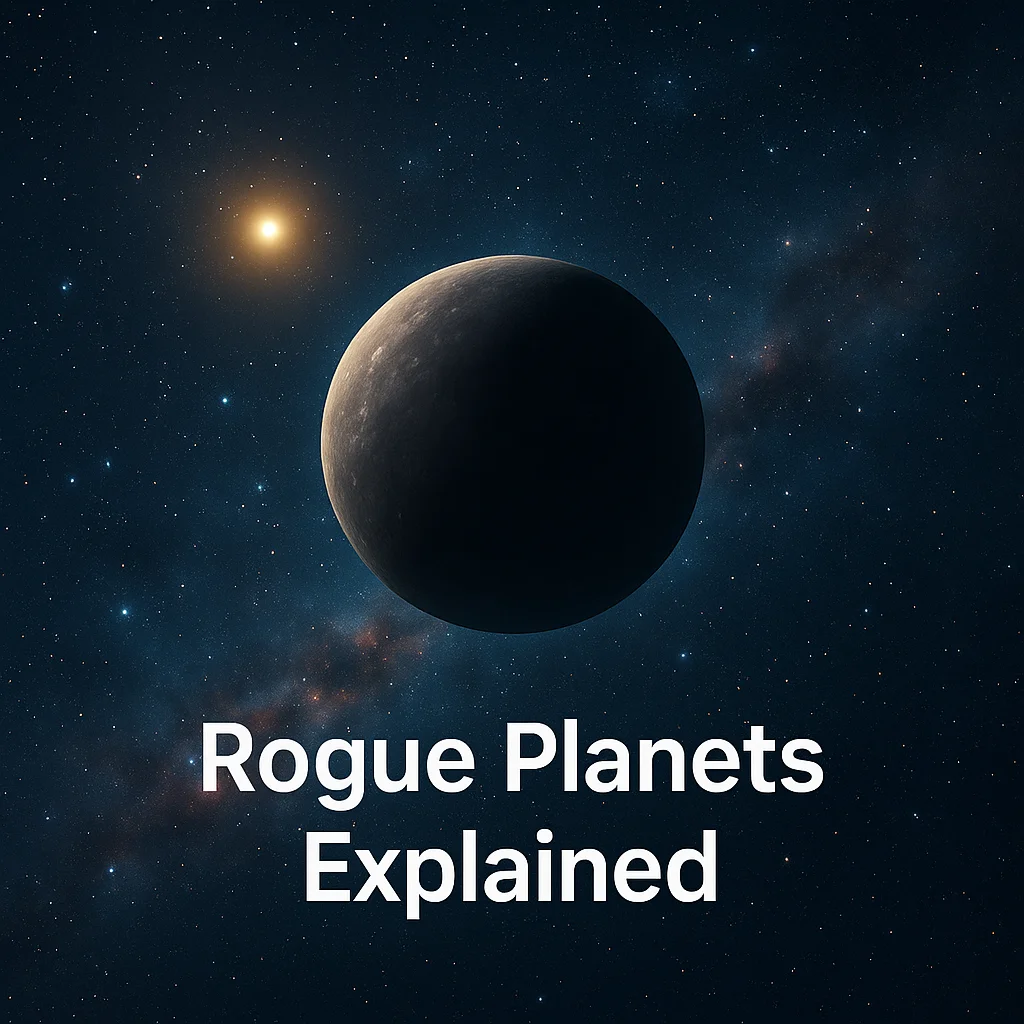
To be considered a planet, a celestial body must meet certain criteria: it must orbit a star, be spherical due to its own gravity, and have cleared its orbital path of debris. Rogue planets fall outside this traditional classification because they lack a central star.
In this article, we'll explore what makes rogue planets unique, how they move through the galaxy, and what astronomers have learned about these fascinating wanderers.
📍 Where It Is and How Far Away
Rogue planets are scattered throughout the Milky Way galaxy, with their distances from Earth varying widely. Unlike the planets in our Solar System, which are orbiting within a relatively close distance in cosmic terms, rogue planets can be located many light-years away.
Their location in space means that sunlight and temperature can vary dramatically. Some rogue planets may be pitch black, far from any star to provide warmth, making them extremely cold. Others, however, might be passing through regions with nearby stars, offering a brief glimpse of light and warmth.
Since these planets are not bound to a star, measuring their distance often involves complex astronomical techniques and observations rather than simple light-years or Astronomical Units (AU).
🧱 Size, Mass, and Gravity (Made Simple)
Rogue planets can vary greatly in size, from bodies as small as Earth to those much larger than Jupiter. This variation in size often translates to differences in mass and gravitational effects. If we compare our experience on Earth, a more massive rogue planet would have stronger gravity.
If a rogue planet has no solid surface, like gas giants, the concept of gravity gets tricky. For a large gas rogue planet, the gravity would pull you toward its center, but standing on the surface wouldn't be possible as you'd sink into the gaseous atmosphere.
This lack of a firm surface is an important consideration when trying to understand what life would be like on a rogue planet. Exploring such a planet requires innovative techniques beyond the traditional methods.
🌡️ Atmosphere and Weather
The atmosphere of a rogue planet depends on its origin and composition. A rogue planet that formed around a star might retain some elements of its original atmosphere. This could include hydrogen, helium, and possibly other gases, creating conditions for complex weather systems.
Without a nearby star, rogue planets experience unique weather patterns. Some might have thick clouds of gas that insulate the planet, trapping heat from its core. Others might be barren and cold, with minimal atmospheric activity due to the lack of external warmth.
The behavior of the weather on a rogue planet is largely influenced by the planet's rotation and internal heat, rather than sunlight. This results in unusual and extreme climate phenomena compared to planets that orbit stars.
🪨 Surface and Interior
Rogue planets, particularly those composed of rock, may have surfaces shaped by impacts and geological activity. Heavy bombardment by meteoroids or comets can lead to a surface filled with craters.
Gas or ice giant rogue planets do not have a well-defined surface. Instead, they consist of layers of gas or ice, becoming denser the deeper you go. In these planets, conditions such as pressure and temperature increase as you approach the core.
The interiors of rogue planets are less understood, but scientists believe these planets have a core that might be rocky or composed of solid hydrogen, depending on their formation history and size.
🌀 Rotation, Orbit, and Seasons
The rotation of a rogue planet affects its atmospheric dynamics, just like it does on Earth. The length of a day on a rogue planet can vary widely depending on how fast it spins around its axis.
Without a host star to orbit, rogue planets do not have traditional seasons. Instead, any variation in temperature or atmosphere is driven by internal heat and possibly distant nearby stars.
If a rogue planet has an unusual axial tilt, it might experience unusual cycles in atmospheric pressure and temperature, but these are not the same well-defined seasons as those on Earth.
🧲 Magnetic Field and Radiation
A magnetic field is crucial for protecting a planet's atmosphere from cosmic radiation. Rogue planets may have magnetic fields, similar to Earth's, generated by their cores.
Such a field can create spectacular auroras as the plasma from cosmic particles interacts with the planet's atmospheric gases. However, these auroras would be quite different from those induced by solar wind on Earth.
The presence of radiation belts around a rogue planet could impact potential space missions or observations, as these belts can be hazardous to spacecraft and instruments.
🌙 Moons, Rings, and Neighbors
While rogue planets are not tethered to stars, some might have moons that orbit them. These moons could range in size and composition, providing a mini-system similar to planets like Jupiter or Saturn.
The gravitational interactions between a rogue planet and its moons can create complex dynamics, similar to tidal forces witnessed in our own Solar System. However, rings are less likely since the material that forms them usually originates from a host star system.
It is also possible for rogue planets to occasionally encounter other stars or planetary systems during their journey through space, although such interactions are rare and brief.
🔭 How We Know (Missions and Observations)
The study of rogue planets relies heavily on both telescopes and instruments aboard spacecraft. Telescopes can detect rogue planets through methods such as microlensing, where the gravity of a rogue planet bends and magnifies the light of a more distant star.
Spacecraft missions have yet to visit rogue planets, but observations from the ground and space have provided valuable data about their properties and behavior. Scientists use images, spectral readings, and gravitational measurements to infer various characteristics.
Famous missions have largely focused on planetary systems with a central star, but advancements in technology and techniques continue to push the boundaries of exploring these mysterious wanderers.
❓ Common Questions and Misconceptions
Is a rogue planet the same as a star?
No, a rogue planet does not undergo nuclear fusion, a key characteristic of stars, and lacks a star's brightness and scale.
Can you stand on a rogue planet?
It depends on its composition. Rocky rogue planets could have surfaces to stand on, whereas gas giants do not.
Is a rogue planet habitable?
Most rogue planets are inhospitable due to extreme cold, lack of light, and unstable atmospheric conditions.
Are rogue planets rare?
Though specific numbers are unknown, some scientists estimate there may be as many rogue planets as stars in the galaxy.
Do rogue planets have colors like regular planets?
Their color would depend on atmospheric composition and surface materials. Some might appear different due to lack of sunlight.
Can rogue planets capture objects, like moons, just like star-bound planets?
Yes, if conditions are right, a rogue planet could capture objects such as moons due to gravitational forces.
📌 Summary
- Rogue planets are planets not bound to any star, wandering through space independently.
- They can be located anywhere in the Milky Way, often far from Earth.
- Sizes vary from Earth-like to giant planets, influencing their gravity.
- Rogue planets might have atmospheres, though their weather is often extreme.
- Surface and interior compositions vary; gas giants lack solid surfaces.
- Without a set orbit, rogue planets don't experience traditional seasons.
- Some possess magnetic fields, which affect cosmic radiation impacts.
- Few have moons, and ring systems are rare due to their isolated nature.
- Understanding primarily comes from telescope observations and data collection.
- A memorable fact: Rogue planets challenge traditional definitions of what makes a planet.