🪐 Kepler’s Exoplanet Discoveries Explained
🌌 What It Is
Kepler's exoplanet discoveries refer to the vast number of planets found beyond our solar system, thanks largely to NASA's Kepler Space Telescope. An exoplanet is any planet that orbits a star outside our solar system. Kepler's findings have expanded our understanding of the universe and our place within it.
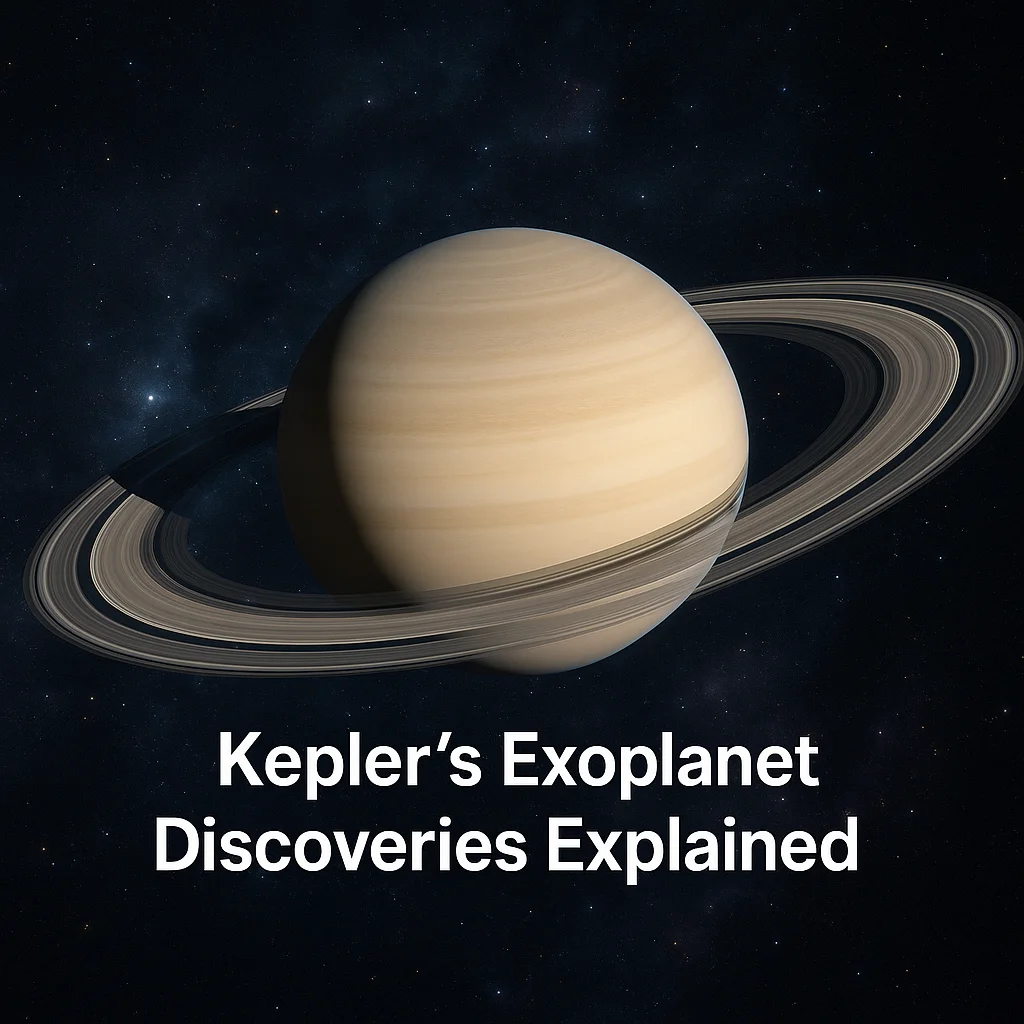
The Kepler Space Telescope was launched by NASA in 2009 with the primary aim of discovering Earth-like planets in other solar systems. By observing changes in the brightness of stars, the telescope could infer the presence of planets passing between the stars and us.
In this article, you will learn about the various aspects of Kepler's exoplanet discoveries, including their locations, sizes, atmospheres, and many other intriguing characteristics.
📍 Where It Is and How Far Away
Kepler's exoplanets are scattered throughout the Milky Way galaxy. While the telescope observed a specific section of the sky, the planets it discovered are situated around hundreds and even thousands of light-years away from Earth. In comparison, our own solar system's outermost planet, Neptune, is a mere six hours of light travel time away.
The vast distances mean that the exoplanets Kepler discovered are far out of reach for current space travel technology. However, studying these planets helps scientists understand more about how planets form and the variety of worlds that exist.
Because these exoplanets orbit stars at varying distances, they experience a wide range of temperatures. Those close to their stars can be blisteringly hot, while those further away might be frozen worlds.
🧱 Size, Mass, and Gravity (Made Simple)
The exoplanets discovered by Kepler vary greatly in size and mass. Some are small, rocky worlds, similar to Earth or Mars, while others are as large or even larger than Jupiter, our solar system's biggest planet.
Gravity on these planets would feel different than on Earth. On a larger planet like a gas giant, high gravity would make everything feel much heavier. In contrast, a smaller planet with less gravity might feel like you're walking on the Moon, where movements are bouncier.
For many exoplanets discovered, we know the size but not always the exact mass. Even so, these measurements tell scientists about the planet's likely composition, whether it's rocky or gaseous.
🌡️ Atmosphere and Weather
Many of the exoplanets identified by Kepler likely have atmospheres, but these can be significantly different from Earth's. Some may have thick, crushing atmospheres made primarily of hydrogen and helium, making them gas giants.
Weather on these planets can be extreme. For example, a gas giant close to its star might have incredibly fast winds and raging storms due to intense heating from the sun.
Understanding an exoplanet's atmosphere is crucial because it can provide clues to potential habitability and conditions on the planet's surface.
🪨 Surface and Interior
For rocky exoplanets, their surfaces could be dotted with craters from meteorite impacts or covered with mountains and volcanoes. Tectonic activity, which shapes Earth's landscape, could be absent or present depending on the planet's composition and heat.
Gas giants, conversely, do not have a solid surface. Instead, they have layers of gases that become denser with depth. The "surface" is typically defined as the point where atmospheric pressure is similar to Earth's sea level.
The interiors of these planets, especially gas giants, are thought to contain cores of metal and rock, although direct observation isn't possible from our current vantage point.
🌀 Rotation, Orbit, and Seasons
The rotation and orbit of exoplanets vary widely. Some planets have very short days, spinning quickly on their axes, while others rotate more slowly. A planet's year, or its time to orbit its star, can range from just a few days to many years.
Some exoplanets may be tidally locked, meaning they always show the same face to their star, much like how the Moon always shows the same face to Earth. This can result in extreme temperature differences between the planet's night and day sides.
The tilt of a planet's axis affects its seasons, just as Earth's tilt leads to our seasonal changes. However, not all exoplanets have axial tilt that results in noticeable seasons.
🧲 Magnetic Field and Radiation
A magnetic field, if present, would protect a planet from solar and cosmic radiation, similar to how Earth's magnetic field shields us. It could also be responsible for generating auroras, which are stunning light displays seen in polar regions.
Exoplanets with high radiation levels may pose challenges for potential life forms and would affect how spacecraft could safely navigate around them.
Understanding a planet's magnetic field is important for gauging its atmosphere's longevity, as these fields can prevent atmospheric erosion from solar winds.
🌙 Moons, Rings, and Neighbors
Many exoplanets may have moons, though detecting them is challenging with current technology. Moons could significantly affect a planet's environment, including tides and even potential biology.
Rings are more likely to be observed around larger gas giants. These rings can provide clues about the planet's gravitational history and interactions with nearby celestial bodies.
The presence or absence of moons and rings adds to the diversity and complexity of planetary systems, offering insights into their formation and evolution.
🔭 How We Know (Missions and Observations)
The primary tool for discovering these exoplanets was the Kepler Space Telescope, which analyzed the slight dimming of stars as planets passed in front of them. This method is known as the transit method.
Additionally, ground-based telescopes and other space telescopes have contributed follow-up observations, providing more details about the planets' compositions and atmospheres through methods like spectroscopy.
Future missions are aiming to better understand these distant worlds, with more advanced instruments that can directly image exoplanets or analyze their reflected light.
❓ Common Questions and Misconceptions
Is an exoplanet a star? No, exoplanets orbit stars and do not emit their own light, unlike stars.
Can you stand on a gas giant? No, gas giants lack a solid surface like Earth’s, making standing impossible.
Are exoplanets habitable? Some may be, especially those in the "habitable zone," but most discovered so far are unlikely to support human life.
Why are exoplanets different colors? Their colors depend on atmospheric composition, reflective clouds, and sometimes their surfaces.
Can we visit these planets? Not with current technology; they are too far for human reach, but robotic missions might one day explore nearby stars.
Do exoplanets only orbit single stars? No, many orbit binary or even multiple star systems, complicating their climate and conditions.
Are they all like Earth? Exoplanets come in various types and sizes, showing far more diversity than previously imagined.
Can exoplanets have liquid water? Some might, especially if they are in the "habitable zone" where temperatures allow liquid water to exist.
Are all stars likely to have planets? Scientists believe planets are common, though not every star has planets, especially Earth-sized ones.
Do exoplanets have similar day-night cycles as Earth? Many factors like rotation speed and axial tilt create diverse day-night cycles.
📌 Summary
- What it is: Kepler's discoveries of planets beyond our solar system
- Where it is: Distant stars within the Milky Way galaxy
- Size/gravity takeaway: Range from small rocky planets to massive gas giants
- Atmosphere/weather: Diverse atmospheres leading to extreme weather patterns
- Surface/interior: Rocky surfaces or layer-rich gaseous outer planets
- Orbit/rotation: Varied orbits and rotations affect day length and seasons
- Magnetic/radiation: Possibility of magnetic fields and radiation impacts
- Moons/rings: Potential for moons and rings, complex interactions
- How we know: Discovered mainly via space and ground telescopes
- One memorable fact: Kepler has identified thousands of exoplanets, revealing diverse planetary systems