🪐 Proxima b: What We Know So Far
🌌 What It Is
Proxima b is an exoplanet, which means it is a planet that orbits a star outside our Solar System. Discovered in 2016, Proxima b orbits Proxima Centauri, the closest known star to the Sun.
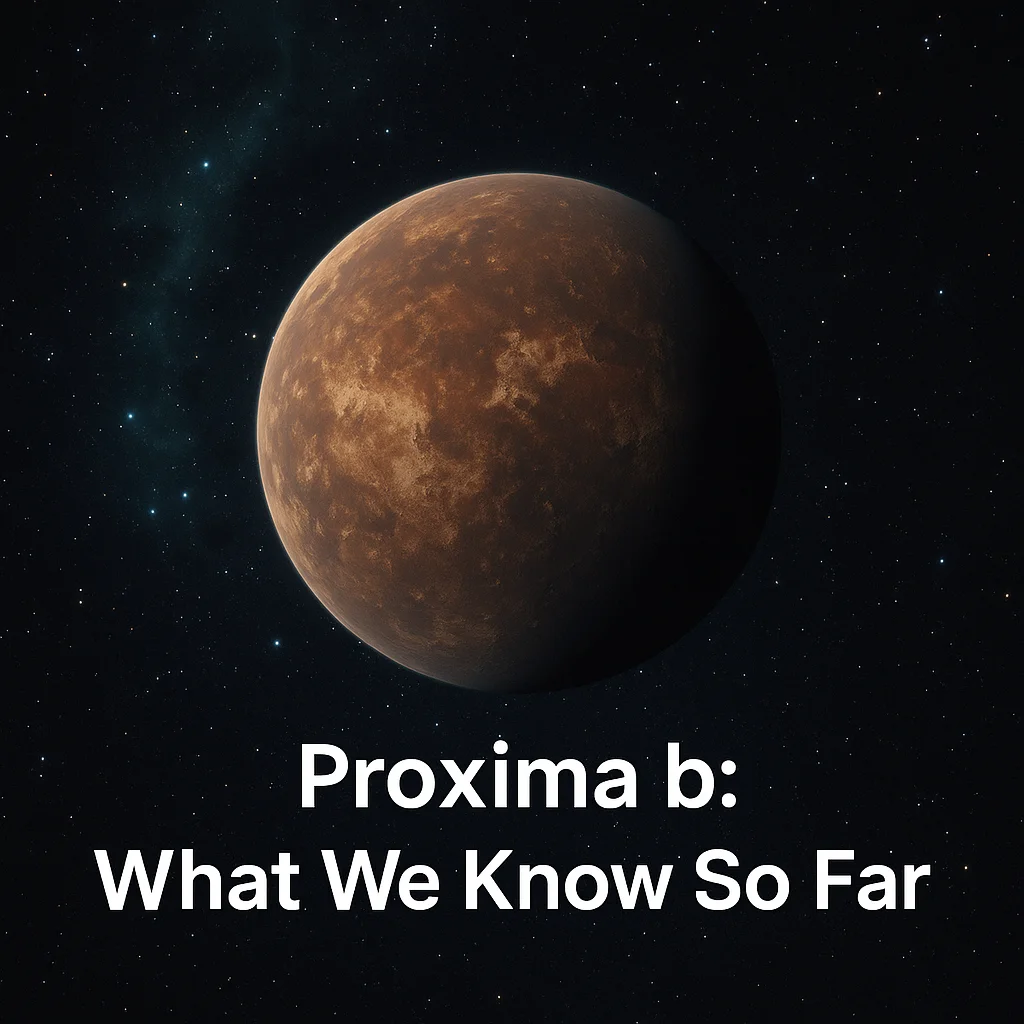
Unlike planets in our own system, Proxima b is classified as a terrestrial planet. This means it has a rocky composition similar to Earth, rather than being gas-based like Jupiter or Saturn.
In this article, you will learn about Proxima b's location, physical characteristics, atmosphere, and the observations that have informed our current understanding.
📍 Where It Is and How Far Away
Proxima b orbits Proxima Centauri, a red dwarf star that is part of the Alpha Centauri star system. This star system lies about 4.24 light-years from Earth, making it our nearest stellar neighbor.
To put this distance into perspective, light from the Sun takes about 8 minutes to reach Earth. In contrast, light from Proxima Centauri takes over four years to arrive, highlighting the vastness of interstellar space.
The proximity of Proxima Centauri means that the sunlight reaching Proxima b is much dimmer compared to what Earth receives, affecting the planet's temperature and potential habitability.
🧱 Size, Mass, and Gravity (Made Simple)
Proxima b is slightly larger than Earth, with a similar composition that suggests a rocky surface. It has about 1.3 times the mass of Earth, indicating a gravitational pull strong enough to potentially retain an atmosphere.
Surface gravity on Proxima b would be somewhat stronger than Earth's, meaning you would feel slightly heavier if you could stand on its surface.
Understanding these physical characteristics gives scientists clues about the planet's potential to support liquid water or even life.
🌡️ Atmosphere and Weather
Due to its proximity to a red dwarf star, Proxima b might have a significantly different atmosphere than Earth. Red dwarfs are known for their stellar flares, which can strip away planetary atmospheres or alter their chemical composition.
Scientists believe that if Proxima b has an atmosphere, it could be thicker than Earth's to protect against stellar radiation and maintain surface temperatures conducive to liquid water.
The lack of direct observational evidence leaves the exact nature of Proxima b's atmosphere a topic of active research and speculation.
🪨 Surface and Interior
The surface of Proxima b, if indeed terrestrial, is hypothesized to consist of rocky material with potential for mountainous terrain and craters from asteroid impacts.
The interior structure of Proxima b would likely consist of a metallic core, a silicate mantle, and a rocky crust, similar to Earth. However, the exact composition and presence of tectonic activity remain unknown.
The planet's geological activity, if any, would play a crucial role in its capability to host life by influencing surface temperatures and recycling atmospheric gases.
🌀 Rotation, Orbit, and Seasons
Proxima b orbits its star much more closely than Earth orbits the Sun, completing an orbit in just 11.2 Earth days. This close orbit implies it is tidally locked, meaning one side of the planet perpetually faces its star while the other side remains in darkness.
This locking leads to extreme differences in temperature and could create a stable climate "terminator line" suitable for life between the light and dark sides.
Because of the planet's minimal axial tilt, if any, Proxima b likely does not experience significant seasonal variations like Earth does.
🧲 Magnetic Field and Radiation
The presence of a magnetic field is critical for a planet like Proxima b as it could protect against harmful stellar flares from its host star, deflecting charged particles and retaining its atmosphere.
A strong magnetic field could also potentially produce auroras similar to Earth's northern and southern lights. However, whether Proxima b has such a magnetic field remains uncertain.
The planet's exposure to radiation from Proxima Centauri is a significant consideration for habitability, potentially affecting both atmospheric composition and surface conditions.
🌙 Moons, Rings, and Neighbors
Currently, there is no evidence that Proxima b has any moons or ring systems. In many ways, this is not unusual for an exoplanet, especially those orbiting very close to their stars.
The lack of satellites or rings means Proxima b may not experience the tidal forces or stabilizing influences that moons can provide, affecting its rotational dynamics.
As part of the Alpha Centauri system, Proxima b shares its stellar neighborhood with other stars, but the interactions between these stars and Proxima b remain a subject of scientific investigation.
🔭 How We Know (Missions and Observations)
Most of what we know about Proxima b comes from observations made with telescopes rather than spacecraft. The planet was discovered using the radial velocity method, detecting shifts in the star's light caused by the planet's gravitational influence.
Instruments like the European Southern Observatory's HARPS spectrograph have played a key role in these observations. As of now, there are no spacecraft missions to Proxima b, owing to its great distance from Earth.
Future advancements in telescope technology, such as larger ground-based observatories and space telescopes, are expected to provide more detailed information about this intriguing exoplanet.
❓ Common Questions and Misconceptions
Is Proxima b a star? No, Proxima b is a planet, not a star. It orbits the star Proxima Centauri.
Can you stand on Proxima b? If it has a solid, rocky surface, standing might be physically possible, though its conditions could be extreme.
Is Proxima b habitable? While it lies within the habitable zone of its star, harsh radiation levels and other factors could challenge habitability.
Why is Proxima b interesting? It is of great interest because of its proximity and Earth-like characteristics, offering insights into potential life-bearing conditions elsewhere.
Is Proxima b bigger than Earth? It is slightly more massive than Earth but has a comparable diameter, suggesting a similar size.
Why can't we visit Proxima b? The vast distance makes current space travel technology inadequate for such a journey.
📌 Summary
- Proxima b is an exoplanet orbiting the nearest star, Proxima Centauri.
- Located 4.24 light-years away in the Alpha Centauri system.
- Slightly larger than Earth with strong surface gravity.
- Possible atmosphere affected by stellar flares.
- Rocky surface hypothesized, but details unknown.
- Tidally locked orbit with a quick, 11.2-day year.
- Magnetic field presence is possible but unproven.
- No moons or rings currently detected.
- Known from ground-based telescopic observations.
- Proxima b's proximity and Earth-like traits make it a valuable target for future study.