🪐 TRAPPIST-1 Explained for Beginners
🌌 What It Is
TRAPPIST-1 is a distant star system that has gained attention due to its seven Earth-sized planets. Discovered in 2016, it is named after the telescope used in its discovery, the TRAPPIST (Transiting Planets and Planetesimals Small Telescope) observatory.
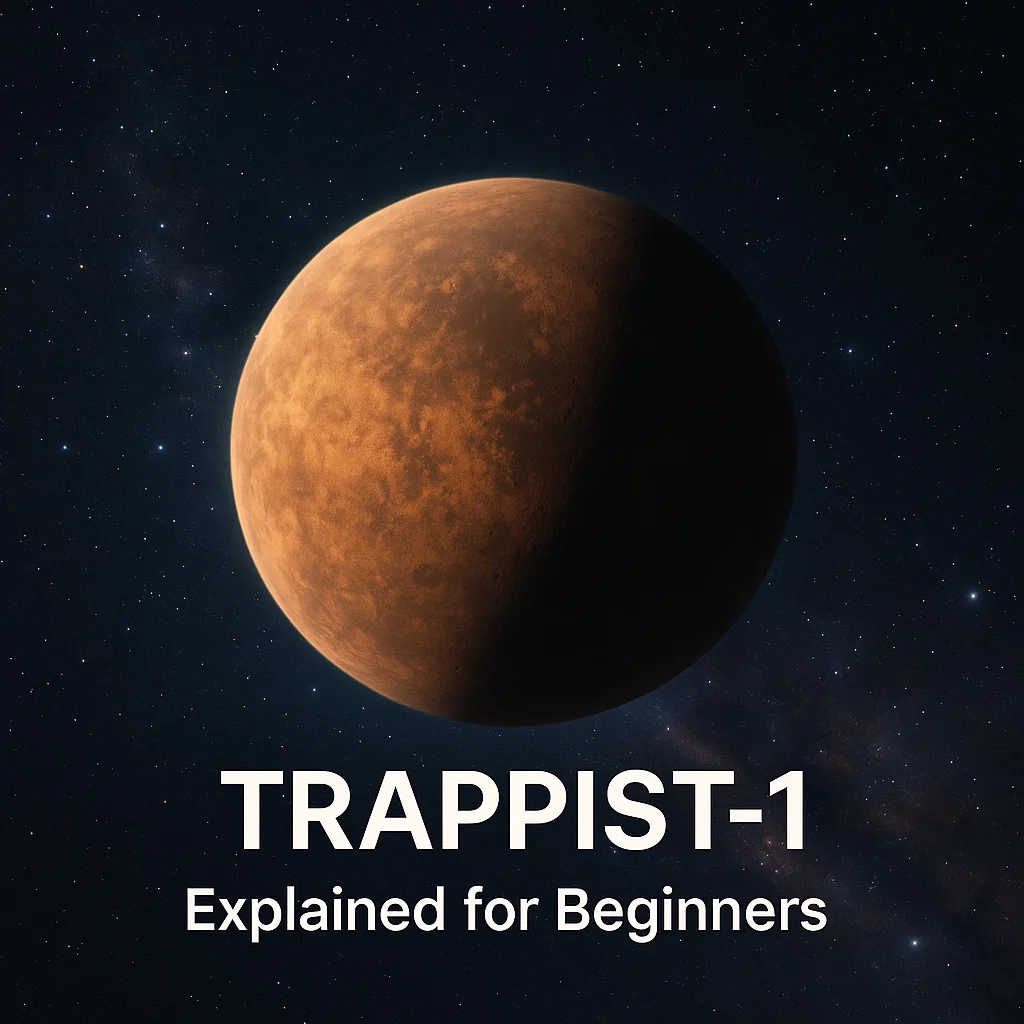
All seven planets in the TRAPPIST-1 system are classified as terrestrial, meaning they have solid, rocky surfaces like Earth. This is significant because, unlike gas giants such as Jupiter, terrestrial planets are more likely to have conditions that could support life.
In this article, you'll learn about TRAPPIST-1's location, its planets’ characteristics, and why it excites scientists studying exoplanets, which are planets located outside our Solar System.
📍 Where It Is and How Far Away
TRAPPIST-1 is located in the constellation Aquarius and is about 39 light-years from Earth. In astronomical terms, that's relatively close, making it an intriguing subject for observation and study.
One light-year represents the distance light travels in one year, which is roughly 5.88 trillion miles. To put it in simpler terms, it would take a commercial jet more than 40 million years to travel one light-year, so TRAPPIST-1 is far but still within our cosmic neighborhood.
Because TRAPPIST-1 is a dim, cool star known as an ultra-cool dwarf, the planets orbiting it receive less sunlight and are cooler than many planets in our Solar System. This affects the potential conditions on these planets, including temperatures and atmospheric properties.
🧱 Size, Mass, and Gravity (Made Simple)
In size, TRAPPIST-1 is much smaller than our Sun, being only about 8% of its mass. This tiny star means the planets orbiting it are also small and have less gravitational pull compared to the gas giants in our Solar System.
The planets in the TRAPPIST-1 system are similar in size to Earth. However, because of their proximity to a small star, they experience different gravity conditions than Earth. On some of these planets, you might feel lighter due to weaker surface gravity.
Most of the planets in TRAPPIST-1 lie so close to their star that their orbits could fit well within Mercury’s orbit around the Sun in our Solar System, highlighting just how compact this system is.
🌡️ Atmosphere and Weather
Scientists are still learning about the atmospheres of the TRAPPIST-1 planets. Early observations suggest that some of these planets could have atmospheres made up of water vapor, carbon dioxide, or other gases.
Given the cool nature of the TRAPPIST-1 star, these planets might experience milder temperatures than planets around hotter stars. This reduced heat from the star affects atmospheric dynamics, such as wind speeds and cloud formation.
Weather patterns on these planets would be quite different from Earth, potentially featuring extreme conditions depending on each planet’s unique atmospheric composition and proximity to their star.
🪨 Surface and Interior
The surfaces of TRAPPIST-1's planets might resemble the rocky terrain of terrestrial planets. These rocky surfaces could have features like mountains, valleys, or craters, shaped by both internal and external processes.
Since these planets are similar in size to Earth, it's possible they have similar structures, including a core, mantle, and crust. However, the specific composition of these layers may vary significantly depending on the planet.
Understanding the exact surface composition and interior structure of these planets is a major goal for astronomers, who use various techniques to piece together clues about these distant worlds.
🌀 Rotation, Orbit, and Seasons
One fascinating aspect of the TRAPPIST-1 system is that many of its planets are likely tidally locked. This means each planet consistently shows the same face to its star, just like how the Moon shows the same face to Earth.
A tidally locked planet would experience permanent day on one side and eternal night on the other, leading to unique seasonal and temperature variations compared to Earth.
The planets have very short orbital periods, ranging from a few days to a couple of weeks, which means a year on TRAPPIST-1 planets passes much quicker than a year on Earth.
🧲 Magnetic Field and Radiation
It is uncertain whether any of the TRAPPIST-1 planets have strong magnetic fields. A magnetic field would protect a planet from stellar radiation and could help sustain an atmosphere, factors important for potential habitability.
The star TRAPPIST-1, being an ultra-cool dwarf, emits less radiation than our Sun, but variability in its stellar activity could still affect the planets, potentially causing auroras and influencing their atmospheres.
Radiation from their host star is a crucial aspect of studying these planets, as it helps determine whether they might support life or have robust atmospheres.
🌙 Moons, Rings, and Neighbors
As of now, no moons or rings have been directly observed around the TRAPPIST-1 planets. The lack of moons may be due to the planets' gravitational interactions and proximity to their parent star, which could prevent moons from forming or remaining stable.
The TRAPPIST-1 planets themselves have intricate gravitational interactions with one another, which can lead to fascinating orbital resonances. These interactions can help scientists infer the planets' masses and densities.
Studying these interactions offers valuable insights but also makes it challenging to detect smaller bodies, like moons, in the system.
🔭 How We Know (Missions and Observations)
The TRAPPIST-1 system was discovered using ground-based telescopes such as the one at the La Silla Observatory in Chile. Observations have primarily been made through the transit method, where planets pass in front of their star and dim its light, providing information on size and orbit.
Telescopes in space, like the Hubble Space Telescope, have been used to study the atmospheres of these planets, analyzing the starlight that filters through any existing atmospheres during transits.
Future missions and telescopes, such as the James Webb Space Telescope, aim to refine our understanding of TRAPPIST-1 by examining these planets in greater detail, looking for atmospheric signatures that could indicate potential habitability.
❓ Common Questions and Misconceptions
Is TRAPPIST-1 a star? Yes, TRAPPIST-1 is a very small, dim star known as an ultra-cool dwarf.
Can you stand on TRAPPIST-1? No, it's a star so you can't stand on it. The planets orbiting it are the ones with surfaces.
Are the TRAPPIST-1 planets habitable? Scientists are still studying this, but some planets are in the habitable zone, where liquid water could potentially exist.
Why is it called TRAPPIST? It stands for Transiting Planets and Planetesimals Small Telescope, the observatory that discovered it.
Do the planets have atmospheres? Early evidence suggests some planets may have atmospheres, but this is still under study.
Why can’t we see them with the naked eye? The TRAPPIST-1 star is too dim and too far away to be visible without a telescope.
📌 Summary
- TRAPPIST-1 is a small, dim ultra-cool dwarf star
- Located about 39 light-years away in the constellation Aquarius
- Seven Earth-sized planets orbiting it with potential for varied gravity
- Atmospheres of some planets might contain water vapor or carbon dioxide
- Surfaces likely rocky, with Earth-like size and possibly similar structures
- Planets’ orbits are short; many are tidally locked with unique weather
- Magnetic fields and radiation characteristics still mostly unknown
- No moons observed, but planets interact gravitationally
- Discovered via transit method, further study with space telescopes
- Key interest in their potential habitability outside our Solar System