🪐 What Makes an Exoplanet “Potentially Habitable”?
🌌 What It Is
Exoplanets are planets that orbit a star outside our Solar System. They can be made of rock, gas, or ice, just like planets around our Sun. The term "potentially habitable" refers to exoplanets that might have conditions suitable for life as we know it.
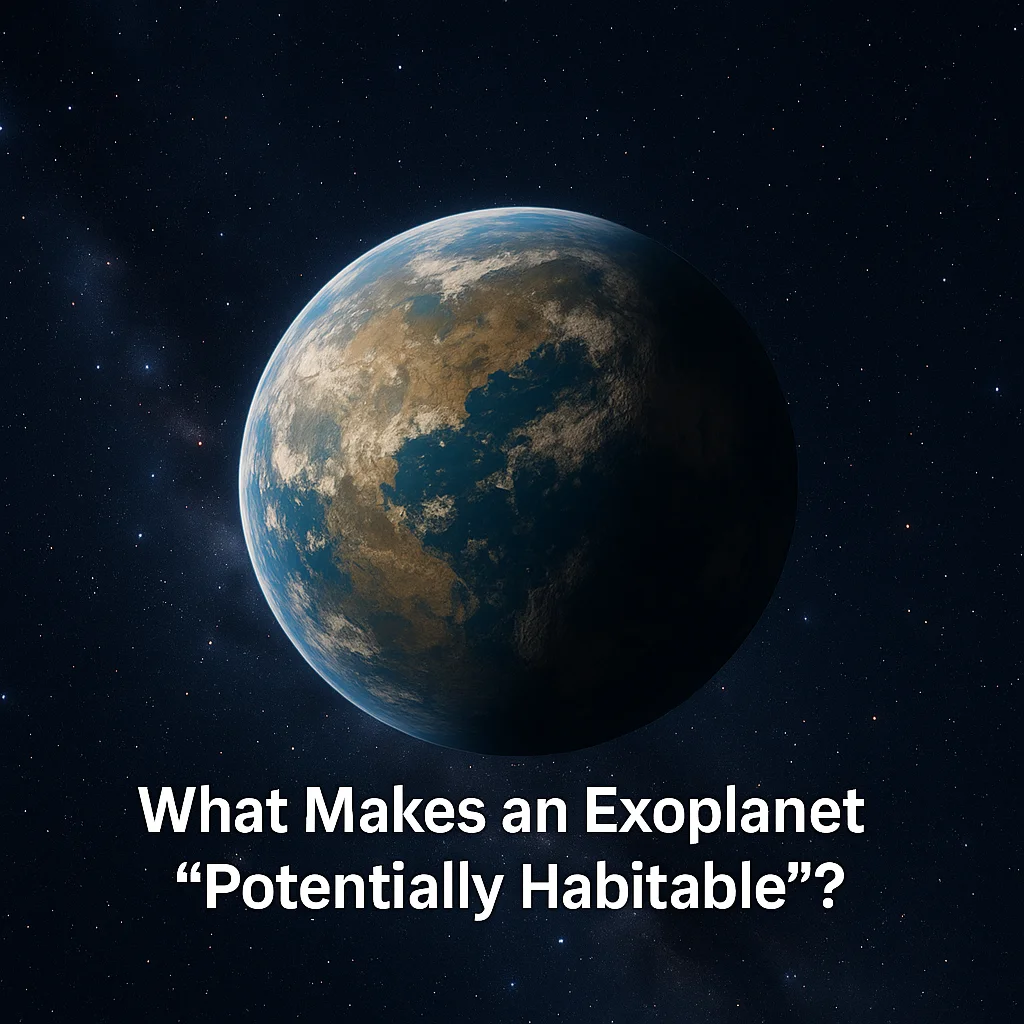
A planet is classified based on its composition and distance from its host star. Most potentially habitable exoplanets are rocky, similar to Earth, and located in what's known as the "habitable zone" where conditions might allow for liquid water.
This article will explore the key features that make an exoplanet potentially habitable, including its location in space, its size, atmosphere, and other features that might influence its ability to support life.
📍 Where It Is and How Far Away
Exoplanets are found in solar systems scattered throughout our galaxy, the Milky Way. They are at varying distances from Earth, often many light-years away. A light-year is the distance light travels in one year, about 9.46 trillion kilometers or 5.88 trillion miles.
The distance of an exoplanet from its star affects the amount of sunlight it receives, impacting its surface temperature. Exoplanets in the habitable zone receive just enough light for water to remain liquid on their surfaces without freezing or boiling away.
Because of these vast distances, scientists use telescopes to gather light from these far-off worlds and infer details about their environment and potential habitability.
🧱 Size, Mass, and Gravity (Made Simple)
The size and mass of an exoplanet determine its gravitational pull, which affects its atmosphere and potential to support life. Planets similar in size and mass to Earth might have Earth-like gravity, making it possible for humans to walk on them without feeling too heavy or light.
Larger exoplanets with much greater mass have stronger gravity, which can retain thicker atmospheres, potentially creating higher atmospheric pressure. Meanwhile, smaller, less massive planets might not hold an atmosphere at all.
🌡️ Atmosphere and Weather
The atmosphere of a potentially habitable exoplanet is crucial for sheltering life and maintaining liquid water. An atmosphere rich in gases like nitrogen and oxygen, similar to Earth’s, might be conducive to life.
Weather on these planets could include patterns of winds, clouds, and storms. The planet's proximity to its star, its rotation, and its atmospheric composition can all influence these weather patterns.
Planets closer to their stars might have hotter climates, whereas those farther away could experience colder conditions or potentially extreme weather, depending on the atmospheric composition.
🪨 Surface and Interior
Rocky exoplanets have solid surfaces where water can pool, which is promising for habitability. Surface features such as mountains, craters, and valleys could exist due to tectonic activities or impacts from space debris.
Beneath the surface, layers like a core and mantle might exist much like Earth’s. These layers can influence the planet's magnetic field, which plays a role in protecting the atmosphere.
The presence of liquid water on the surface, especially in large oceans or lakes, could significantly boost the chances of life evolving or surviving.
🌀 Rotation, Orbit, and Seasons
The duration of day and night on an exoplanet depends on its rotation period. Some exoplanets rotate quickly, leading to short days and nights, while others might be tidally locked, having one face perpetually in daylight.
An exoplanet's orbit around its star defines the length of its year. Planets with orbits similar to Earth may have comparable seasonal patterns, while those tilted differently or with eccentric orbits might experience extreme temperature shifts.
Understanding these patterns helps scientists infer possible climatic and environmental conditions on these distant worlds.
🧲 Magnetic Field and Radiation
A magnetic field is generated by movements in a planet's interior and serves as a shield against harmful cosmic and solar radiation. This field can help preserve the planet’s atmosphere by deflecting charged particles.
Exoplanets with strong magnetic fields may have features like auroras. They are important for habitability, as they protect any potential life forms from radiation that could be harmful.
Understanding whether an exoplanet has a magnetic field helps scientists assess the planet's ability to support and sustain life over long periods.
🌙 Moons, Rings, and Neighbors
Some exoplanets may have moons that influence tides and potentially climate. Though telescopes often struggle to detect these moons, their presence might offer clues about the exoplanet's history and conditions.
Rings, if present, could indicate a planet’s dynamic past and play a role in material exchange with the planet’s surface or atmosphere.
In many cases, the gravitational pull from nearby bodies could stabilize the planet’s tilt and climate, making it more conducive to developing or retaining life-friendly conditions.
🔭 How We Know (Missions and Observations)
Our knowledge about exoplanets comes from both telescopes and space missions. Telescopes on Earth and in space, like the Hubble and Kepler, have identified thousands of exoplanets by measuring light from stars.
Missions like TESS (Transiting Exoplanet Survey Satellite) continue to add to our understanding. They gather data on exoplanet atmospheres and compositions using techniques such as spectroscopy.
These observations allow scientists to infer details like size, composition, and atmospheric content from variations in starlight as planets pass in front of their stars.
❓ Common Questions and Misconceptions
Is an exoplanet just a star? No, exoplanets orbit stars and do not produce light through nuclear fusion like stars.
Can we stand on all exoplanets? Only rocky exoplanets might have solid surfaces. Gas giants, like Jupiter, do not have a surface to stand on.
Is a "habitable" exoplanet definitely home to life? Not necessarily. "Habitable" means conditions might support life, but it doesn't confirm life exists.
Why do exoplanets appear blue or red? Atmospheric composition and interactions with light cause colors. A blue planet might have a lot of ocean or a thick atmosphere with specific gases.
Are exoplanets rare? Not at all. Thousands have been discovered, and there likely are billions in our galaxy alone.
📌 Summary
- Exoplanets are planets outside our Solar System, some potentially habitable.
- They orbit stars in the Milky Way, often light-years away from Earth.
- Size and gravity affect an exoplanet's atmosphere and potential to support life.
- Atmospheres could be Earth-like, impacting possible weather and climate.
- Surface features and interiors may determine habitability potential.
- Rotation and orbit influence day length and seasonal conditions.
- Magnetic fields protect atmospheres from harmful radiation.
- Moons and rings can affect climatic and surface conditions.
- We gather information using telescopes and space missions.
- Exoplanets, while common, require careful study to assess their habitability.