🪐 How the Moon Formed: Leading Theories
🌌 What It Is
The Moon is Earth's only natural satellite, orbiting our planet at an average distance of about 384,000 kilometers (approximately 238,855 miles). It is the fifth-largest satellite in the Solar System. For centuries, humans have gazed at the Moon, wondering about its origins and role in Earth’s cosmic environment.
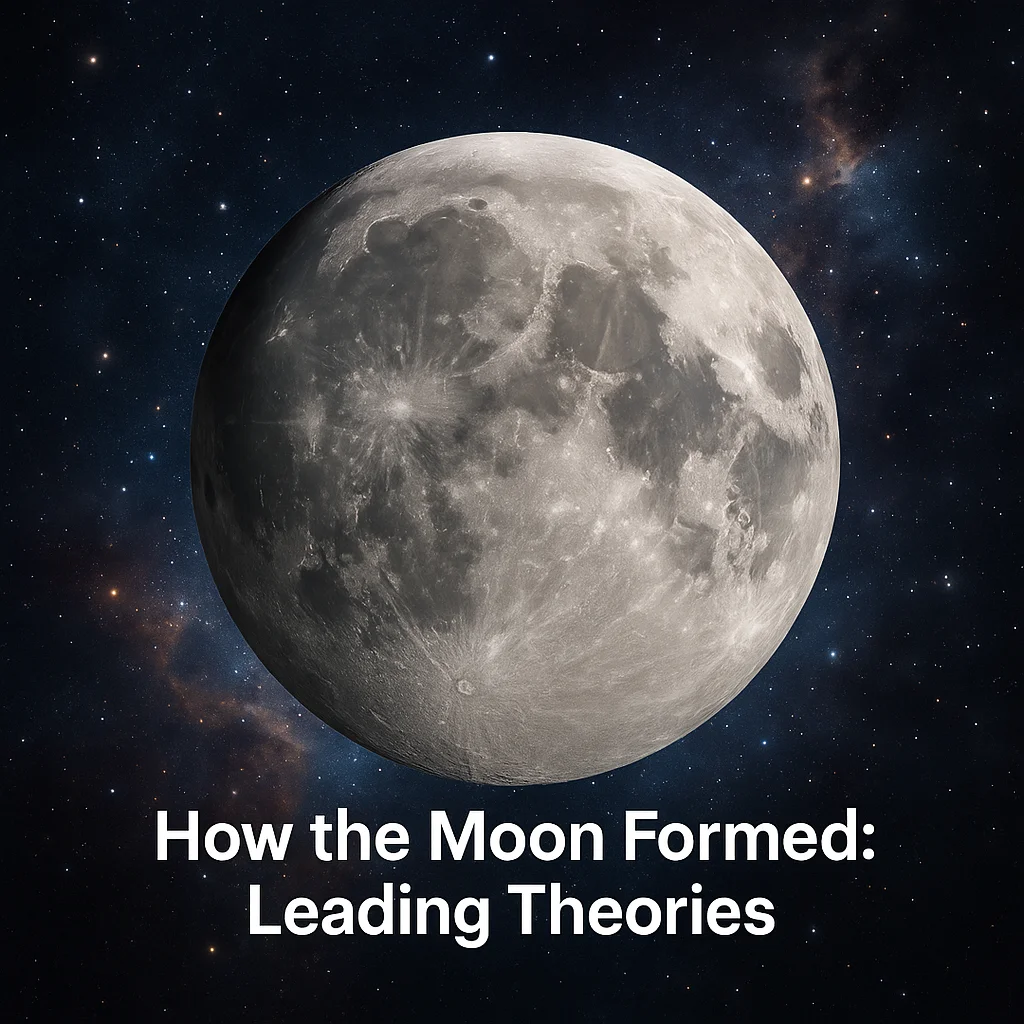
This article explores the leading theories about how the Moon was formed. By understanding its formation, we can learn more about the history of our planet and the processes that were active in the early Solar System.
We will also describe where the Moon is, its physical characteristics, and other intriguing details that make it an object of fascination for scientists and sky-watchers alike.
📍 Where It Is and How Far Away
The Moon is located in the inner part of the Solar System, orbiting Earth at a distance that can be compared to about 30 Earth diameters. In terms of light, it takes about 1.3 seconds for light to travel from the Moon to Earth, much shorter than the 8-minute journey light takes from the Sun.
Because of its proximity, the Moon influences various Earthly phenomena, such as tides. The Moon's orbit is slightly elliptical, causing variations in its distance from Earth between about 363,300 kilometers and 405,500 kilometers.
This proximity means that the Moon experiences significant sunlight, which contributes to its surface temperature variations, with frigid nights and extremely hot days.
🧱 Size, Mass, and Gravity (Made Simple)
The Moon is about 3,474 kilometers in diameter, making it roughly one-fourth the size of Earth. It has a mass about 1/81 that of our planet, which influences its gravitational pull.
If you stood on the lunar surface, you would weigh only about one-sixth of your Earth weight due to the Moon's weaker gravity. This lighter gravity is what gives astronauts that distinctive bounce as they move.
Unlike gas giants, the Moon's solid surface means gravity acts more predictably for potential human activities and explorations.
🌡️ Atmosphere and Weather
The Moon's atmosphere, known as an exosphere, is extremely thin and composed mostly of hydrogen, helium, and small amounts of neon and other gases. It lacks the density to support weather patterns like those on Earth.
Temperatures on the Moon can vary dramatically, from blisteringly hot during the day, reaching up to 127°C (260°F), to frigidly cold at night, dropping to about -173°C (-280°F).
These temperature swings occur because the Moon lacks an atmosphere to trap heat or distribute it evenly around its surface.
🪨 Surface and Interior
The surface of the Moon is characterized by its highlands and maria, which are vast basins filled with basaltic lava. This cratered landscape tells the story of a world bombarded by ancient impacts.
Beneath the surface, the Moon has a mantle and core. Although its interior is not as active as Earth’s, studies suggest the presence of seismic activity, albeit infrequent.
The surface is dusty, covered in regolith, and lacks vegetation or water, creating a stark, rocky landscape.
🌀 Rotation, Orbit, and Seasons
The Moon takes about 27.3 days to complete a rotation on its axis, which is the same amount of time it takes to orbit Earth, leading to the same side always facing us, a state known as synchronous rotation.
Its orbit is slightly tilted relative to Earth’s equator, which means the Moon doesn’t always pass directly between Earth and the Sun, giving us phases rather than regular eclipses.
This unique rotation and orbit result in no significant seasons, unlike Earth, due to the minimal axial tilt of only about 1.5 degrees.
🧲 Magnetic Field and Radiation
The Moon has a very weak magnetic field, much weaker than Earth's. Scientists believe that its magnetic field was once active, but it has significantly dwindled over time.
This weak magnetic field means the Moon's surface is exposed to higher levels of solar and cosmic radiation. Instruments placed by astronauts and spacecraft measure this radiation, providing valuable data for future lunar exploration.
Understanding these fields is important for designing safe missions, especially for roles involving long-term human presence.
🌙 Moons, Rings, and Neighbors
The Moon is unique for having no moons or rings of its own. Its solitary nature as Earth's companion contrasts with some giant planets with dozens of moons and complex ring systems.
Interestingly, the lack of other lunar moons may be related to gravitational dynamics within the Earth-Moon system, which does not support stable orbits for additional satellites.
Despite not having its own moons, the Moon's relationship with Earth creates tides through gravitational pull, affecting oceanic movements.
🔭 How We Know (Missions and Observations)
Human knowledge about the Moon comes from both historical observations and modern technological missions. Telescopes on Earth provide images and data on phases and surface features.
Space missions, notably NASA’s Apollo program, greatly enhanced our understanding. Astronauts brought back Moon rocks, and spacecraft like the Lunar Reconnaissance Orbiter continue to map its surface.
These efforts helped scientists gather insights through photographs, spectral analysis, and seismic data, gradually unraveling the lunar story.
❓ Common Questions and Misconceptions
Is the Moon a star? No, the Moon reflects sunlight; it doesn't produce its light like a star.
Can we stand on the Moon? Yes, its solid surface allows astronauts to walk, albeit in lower gravity.
Is the Moon habitable? No, its lack of atmosphere, extreme temperatures, and radiation make it uninhabitable.
Why does the Moon look different each night? Its phases are due to its orbit around Earth and how sunlight illuminates it differently.
Is there water on the Moon? Recently, ice has been detected in shadowed craters, but liquid water is absent.
Why doesn't the Moon fall into Earth? Its orbital speed balances gravitational forces, keeping it in stable orbit.
Is there a dark side of the Moon? All sides receive sunlight; the far side is simply the half we don't see from Earth.
📌 Summary
- The Moon is Earth's only natural satellite and a fascinating celestial object.
- It orbits Earth at a significant yet relatively close distance.
- The Moon's size is about one-fourth that of Earth, with weaker gravity.
- No weather is present, but it has extreme temperature swings.
- Its surface is rocky, featuring craters and lava plains.
- Rotation and orbit result in lunar phases and rare eclipses.
- The magnetic field is weak, exposing the surface to radiation.
- No additional moons or rings, but it affects Earth's tides.
- Missions and observations reveal its history and composition.
- Discovering ice in craters hints at water's presence, a notable fact.