🪐 The Moon Facts for Beginners
🌌 What It Is
The Moon is Earth's only natural satellite, meaning it is a celestial body that orbits our planet. It's one of the most familiar objects in our night sky, easily recognized by its bright, silvery glow. Although it may seem large and dominant when you gaze up at night, the Moon is actually quite small in astronomical terms.
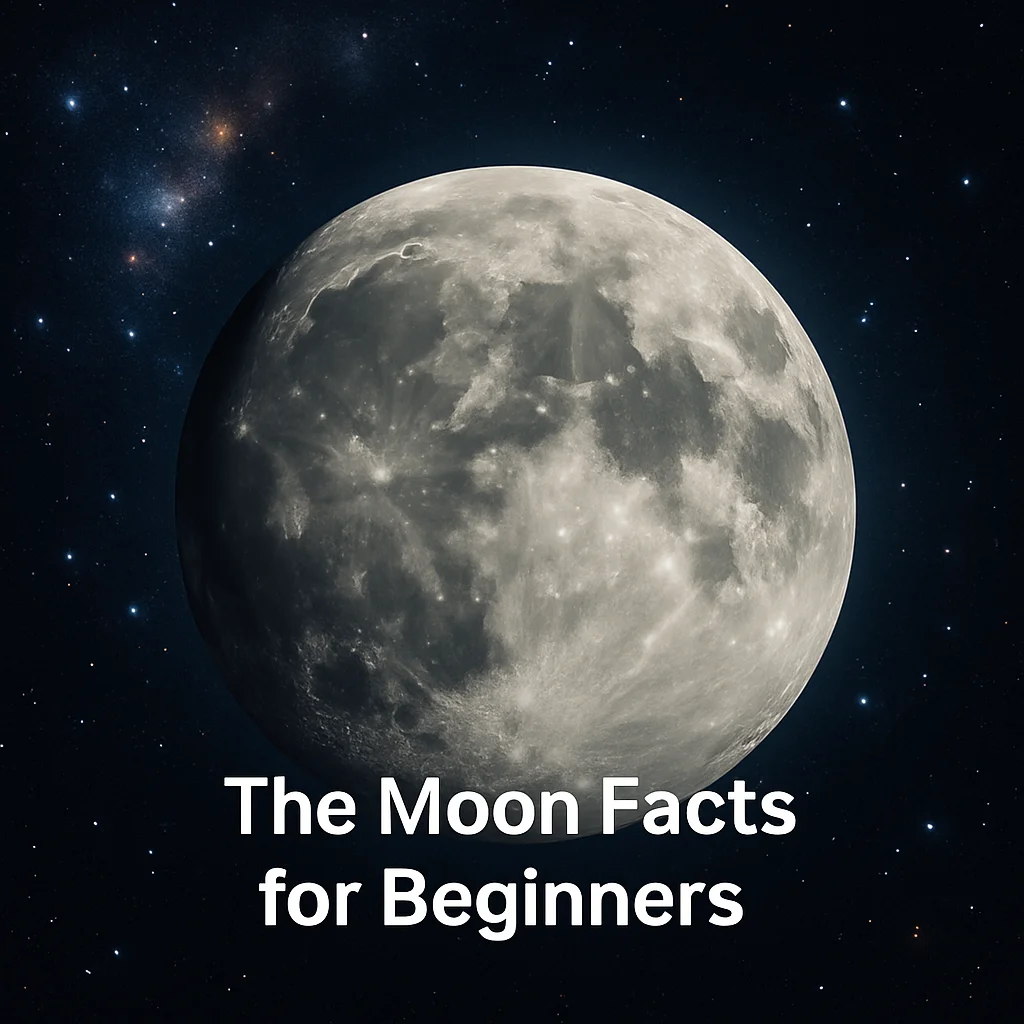
Throughout history, the Moon has been a source of wonder, inspiration, and mystery. Despite its proximity, humans have only recently begun to understand its true nature and composition. Through this article, we'll explore some of the intriguing facts about the Moon, making it easier for beginners to grasp what makes it special.
As we learn about the Moon, we'll dive into topics like its location in the solar system, its size and mass, its atmosphere, and much more. This information will help paint a comprehensive picture of our celestial neighbor, allowing us to appreciate its role in our solar system.
📍 Where It Is and How Far Away
The Moon is located relatively close to Earth, making it an integral part of our night sky. It orbits our planet at a distance of about 238,855 miles (384,400 kilometers). This might sound like a vast distance, but compared to other celestial bodies, the Moon is quite nearby—in fact, it's the closest object in our solar system.
In terms of light travel, the Moon is about 1.28 light-seconds away from us. That means if you could travel at the speed of light, it would take a little over a second to reach the Moon from Earth. This close proximity means sunlight takes only 1.28 seconds to reflect off the Moon and reach our eyes.
The Moon's location also affects its appearance and the light it reflects. Depending on its position relative to the Earth and Sun, we see different phases of the Moon, from the new Moon to a full Moon, offering spectacular views throughout the month.
🧱 Size, Mass, and Gravity (Made Simple)
When discussing the size of the Moon, it's helpful to use comparisons. The Moon has a diameter of about 2,159 miles (3,474 kilometers), roughly a quarter of Earth's diameter. While it's much smaller than Earth, it's one of the largest natural satellites in the solar system.
The Moon's mass is about 1/81th that of Earth, and its gravity is approximately 1/6th as strong. This means that if you weigh 120 pounds on Earth, you would weigh only 20 pounds on the Moon. Because of this reduced gravity, jumping and other activities would be much easier on the lunar surface.
🌡️ Atmosphere and Weather
The Moon has an extremely thin atmosphere, known as an exosphere. It's composed mostly of hydrogen, helium, neon, and a few other trace gases. This atmosphere is so tenuous that it doesn’t provide significant protection from solar radiation or meteoric impacts.
Unlike Earth, the Moon lacks weather patterns because its atmosphere is too thin to support clouds, winds, or storms. The lack of an atmosphere results in extreme temperature variations, with surface temperatures ranging from about -280°F (-173°C) at night to 260°F (127°C) during the day.
These temperature extremes make the Moon an inhospitable environment, and any future lunar missions or bases will require technology to manage these harsh conditions.
🪨 Surface and Interior
The Moon's surface is covered with a layer of dust and rocky debris known as regolith. This regolith is the result of billions of years of impacts by meteoroids, which have left a surface marked with craters of all sizes, including the famous Tycho and Copernicus craters.
The Moon doesn't have active volcanoes or tectonic activity like Earth. Instead, its geological features have remained largely unchanged for millions of years, preserving a history of the solar system's early days.
Inside, the Moon is thought to have a core, mantle, and crust, similar to Earth, though the exact composition and state of these layers remain subjects of study.
🌀 Rotation, Orbit, and Seasons
The Moon has a synchronous rotation, meaning it takes the same amount of time to rotate on its axis as it does to orbit Earth—about 27.3 days. This is why we always see the same side of the Moon from Earth, often referred to as the “near side.”
Because of this synchronized rotation, the Moon does not experience seasons like Earth. The tilt of its axis is only about 1.5 degrees, compared to Earth's 23.5 degrees, resulting in minimal seasonal changes.
The lack of significant axial tilt means that the Moon's poles are in permanent shadow, creating cold traps that retain ice, an important resource for potential future lunar exploration.
🧲 Magnetic Field and Radiation
The Moon's magnetic field is much weaker than Earth's, which results in greater exposure to solar and cosmic radiation on its surface. Although it has some localized magnetic regions, it lacks a global magnetic field to protect it from charged particles.
This absence of a strong magnetic field results in higher radiation levels on the Moon compared to Earth, posing challenges for human exploration and colonization. Astronaut gear and any future lunar habitats will need to be specially designed to protect against this radiation exposure.
🌙 Moons, Rings, and Neighbors
Unlike the gas giants, the Moon does not have any moons or ring systems of its own. Its solitary nature as a major satellite of Earth makes it a unique neighbor in the solar system.
The gravitational interaction between Earth and the Moon is responsible for the ocean tides, a fascinating demonstration of how even celestial objects can have a profound effect on each other. These tides are a result of the Moon's gravitational pull on Earth, causing the water in the oceans to bulge out slightly in the Moon’s direction.
🔭 How We Know (Missions and Observations)
Much of what we know about the Moon comes from both telescopic observations and space missions. Telescopes allow scientists to study the Moon's surface from Earth, while spacecraft have provided more detailed observations and direct data collection.
Notable missions include the Apollo program, which landed astronauts on the Moon. These missions provided unprecedented insights into its composition and surface features. More recently, robotic missions continue to explore and gather data about our lunar companion.
These efforts have helped refine our understanding of the Moon, from its surface chemistry to its interior structure, and continue to drive interest in its exploration.
❓ Common Questions and Misconceptions
Is the Moon a star? No, the Moon is not a star. It's a rocky satellite that reflects the Sun's light.
Can you stand on it? Yes, you can stand on the Moon, as it's made of solid rock and covered in dust.
Is it habitable? Currently, the Moon is not habitable due to its lack of atmosphere and extreme temperatures.
Why is it that color? The Moon's color can appear white, gray, or even slightly orange, depending on Earth's atmospheric conditions during viewing.
Does it have weather? No, the Moon does not have weather patterns because of its thin atmosphere.
Can we see the other side? No, only the near side of the Moon is visible from Earth due to its synchronous rotation.
📌 Summary
- The Moon is Earth's only natural satellite.
- It orbits Earth at a distance of about 238,855 miles.
- Its gravity is 1/6th that of Earth's, making activities easier.
- The Moon lacks significant atmosphere and weather.
- Its surface is covered in craters and rocky debris.
- The Moon's synchronized rotation means we only see one side.
- Ithas no substantial magnetic field, exposing it to radiation.
- Responsible for Earth's ocean tides through gravitational pull.
- Explored through telescopes, Apollo missions, and robotic spacecraft.
- Despite challenges, it remains a key target for future exploration.