🪐 Why the Moon Always Shows One Face
🌌 What It Is
The Moon is Earth's only natural satellite, a celestial body that orbits our planet. Despite its presence in our night sky, only one face of the Moon is visible from Earth, a phenomenon called tidal locking. This article will explore why this happens and delve into other aspects of the Moon, from its surface to its role in the solar system.
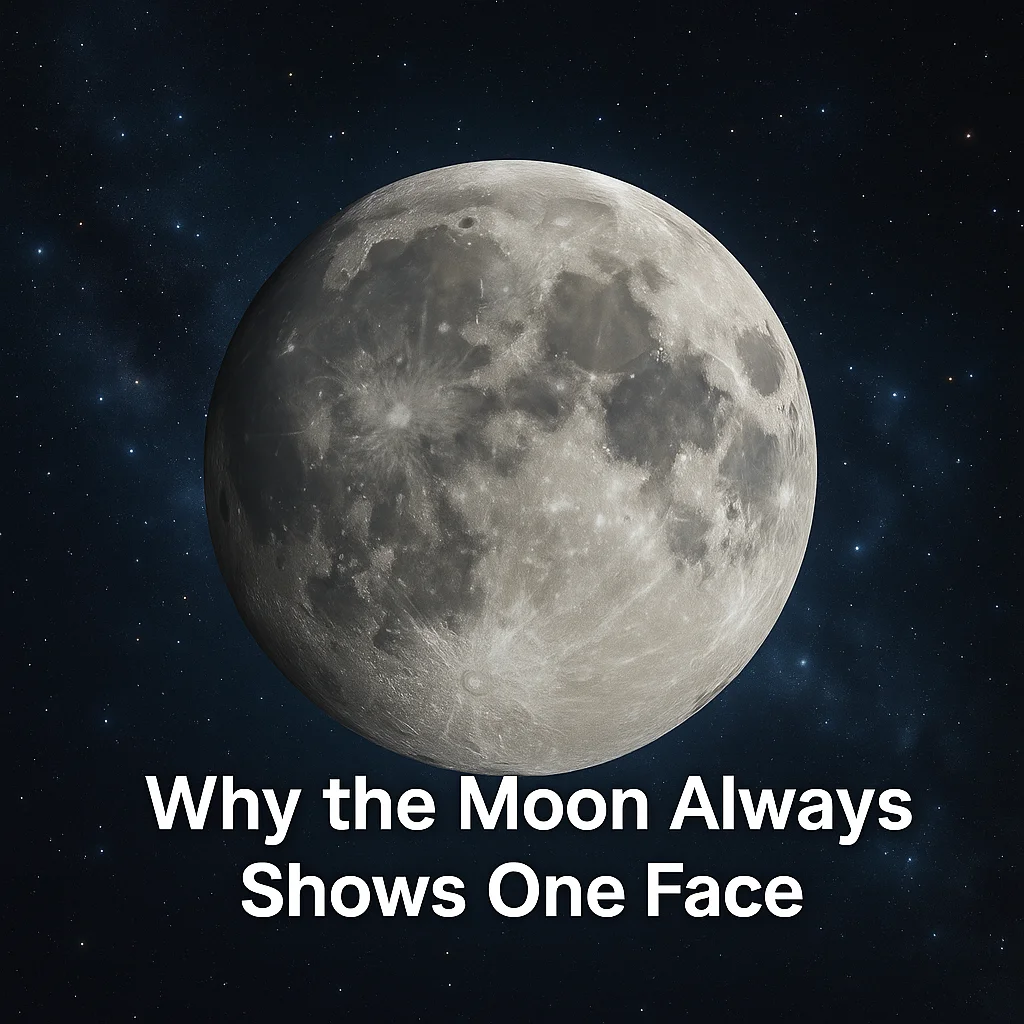
The Moon isn't just a rock floating in space. It's the fifth-largest moon in the solar system and plays a crucial role in influencing Earth's tides. As a rocky body, the Moon is classified as a terrestrial satellite, similar to a planet with a solid, rocky surface.
In this article, you will learn why the Moon always shows the same face to Earth, how its gravity affects us, and what its surface and interior are like. You'll also discover how we've explored the Moon and answered questions about our nearest neighbor.
📍 Where It Is and How Far Away
The Moon is located about 384,400 kilometers (approximately 238,855 miles) from Earth. This distance can vary slightly due to its elliptical orbit, but it remains our closest celestial neighbor. Because of this proximity, the Moon is easily visible in our night sky and plays a significant role in our planet's natural phenomena.
To put this distance into perspective, if you could drive a car straight up into the sky at highway speeds, it would take you a bit more than a week to reach the Moon. Scientists often describe distances in the solar system using astronomical units (AU), where 1 AU is the average distance from Earth to the Sun. The Moon is just a fraction of an AU away.
Being so close to Earth allows the Moon to reflect sunlight onto our planet, affecting Earth’s lighting, tides, and natural rhythms. The Moon's position relative to the Sun affects how much of its surface is illuminated, leading to the cycle of phases we observe each month.
🧱 Size, Mass, and Gravity (Made Simple)
The Moon is about one-quarter the diameter of Earth, making its size more manageable in our sky yet significantly smaller than our planet. It has a diameter of about 3,474 kilometers (or 2,159 miles), which is quite large for a natural satellite.
The mass of the Moon is only about 1/80th of Earth's mass. Despite its relatively small size and mass, the Moon still exerts a gravitational pull strong enough to affect Earth's tides. Its surface gravity is about 1/6th that of Earth's. This means if you weigh 60 kilograms on Earth, you would weigh around 10 kilograms on the Moon.
Due to this reduced gravity, astronauts on the Moon can jump higher and carry heavier loads compared to Earth. However, the Moon's gravity is strong enough to keep it tethered to Earth in a stable orbit.
🌡️ Atmosphere and Weather
The Moon has a very tenuous atmosphere called an exosphere. It's composed of sparse molecules, including helium, neon, and hydrogen. This exosphere is so thin that it wouldn't be considered an atmosphere like Earth's, which means there is virtually no weather on the Moon.
Without a true atmosphere, the Moon does not have clouds or wind. Weather patterns and storms simply don't exist there. This lack of atmosphere also means temperatures on the Moon can swing dramatically between day and night.
During the lunar day, temperatures can soar to 127 degrees Celsius (260 degrees Fahrenheit), while at night, they can plummet to -173 degrees Celsius (-279 degrees Fahrenheit). The absence of an atmosphere leads to these harsh temperature extremes.
🪨 Surface and Interior
The Moon's surface is dotted with craters, the result of billions of years of impacts from comets and asteroids. It also features vast plains called "maria," which are large, dark basaltic areas. These formations were created by ancient volcanic activity.
Other surface features include mountains and valleys, remnants of geological processes long gone. The surface, covered with a fine dust called regolith, reflects sunlight, contributing to the Moon's brightness.
Inside, the Moon lacks the tectonic activity seen on Earth. However, scientists believe it has a layered internal structure, with a small core, a mantle, and a crust composed primarily of oxygen, silicon, magnesium, iron, calcium, and aluminum.
🌀 Rotation, Orbit, and Seasons
The Moon's day, or the time it takes to complete one rotation on its axis, is about 27.3 Earth days, the same time it takes to complete one orbit around Earth. This synchronous rotation is why the same side of the Moon always faces Earth.
The Moon orbits Earth in an elliptical path, which causes its distance from us to change slightly over time. This orbit also results in a wobble effect known as libration, allowing us to sometimes see a bit more than just one hemisphere.
Unlike Earth, the Moon does not have pronounced seasons because its axial tilt is only about 1.5 degrees. In comparison, Earth's tilt is about 23.5 degrees, a significant factor in our planet's seasonal changes.
🧲 Magnetic Field and Radiation
The Moon does not have a global magnetic field like Earth. Instead, it has localized magnetic areas scattered across its surface, remnants of a magnetic field that probably existed billions of years ago.
This lack of a strong magnetic field means the Moon cannot deflect radiation from the Sun, leaving its surface exposed to solar and cosmic radiation. It also affects how certain materials on the surface have been magnetized over time.
The absence of a strong magnetic field impacts spacecraft and astronaut missions, as they need to be shielded from radiation when near or on the Moon's surface.
🌙 Moons, Rings, and Neighbors
The Moon has no natural moons or rings of its own, being Earth's sole natural satellite. Its gravitational interactions with Earth create the tides, showcasing its influence on its host planet despite its solitary nature.
The Moon's effect on tides is due to its gravitational pull on Earth, causing the ocean levels to rise and fall. This gravitational connection also stabilizes Earth's axial tilt, which is crucial in maintaining our climate patterns.
While the Moon is alone in its orbit around Earth, its interaction with our planet is a defining feature of our solar system's dynamics, making it an essential companion to Earth.
🔭 How We Know (Missions and Observations)
Much of what we know about the Moon comes from telescopic observations and lunar missions. Before spaceflight, telescopes on Earth were our primary tools, allowing us to view its surface and phases.
With the advent of space exploration, the Apollo missions in the 1960s and 1970s played a pivotal role in expanding our understanding. These missions provided not only stunning photographs and videos but also samples of lunar rocks and soil.
Modern unmanned missions and orbiters, such as NASA's Lunar Reconnaissance Orbiter, continue to map the Moon's surface and gather valuable data about its composition, gravity, and temperature variations.
❓ Common Questions and Misconceptions
Many people wonder if the Moon is a star. It is not; the Moon is a rocky body reflecting the Sun's light. Stars, on the other hand, are massive, glowing gas spheres producing their own light.
Another question often asked is whether you can stand on the Moon. Yes, though you need a pressure suit to survive the lack of air and extreme temperatures.
Some believe the Moon has weather like Earth. However, without a significant atmosphere, the Moon does not experience weather patterns, rain, or wind.
Is the Moon habitable? Currently, its lack of air and water makes it inhospitable for human life as we know it.
People often ask why the Moon is gray. Its color comes from the minerals in the rocks and dust on its surface, which reflect sunlight in a way that gives off a grayish appearance.
Finally, a common misconception is that the Moon doesn't rotate. It does rotate, but because its rotation period matches its orbit around Earth, we only see one face.
📌 Summary
- The Moon is Earth’s only natural satellite, always showing one face due to tidal locking.
- Located about 384,400 km from Earth, it affects our tides and climates.
- Smaller than Earth, with 1/6th its gravity, influencing how things feel on the Moon.
- Has a thin exosphere, causing extreme temperature changes without weather.
- Features craters and volcanic plains, with a solid core and mantle.
- Completes a rotation and orbit in 27.3 days, leading to synchronous rotation.
- Lacks a strong magnetic field, exposing its surface to radiation.
- No rings or smaller moons, but powerful tidal interactions with Earth.
- Knowledge from telescopic observations and space missions like Apollo.
- The Moon is gray due to its surface minerals, not habitable, nor a star.