🪐 Europa Facts for Beginners
🌌 What It Is
Europa is one of the intriguing moons orbiting Jupiter, the largest planet in our Solar System. Known for its icy surface and potential subsurface ocean, Europa has captured the interest of scientists and space enthusiasts alike. As the fourth-largest moon of Jupiter, it stands out due to its smooth, icy crust.
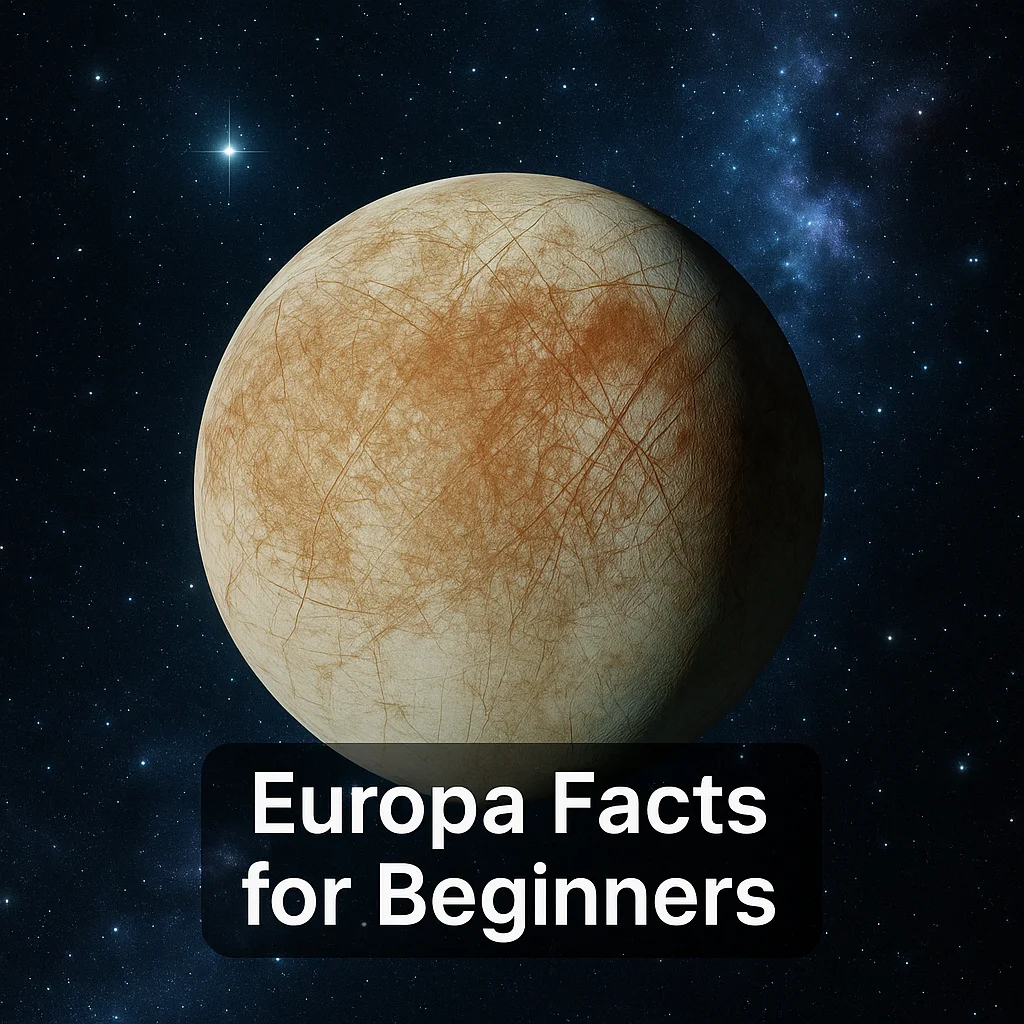
Europa is often classified as an icy moon because of its thick ice cover that might conceal a vast ocean beneath. This ocean is thought to harbor more water than all of Earth's oceans combined. Scientists believe studying Europa could help us understand more about the potential for life elsewhere in our Solar System.
This article will guide you through the essential facts about Europa, including its location, size, atmosphere, surface features, and much more. By the end, you'll have a solid understanding of why this moon is a major target for future space missions.
📍 Where It Is and How Far Away
Europa is located in the Solar System and orbits around Jupiter, the fifth planet from the Sun. Positioned as the sixth-closest moon to Jupiter, it completes an orbit every 3.5 Earth days. Europa is part of a group of moons known as the Galilean moons, named after the astronomer Galileo Galilei who discovered them in 1610.
Europa is about 484 million miles from Earth on average, which varies as both planets move in their respective orbits. If we measure this distance in astronomical units (AU), where one AU represents the average distance from Earth to the Sun, Europa is roughly 5.2 AU away from the Sun.
Being so far from the Sun means Europa receives much less sunlight than Earth does. Temperatures on Europa are extremely cold, averaging around minus 260 degrees Fahrenheit (minus 160 degrees Celsius). The moon's icy surface reflects much of the sunlight, giving it a bright appearance when viewed from space.
🧱 Size, Mass, and Gravity (Made Simple)
Europa is slightly smaller than Earth's Moon, with a diameter of about 1,940 miles (3,100 kilometers). Despite its smaller size, its mass is substantial enough to give it a gravitational pull that is about 13% of Earth's gravity. This means that objects on Europa would weigh significantly less than they do on Earth.
If you could stand on Europa—hypothetically, since it's entirely covered in ice—you would experience a weak gravitational pull, enough to feel a little lighter, similar to how astronauts feel on the Moon. However, remember that Europa's surface is not solid ground but a thick ice sheet, which might conceal an ocean below.
The combination of size and gravity makes Europa an interesting object to study, as it provides clues about its internal composition and the potential for sustaining life beneath its icy exterior.
🌡️ Atmosphere and Weather
Europa has a very thin atmosphere composed mostly of oxygen, but it is far too sparse to support human or Earth-like life. Unlike Earth's atmosphere, Europa's lacks the density to retain heat, contributing to its extremely cold surface temperatures.
There are no substantial clouds or weather systems like those on Earth. However, the interaction between Jupiter's magnetic field and Europa's surface creates fascinating phenomena, such as the potential for auroras near Europa's poles.
Weather patterns as we know them on Earth don't exist on Europa due to its lack of a significant atmosphere. This absence of weather allows the icy surface to remain relatively unchanged over long periods, except for occasional resurfacing events caused by internal ocean activity.
🪨 Surface and Interior
Europa's surface is one of the smoothest in the Solar System, characterized by a thick layer of ice. The ice crust features an array of cracks and streaks, which are believed to be caused by tidal flexing, resulting from its close orbit around massive Jupiter.
Beneath the icy crust, scientists believe there is a liquid water ocean, kept warm by heat generated from tidal forces. This ocean could potentially harbor life, similar to some microbial life forms found in extreme environments on Earth.
The interior of Europa is thought to consist of a rocky mantle and an iron core, similar to what we find in terrestrial planets like Earth. This structure suggests a differentiated interior, meaning that its materials are organized into distinct layers.
🌀 Rotation, Orbit, and Seasons
Europa is in synchronous rotation with Jupiter, meaning one side of Europa always faces Jupiter, much like the same side of the Moon always faces Earth. Europa's orbit around Jupiter takes about 3.5 days, and in that time, it rotates once on its axis.
Because its axial tilt is minimal, Europa doesn't experience significant seasonal changes like Earth does. The moon's constant position relative to the Sun and Jupiter ensures that its surface remains consistently and extremely cold.
As Europa orbits Jupiter, it experiences intense gravitational pull from the planet, leading to significant tidal forces. These forces create heat through friction, maintaining the liquid state of its subsurface ocean despite the far distance from the Sun.
🧲 Magnetic Field and Radiation
Europa itself does not have a significant magnetic field. However, it interacts with Jupiter's powerful magnetic field, which induces a faint magnetic field within Europa. This interaction provides vital clues about the composition and structure of its interior, particularly the subsurface ocean.
Radiation from Jupiter presents a challenge for missions to Europa, as intense radiation belts surround the planet. Any spacecraft visiting Europa must be carefully shielded to withstand the harsh radiation environment.
The presence of induced magnetic fields and radiation affects both the moon's atmosphere and surface. Scientists study these effects to learn more about Europa's potential habitability and its ability to protect a hidden ocean.
🌙 Moons, Rings, and Neighbors
Europa does not have any moons or rings of its own. However, it is a part of the Galilean moons of Jupiter, a group of four large moons discovered by Galileo. These moons—Io, Europa, Ganymede, and Callisto—each have unique features and properties.
Europa's gravitational interactions with its neighboring moons and Jupiter create a remarkable system of resonances. These interactions influence its orbital shape and speed, helping maintain the tidal heating that keeps its ocean liquid beneath the surface.
The lack of moons and rings makes Europa distinct among the Galilean moons, each having its own complex relationship with Jupiter and the surrounding space environment. Europa's simplicity in terms of companions makes its internal and surface dynamics even more intriguing.
🔭 How We Know (Missions and Observations)
Much of what we know about Europa comes from spacecraft that have studied the Jupiter system. Pioneer and Voyager missions first imaged Europa in the 1970s. Later, the Galileo spacecraft provided detailed photographs and data about Europa's surface and possible ocean beneath.
More recently, missions like the Hubble Space Telescope have offered supportive evidence of water-vapor plumes ejecting from Europa's surface, suggesting active geological processes. These observations have sparked further interest in sending dedicated missions to explore Europa's potential for life.
Upcoming missions like NASA's Europa Clipper, set to launch in the 2020s, aim to conduct detailed reconnaissance of Europa's ice shell and subsurface ocean, offering even more insights into this intriguing moon.
❓ Common Questions and Misconceptions
Is Europa a planet? No, Europa is one of Jupiter's largest moons, not a planet.
Can you stand on Europa? Technically, you could stand on its surface ice, but it's extremely cold and airless.
Is Europa habitable? While the surface is inhospitable, the subsurface ocean might support microbial life.
Why is Europa's surface so smooth? Its icy crust has been resurfaced by liquid water from beneath, smoothing out craters.
Does Europa have an atmosphere? It has a very thin atmosphere made largely of oxygen, not breathable by humans.
Why is Europa icy? It's far from the Sun, so water on its surface remains frozen.
What gives Europa its streaks? The streaks are cracks in the ice, likely caused by tidal forces and possible subsurface shifts.
How was Europa discovered? Galileo Galilei discovered Europa in 1610 using a telescope.
Why study Europa? Its potential ocean and compatibility with life make it a key focus for astrobiology.
Is there volcanic activity on Europa? Not like Io, but heat from tidal forces may allow for water plumes or ice movement.
📌 Summary
- Europa is one of Jupiter's moons, part of the Galilean group.
- Situated 5.2 AU from the Sun, Europa orbits Jupiter every 3.5 days.
- It's smaller than Earth's Moon with a gravitational pull of 13% that of Earth.
- Europa's atmosphere is thin and largely composed of oxygen gas.
- Its surface is covered with ice, possibly hiding an ocean beneath.
- Europa is in synchronous rotation with Jupiter, having minimal seasonal change.
- No intrinsic magnetic field but influenced by Jupiter's magnetism.
- Europa lacks rings or moons of its own but serves as a gravitational partner to others.
- Information about Europa comes from spacecraft missions like Voyager and Galileo.
- Europa's ice and potential ocean make it a promising candidate for studying life beyond Earth.