🪐 How Jupiter Shapes Its Moons
🌌 What It Is
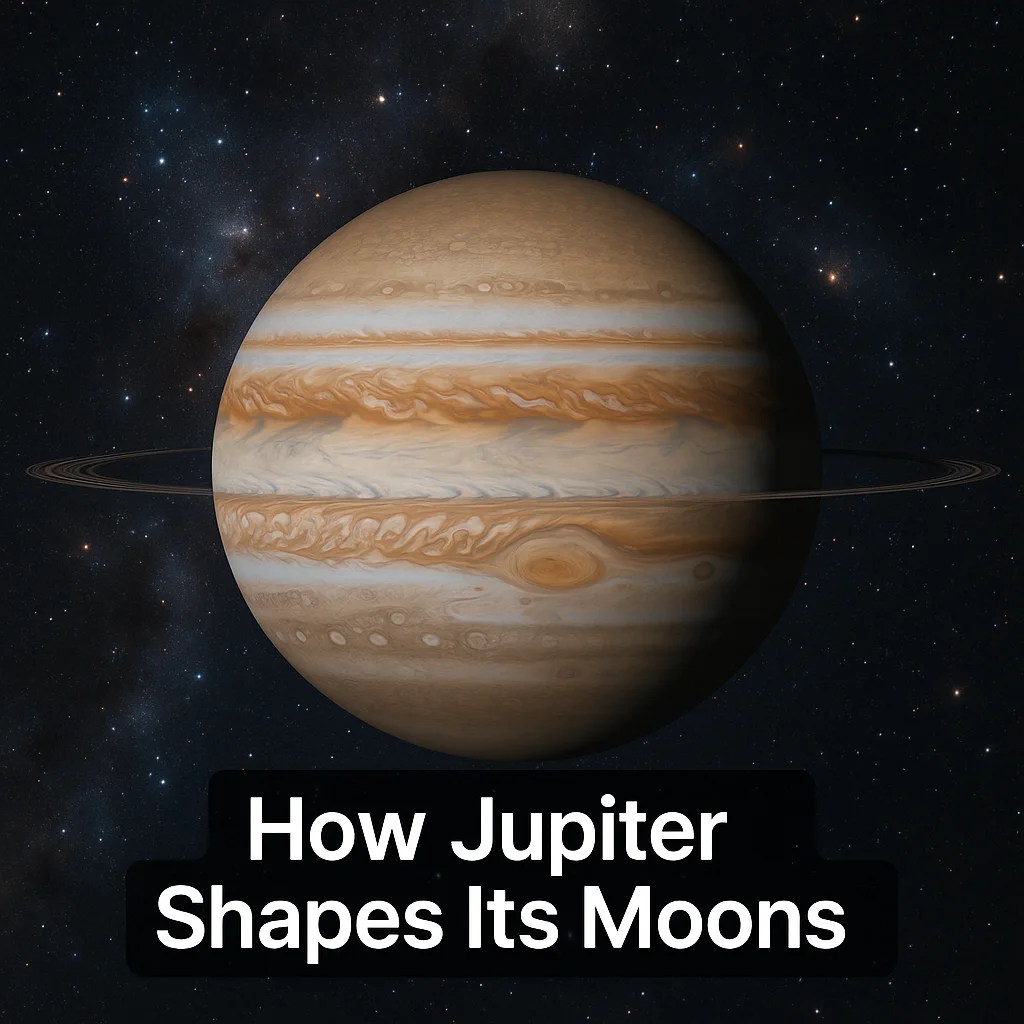
Jupiter is the largest planet in our Solar System and is classified as a gas giant. Unlike terrestrial planets such as Earth, Jupiter lacks a solid surface and is primarily composed of hydrogen and helium. Being a gas giant, it has a massive atmosphere and formidable gravity that influence not only its environment but also its numerous moons.
In this article, we’ll explore how Jupiter’s immense size and gravity affect its moons, what makes each moon unique, and how they’ve become a focal point of study for scientists aiming to understand our Solar System better.
The planet itself is often referred to as a mini solar system due to the complex interactions it has with its moons and its extensive magnetic field. This makes Jupiter a fascinating object of study not just for planetary science but also for understanding how celestial bodies interact with each other.
📍 Where It Is and How Far Away
Jupiter is the fifth planet from the Sun, located between the asteroid belt and the outer planets like Saturn, Uranus, and Neptune. It's about 484 million miles (778 million kilometers) from the Sun. To give you a sense of this distance, light from the Sun takes more than 40 minutes to reach Jupiter, whereas it takes only about 8 minutes to reach Earth.
This significant distance from the Sun means that sunlight reaching Jupiter is only about 4% as strong as the sunlight that illuminates Earth. Jupiter's position affects its temperature, making it much colder than the inner planets, with average temperatures plunging far below freezing.
The sheer size of the planet, which is more than 11 times the diameter of Earth, allows it to wield intense gravitational effects on its moons and even the space around it. This gravitational dominance is a central theme in how Jupiter shapes its moons.
🧱 Size, Mass, and Gravity (Made Simple)
Jupiter’s size and mass are staggering. It has a diameter of about 86,881 miles (139,822 kilometers), making it the largest planet in our Solar System. Its mass is approximately 318 times that of Earth, and this immense mass contributes to its significant gravitational pull.
This gravity essentially "pulls" its moons into stable orbits, influencing their positions and trajectories. Because it is a gas giant, Jupiter does not have a solid surface where you could "stand." If you could, its surface gravity would feel about 2.5 times stronger than Earth's, meaning a person weighing 100 pounds on Earth would feel like they weigh 250 pounds on Jupiter.
The lack of a solid surface is critical for understanding how the planet interacts with its moons, as the gravitational forces extend through space, creating complex dynamics.
🌡️ Atmosphere and Weather
Jupiter's atmosphere is a turbulent marvel, composed mainly of hydrogen and helium. The striking bands and zones that circle the planet are a result of strong winds, which can reach speeds of up to 384 miles per hour (618 kilometers per hour). This is significantly faster than any wind found on Earth.
The planet is famous for its Great Red Spot, a gigantic storm that has likely been raging for hundreds of years. This storm is so large that it could envelop Earth with room to spare. Scientists believe the planet’s rapid rotation—completing one day in just about 10 hours—contributes to these weather patterns.
The high-speed rotation generates strong jet streams, separating the atmosphere into different latitudinal bands. These atmospheric conditions play a significant role in how the planet's moons interact with Jupiter, especially when it comes to gravitational forces.
🪨 Surface and Interior
Unlike terrestrial planets, Jupiter is composed mostly of hydrogen and helium and lacks a true solid surface. If you were to descend through the atmosphere, you would eventually reach thick layers of liquid hydrogen, which acts more like a deep ocean than a solid ground.
Beneath this lies a layer of metallic hydrogen, which conducts electricity and generates the planet’s powerful magnetic field. At the center, scientists believe there might be a solid core, made up of heavier elements, about the size of Earth.
This interior structure influences the gravitational fields that extend far into space, affecting not just the planet itself but also the movement and the behavioral patterns of its moons.
🌀 Rotation, Orbit, and Seasons
Jupiter rotates very quickly around its axis, with a day lasting roughly 10 hours. Despite this rapid rotation, it takes about 12 Earth years for Jupiter to complete one orbit around the Sun. This slow orbit results in long seasons compared to Earth.
The planet’s axial tilt is relatively small, at just 3 degrees, which means it doesn’t have significant seasonal changes like Earth does. Instead, the environment remains relatively consistent throughout its orbit.
These rotational dynamics impact not only Jupiter’s weather patterns but also influence the complex gravitational interactions it has with its moons.
🧲 Magnetic Field and Radiation
Jupiter has the strongest magnetic field of any planet in the Solar System, generated by the motion of metallic hydrogen inside. This magnetic field extends far beyond the planet itself, enveloping many of its moons and creating intense radiation belts similar to Earth's Van Allen belts.
These belts can be hazardous for both spacecraft and potential human visitors. The strong magnetic fields also result in spectacular auroras at Jupiter’s poles, similar to the Northern and Southern Lights on Earth but much more powerful and extensive.
The magnetic field and radiation environment are crucial for understanding how Jupiter interacts with its moons and for planning any future missions to the Jovian system.
🌙 Moons, Rings, and Neighbors
Jupiter has 79 known moons, with the four largest being the Galilean moons: Io, Europa, Ganymede, and Callisto. These moons are fascinating worlds in their own right, each offering unique features such as volcanic activity on Io or the subsurface ocean of Europa, which could harbor life.
Jupiter’s gravity significantly affects these moons, creating tidal forces that can cause heating and geological activity, especially noticeable on the volcanically active Io. These interactions create a dynamic and continuously changing system.
In addition to its moons, Jupiter also has a faint ring system made of small particles, dust, and ice. Though not as prominent as Saturn's rings, they are an intriguing aspect of Jupiter's diverse environment.
🔭 How We Know (Missions and Observations)
Our understanding of Jupiter has been significantly advanced through observations made by telescopes, as well as spacecraft missions such as the Galileo and Juno missions. Telescopes offer insight into atmospheric changes, surface conditions on the moons, and shifts in magnetic fields.
The Galileo spacecraft provided a wealth of data on the Jovian system, especially about its moons. More recently, the Juno mission has been orbiting Jupiter, giving us unprecedented insights into its atmosphere and interior structure.
Each mission provides different types of data. For instance, telescopes can capture images and spectra from afar, while spacecraft can measure gravitational and magnetic forces up-close, offering deeper insights into this giant planet's role in the Solar System.
❓ Common Questions and Misconceptions
Is Jupiter a star? No, Jupiter is not a star. While it is massive, it lacks the necessary mass to ignite nuclear fusion.
Can you stand on Jupiter? No, you cannot stand on Jupiter because it doesn’t have a solid surface.
Is Jupiter habitable? It's unlikely due to its hostile gas environment, but some of its moons, like Europa, may have conditions suitable for life.
Why is Jupiter so colorful? The colors come from different chemical compounds in its atmosphere, such as ammonia and methane, interacting with sunlight.
Does Jupiter have seasons? Not really; its tilt is very small, leading to minimal seasonal variation.
Why doesn’t Jupiter have large rings like Saturn? Jupiter has rings, but they are made of smaller, lighter particles, making them less visible.
What are the Great Red Spot and the white ovals? The Great Red Spot is a massive storm, while white ovals are smaller storms, all part of Jupiter's dynamic weather system.
📌 Summary
- Jupiter is the largest gas giant in our Solar System.
- Located beyond Mars, it’s 484 million miles away from the Sun.
- The planet’s immense gravity affects its 79 known moons.
- Jupiter’s atmosphere is made of hydrogen and helium with fast winds and storms.
- Lacking a solid surface, its interior consists of liquid and metallic hydrogen.
- Jupiter rotates every 10 hours, completing an orbit every 12 years.
- It has a powerful magnetic field, creating strong radiation belts.
- The Galilean moons offer diverse geological characteristics.
- Space missions like Galileo and Juno have enhanced our understanding.
- Despite being a gas giant, Jupiter’s influence extends to a mini solar system of moons.