🪐 Io Facts for Beginners
🌌 What It Is
Io is one of the fascinating moons orbiting the planet Jupiter, known for its extreme geological activity. As a natural satellite, it's considered the most volcanically active body in the entire solar system.
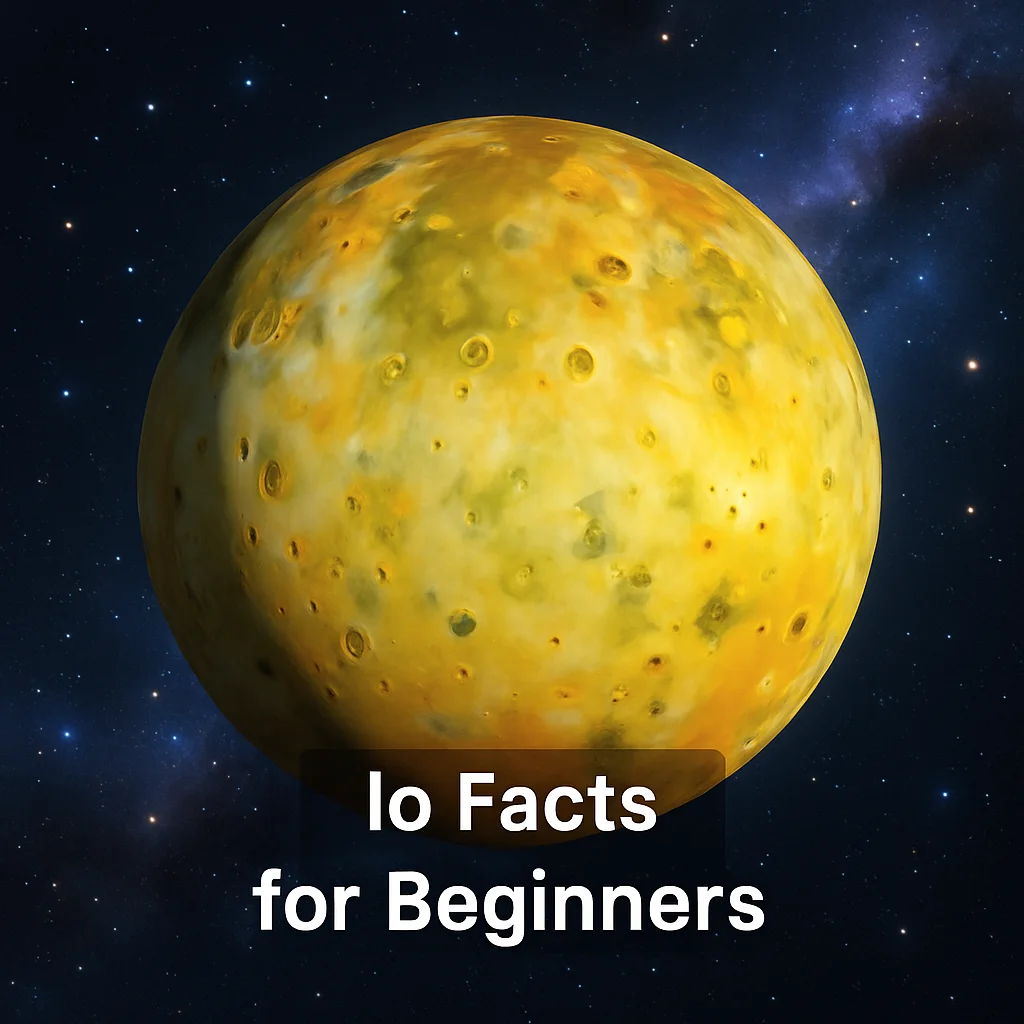
This moon is one of the four Galilean moons, the others being Europa, Ganymede, and Callisto; they were discovered by Galileo Galilei in 1610. They are the largest of Jupiter's moons and are named after characters associated with the Roman god Jupiter.
In this article, you'll learn about Io's position in the solar system, its unique surface, atmosphere, and other intriguing facts that make it a fascinating object of study for scientists and space enthusiasts.
📍 Where It Is and How Far Away
Io is situated in the solar system as one of the major moons of Jupiter, the fifth planet from the Sun. It orbits Jupiter, which itself orbits the Sun, making Io about 484 million miles from the star at the center of our solar system.
To put that distance into context, sunlight takes about 43 minutes to travel from the Sun to Jupiter. This vast distance affects the amount of sunlight Io receives, resulting in much lower daylight levels compared to Earth.
Io's position in relation to Jupiter means it experiences significant gravitational forces, which contribute to its intense volcanic activity. These forces generate heat within Io, further affecting its environmental conditions.
🧱 Size, Mass, and Gravity (Made Simple)
Io is approximately 2,264 miles in diameter, making it slightly larger than Earth's moon. Despite this size, Io's mass is about one-eighth that of Earth's moon due to its lower density.
The gravity on Io is about 0.18 times the gravity on Earth. This means that a person weighing 100 pounds on Earth would weigh only 18 pounds on Io, offering a vastly different experience from the gravitational pull we feel here.
Although it has a solid surface, Io's environment and gravity are dramatically different from those on Earth, mainly due to its volcanic nature and proximity to the massive planet Jupiter.
🌡️ Atmosphere and Weather
Io's thin atmosphere is composed mainly of sulfur dioxide, a compound commonly associated with volcanic activity. The atmosphere is continuously replenished by gases emitted from its numerous volcanoes.
Unlike Earth, Io lacks significant weather systems. The combination of its thin atmosphere and low temperatures means that weather patterns as we understand them don’t really occur here.
Temperature variations on Io are extreme. Its surface temperature is frigid, averaging around minus 202 degrees Fahrenheit. However, near its volcanic eruptions, temperatures can skyrocket significantly, contributing to the diverse conditions found across the moon's surface.
🪨 Surface and Interior
Io's surface is unlike any other in the solar system, with hundreds of active volcanoes, some of which spew sulfur gases hundreds of miles into space. These eruptions are visible from orbit and give Io its distinctive yellow, red, and orange coloration.
The intense geological activity continually reshapes the moon’s surface, with old volcanic features being covered by newer lava flows. Io lacks impact craters, as these features are quickly buried by volcanic activity.
Beneath its surface lies a partially molten interior, influenced by the gravitational tug from Jupiter and the other Galilean moons. This internal structure is responsible for the moon's persistent volcanism.
🌀 Rotation, Orbit, and Seasons
Io has a synchronous rotation, meaning it always shows the same face to Jupiter, similar to how our Moon always shows the same face to Earth. One complete rotation takes about 1.8 Earth days, the same time it takes to orbit Jupiter once.
This synchronization results in no noticeable seasonal changes since different parts of Io are not exposed to varying amounts of sunlight throughout its orbit.
The interaction between Io's orbit, Jupiter’s immense gravity, and the other moons result in orbital resonances, which help sustain its volcanic activity by generating internal heat through tidal forces.
🧲 Magnetic Field and Radiation
Io does not have its own global magnetic field. However, it influences Jupiter’s magnetosphere, as this massive planet exerts a strong magnetic influence over Io.
The interaction between Io and Jupiter’s magnetic field results in Io’s auroras, visible as bright spots where magnetic field lines intersect the moon’s atmosphere.
Due to this interaction, Io’s surface is subject to intense radiation from Jupiter’s magnetic field, posing significant challenges for potential spacecraft that visit or observe this moon closely.
🌙 Moons, Rings, and Neighbors
Io is part of a celestial family that includes the other Galilean moons: Europa, Ganymede, and Callisto, with Jupiter acting as their dominating neighbor.
These moons have a gravitational influence on each other, creating resonances that affect their orbits and activity. This gravitational interplay is partly responsible for Io's extreme volcanism.
Io does not have any moonlets or rings of its own, as the moon is primarily known for its volcanic activity rather than additional celestial bodies orbiting it.
🔭 How We Know (Missions and Observations)
Our knowledge about Io comes from a combination of ground-based telescopic observations and data from various space missions. NASA’s Galileo spacecraft, which orbited Jupiter from 1995 to 2003, provided detailed insights into Io’s surface and geological activity.
Images and spectra taken by the Hubble Space Telescope and other observatories have also contributed to our understanding of Io’s atmosphere and volcanic processes. These tools capture data in multiple wavelengths, revealing details that are invisible to the naked eye.
Each mission and observation further refines our understanding of Io by analyzing its surface features, volcanic plumes, temperature variations, and interaction with Jupiter’s magnetic field.
❓ Common Questions and Misconceptions
Is Io a star? No, Io is a moon, one of Jupiter’s four large Galilean moons. It's not a star, which is a massive, luminous sphere of burning gas.
Can you stand on Io? Technically, you could stand on Io as it has a solid surface. However, the intense volcanic activity and radiation would make it extremely hazardous.
Is Io habitable? Io is not considered habitable due to its extreme volcanic activity, high radiation levels, and frigid temperatures.
Why is Io so colorful? Io's vibrant colors stem from sulfur and its compounds, which are spread across the surface by volcanic activity.
Does Io have an atmosphere like Earth's? Io’s atmosphere is very thin and primarily consists of sulfur dioxide, unlike the breathable mix found on Earth.
Does Io have water? Unlike some of Jupiter’s other moons, Io lacks significant water ice on its surface due to its proximity to Jupiter, which causes the disappearance of lighter elements.
What causes Io’s volcanoes? The intense gravitational pull from Jupiter and neighboring moons generates tidal heating, melting Io's interior and fueling its volcanoes.
Does Io have seasons? No, Io doesn’t experience seasons as its synchronous rotation means the same side always faces Jupiter, and its axial tilt is minimal.
📌 Summary
- Io is one of Jupiter's Galilean moons and the most volcanically active body in the solar system.
- It orbits Jupiter, about 484 million miles from the Sun.
- Io is slightly larger than Earth's moon, with gravity that is nearly one-fifth of Earth's.
- The thin atmosphere is made mostly of sulfur dioxide, and weather patterns as we know them are absent.
- Volcanic features dominate Io's surface, reshaped continually by eruptions.
- Io has a synchronous rotation with an orbital period of 1.8 Earth days, leading to gravitational interactions.
- While it lacks a magnetic field, it influences Jupiter’s and is affected by intense radiation.
- Io is one of several moons orbiting Jupiter and lacks its own moons or rings.
- Major discoveries about Io have come from spacecraft like Galileo and observations from telescopes.
- One memorable fact: Io's bright colors come from sulfur compounds deposited by its active volcanoes.