🪐 Saturn’s Moons Overview: The Biggest Highlights
🌌 What It Is
Saturn is a spectacular gas giant and the sixth planet from the Sun in our Solar System. Known for its stunning ring system, Saturn is a fascinating world that also boasts an incredible collection of moons. Saturn's moons range from tiny moonlets to some of the largest natural satellites in the Solar System.
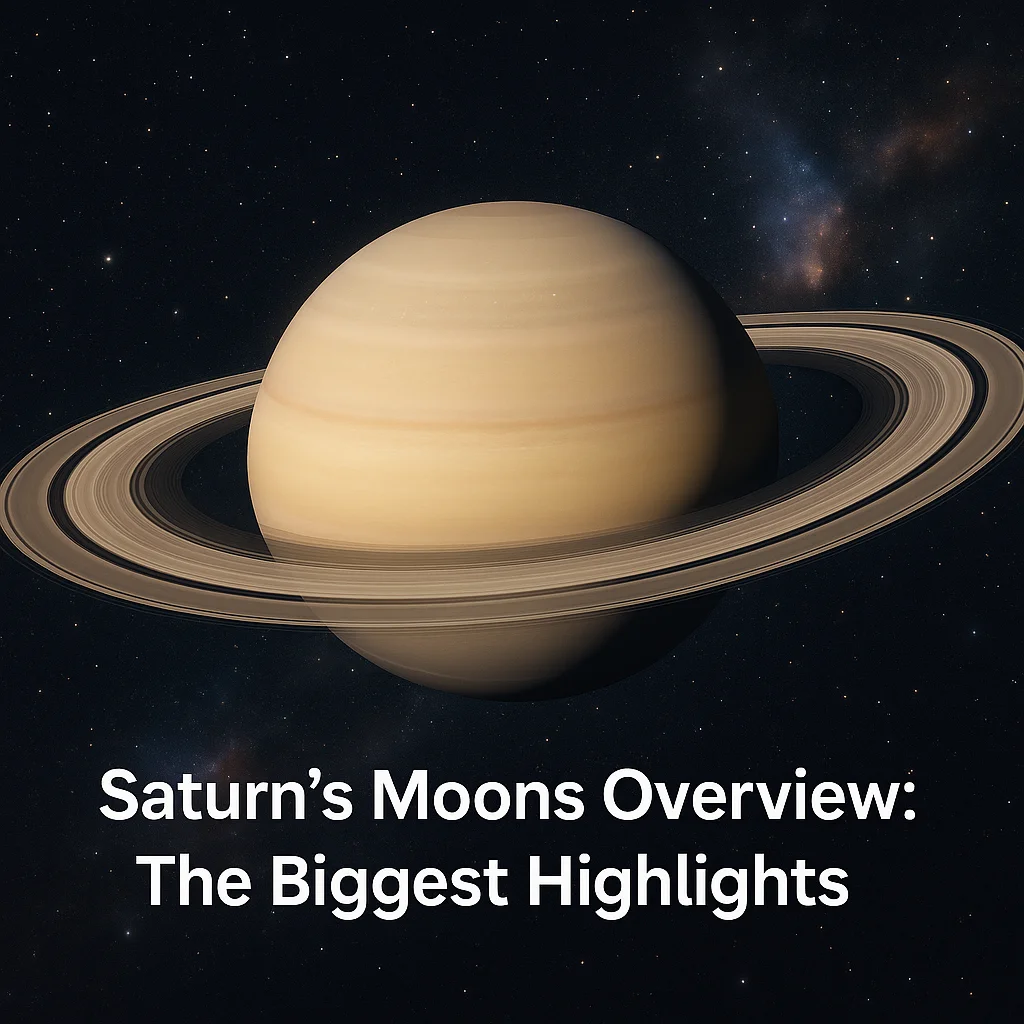
The planet itself is classified as a gas giant, meaning it's primarily composed of hydrogen and helium, unlike the rocky terrestrial planets such as Earth and Mars. Saturn, along with Jupiter, Uranus, and Neptune, belongs to the outer planets located beyond the asteroid belt.
In this article, you will learn about the most significant highlights of Saturn's moons, focusing on their varied characteristics, uniqueness, and what they reveal about our Solar System.
📍 Where It Is and How Far Away
Saturn resides in the outer region of our Solar System, positioned as the sixth planet from the Sun. It's considerably further from the Sun than Earth, lying on average about 1.4 billion kilometers (or approximately 886 million miles) away. This vast distance makes Saturn nearly 9.5 astronomical units from the Sun, where one astronomical unit is the average distance from Earth to the Sun.
The planet's distance influences the amount of sunlight it receives, resulting in much colder temperatures than those experienced on Earth. The reduced solar energy reaching Saturn influences the environmental conditions of its moons as well, affecting their potential habitability and surface conditions.
This vast distance also means light from Saturn takes a significant amount of time to reach Earth. This distance and its position in the Solar System add a layer of complexity to both observing and exploring these distant moons.
🧱 Size, Mass, and Gravity (Made Simple)
Saturn is an immense planet, second only to Jupiter in terms of size and mass within our Solar System. This giant measures about 120,000 kilometers (around 75,000 miles) in diameter, over nine times wider than Earth. Despite its enormous size, Saturn has a relatively low density due to its gaseous composition.
While Saturn’s gravity is stronger than Earth's because of its size, its pull at the cloud tops is just slightly greater due to the planet's low density. This means a person standing on a hypothetical surface in Saturn's upper atmosphere would weigh only a little more than they would on Earth.
Without a solid surface to stand on, gravity on Saturn is calculated differently from that on terrestrial planets. The gas giant's swirling atmosphere creates a unique environment where gravity's effects are felt ‘in the air,’ affecting everything from its tenacious and expansive rings to its numerous moons.
🌡️ Atmosphere and Weather
The atmosphere of Saturn is primarily composed of hydrogen and helium, much like that of Jupiter. Trace amounts of methane, ammonia, and ice particles contribute color and character to its clouds. The upper atmosphere showcases bands of clouds that are driven by high-speed winds.
Weather on Saturn is mainly characterized by these strong winds, often reaching speeds of up to 1,800 kilometers (about 1,118 miles) per hour near the equator. This makes Saturn's winds some of the fastest in the Solar System. The planet also experiences phenomena such as long-lasting storms and massive hexagonal weather patterns at its poles.
Overall, Saturn's weather is influenced by both the energy from the Sun and the planet's own internal heat, which drives convection currents within its cloud layers. The intricate weather systems on Saturn add to the dynamic nature of its moons, affecting their climates and surfaces in various ways.
🪨 Surface and Interior
Unlike Earth, Saturn lacks a solid surface. As a gas giant, it has no definite boundary where gaseous atmosphere ends and the core begins. Instead, the planet exhibits layers that become denser and hotter below the cloud tops.
Deep within Saturn, scientists hypothesize the presence of a core composed of heavier elements, possibly surrounded by layers of metallic hydrogen. These inner layers are enveloped by molecular hydrogen and helium, forming the visible atmospheric bands.
Saturn’s lack of a solid surface affects its moons significantly, as none of them can be held directly accountable for interacting with a planetary surface. Instead, the moons operate under the influence of the planet's gravitational pull and dynamic atmospheric conditions.
🌀 Rotation, Orbit, and Seasons
Saturn has an extremely brisk rotation, completing one full spin on its axis roughly every 10.7 hours. This rapid rotation causes a noticeable flattening at the poles and a bulging at the equator. The planet completes its orbit around the Sun in approximately 29.5 Earth years.
Saturn's axis is tipped slightly, approximately 26.7 degrees to its orbital plane, giving it seasons. This axial tilt causes differing sunlight exposure as Saturn orbits the Sun, leading to seasonal variations over long periods.
Despite its distance from the Sun, these seasons still influence Saturn's moons, affecting temperatures and perhaps influencing geysers or other geological activity in specific moons like Enceladus.
🧲 Magnetic Field and Radiation
Saturn has a substantial magnetic field, though not as strong as Jupiter's. Generated by its internal rotation and possibly liquid metallic hydrogen layer, this field extends well beyond the planet, influencing its moons.
The magnetic field shields Saturn from solar wind but also creates auroras visible in ultraviolet light. These auroras differ from Earth's due to the distinct atmospheric composition and magnetic field characteristics.
The radiation belts within this magnetic realm affect spacecraft traveling through and around Saturn, requiring robust shielding and careful mission planning.
🌙 Moons, Rings, and Neighbors
Saturn is renowned for its captivating rings composed of ice particles, rocky debris, and dust. However, what truly sets it apart is its collection of over 80 moons, some of which are remarkably unique and intriguing.
Titan, Saturn's largest moon, stands out with its thick atmosphere and possible lakes of liquid methane on its surface. Enceladus captures interest with its geysers ejecting water vapor, suggesting a subsurface ocean beneath its icy crust.
These moons, in conjunction with the broad and brilliant ring system, narrate a tale of gravitational interactions and resonance, making Saturn an incredibly dynamic celestial stage.
🔭 How We Know (Missions and Observations)
Human understanding of Saturn and its moons has expanded significantly through the use of advanced telescopes and dedicated spacecraft missions. Observations began with telescopes in the 17th century, providing initial glimpses of its rings and larger moons.
The arrival of spacecraft such as Pioneer 11 and the Voyager missions revealed more details. However, it was the Cassini-Huygens mission that truly transformed our knowledge. Launched in 1997, Cassini spent 13 years studying Saturn, its rings, and moons, sending back invaluable data about their composition and behavior.
Through data collected from missions and telescopic observations, we gain insights about Saturn in terms of gravity measurements, magnetic readings, and direct sampling of moons' materials, enhancing our comprehension of this vast system.
❓ Common Questions and Misconceptions
Is Saturn a star? No, Saturn is not a star. It is a planet made predominantly of gas and does not produce light on its own.
Can you stand on Saturn? You cannot stand on Saturn, as it lacks a solid surface. The 'surface' is made of gases, transitioning into denser materials.
Is Saturn habitable? Saturn itself is not habitable due to its gaseous composition and harsh conditions. However, some moons like Titan and Enceladus are considered for potential habitability studies.
Why is Saturn that color? Saturn appears yellowish due to ammonia crystals in its upper atmosphere, which reflect sunlight in that spectrum.
Do all moons have atmosphere? Not all of Saturn's moons have atmospheres. The most notable exception is Titan, which possesses a thick atmosphere rich in nitrogen.
Is Saturn the largest planet? Saturn is the second-largest planet in the Solar System after Jupiter in terms of mass and size.
Are Saturn's rings permanent? Saturn's rings are long-lasting but not permanent. Over time, they could dissipate due to gravitational interactions and icy particle dispersion.
Could we live on a moon? Some of Saturn's moons, particularly Titan, have conditions that could support life in some form, making them subjects of intense scientific interest.
📌 Summary
- What it is: Saturn is a gas giant, known for its striking rings and extensive moon system.
- Where it is: Sixth planet from the Sun, orbiting about 1.4 billion kilometers away.
- Size/gravity takeaway: Second-largest in the Solar System with gravity slightly stronger than Earth's.
- Atmosphere/weather: Predominantly hydrogen and helium, dynamic with high-speed winds.
- Surface/interior: No solid surface; layers of gases and possible solid core.
- Orbit/rotation: Rotates every 10.7 hours, orbit takes about 29.5 Earth years.
- Magnetic/radiation: Powerful magnetic field, contributing to auroras and radiation belts.
- Moons/rings: Over 80 moons and iconic rings; Titan and Enceladus are key interest points.
- How we know: Telescopic observation and missions like Cassini have provided critical data.
- One memorable fact: Titan, larger than Mercury, is unique with thick atmosphere and liquid bodies.