🪐 Titan Facts for Beginners
🌌 What It Is
Titan is one of the most intriguing moons in our Solar System. It is a natural satellite of Saturn, the sixth planet from the Sun. Titan is particularly special because it is the largest moon of Saturn and the second-largest moon in our solar system, only slightly smaller than Jupiter's moon Ganymede.
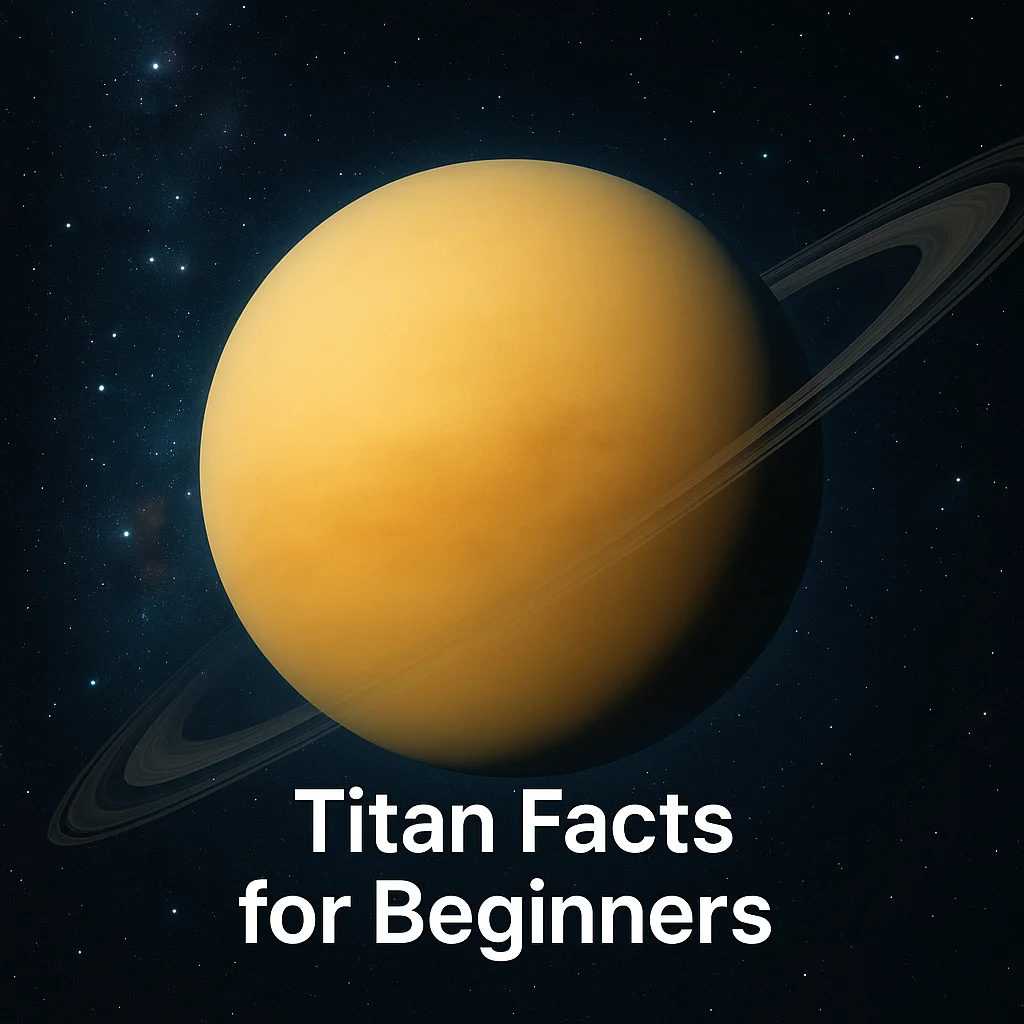
Unlike many moons, Titan has a thick atmosphere, composed largely of nitrogen, with traces of methane and other gases. This dense atmosphere sets Titan apart from many other moons and indeed some small planets like Mercury, which doesn't have a significant atmosphere at all.
In this article, we will explore Titan's location, its distance from us, what it is made of, and how it behaves. We will also discuss the various missions that have helped us learn more about this fascinating moon.
📍 Where It Is and How Far Away
Titan resides in the outer regions of our Solar System, orbiting Saturn, which is the sixth planet from the Sun. Saturn itself is one of the four gas giants and is well-known for its beautiful ring system. Titan orbits Saturn at a significant distance of about 1.2 billion kilometers or around 746 million miles from the Sun. This places it about 10 times farther from the Sun than Earth is.
This great distance means sunlight is much weaker and temperatures on Titan are extremely cold, averaging around minus 179 degrees Celsius (minus 290 degrees Fahrenheit). To put that in perspective, it would be like living in an enormous, cold desert.
In astronomical terms, Titan is approximately 1.3 million kilometers (or about 800,000 miles) away from Saturn, which means it orbits well beyond the planet's rings but is still subject to its gravitational influence.
🧱 Size, Mass, and Gravity (Made Simple)
Titan is a giant among moons. With a diameter of about 5,150 kilometers (3,200 miles), it's larger than the planet Mercury. Despite that, its mass is only about 2% of Earth's mass due to its icy composition, which contains more rock-like material.
The surface gravity on Titan is about 14% that of Earth. What does that mean? Imagine weighing 100 pounds on Earth; on Titan, you'd feel like you only weigh 14 pounds. This is due to both the moon's smaller size and mass compared to Earth. If you were to leap into the air, you'd find yourself enjoying a much longer hang-time on Titan!
Since Titan has no solid surface like Earth or Mars but rather dense clouds and thick atmosphere leading to potential oceans of methane and ethane, standing on Titan would mean floating or sinking into its icy liquid surfaces.
🌡️ Atmosphere and Weather
Titan is enveloped in a thick atmosphere, mainly made of nitrogen, with clouds and hazes of methane and ethane. This atmospheric composition is unusual for a moon and has led scientists to consider Titan a more Earth-like body compared to most other moons in the Solar System.
The weather on Titan includes not rain of water, but rain of methane. This methane rain can create rivers and lakes on the surface, similar to the ones on Earth, but composed of liquid hydrocarbons. Wind and seasonal changes also occur, driven by Titan's changing solar input as it orbits Saturn.
Because sunlight is scarce, the temperatures on Titan remain extremely low, but this low energy results in an atmospheric pressure that is about 50% greater than Earth's, meaning if you were standing on Titan's surface without a spacesuit, you'd feel a comfortable pressure, though far too cold to survive without protection.
🪨 Surface and Interior
Titan's surface is a rugged landscape shaped by its atmospheric processes. It contains vast plains, dunes of icy grains, and lakes filled with liquid methane and ethane. Titan's icy surface is thought to rest over an ocean of liquid water mixed with ammonia, deep beneath the exterior crust.
The interior of Titan likely consists of a core of rock and ice. Unlike the Earth's solid crust, Titan's surface is constantly affected by its climate, creating geological features similar to Earth's, like lakes and rivers. However, due to the immense cold, the surface is frozen, leading scientists to speculate about the presence of cryovolcanoes that may eject water mixed with ammonia from the interior to the surface.
This interplay of liquid and ice makes Titan a place of great interest for scientists studying the possibilities of life beyond Earth, as well as understanding more about our own planet's atmospheric and surface processes.
🌀 Rotation, Orbit, and Seasons
Titan takes about 16 Earth days to complete one orbit around Saturn. It is tidally locked, meaning it always shows the same face towards Saturn, much like our Moon does towards Earth. This tidally locked rotation results in consistent surface features always facing Saturn.
The moon's orbit is nearly circular around Saturn, and this orbital distance does not favor intense seasons since variations are minimal. However, Titan experiences different seasons due to the 29.5-year-long solar orbit of Saturn. These seasonal changes are prominent in the atmosphere, causing shifts in weather patterns.
Though the seasonal changes are slower due to the long orbit, they cause significant effects like shifting methane cloud decks and varying surface temperatures, which alter the distribution of its characteristic methane lakes and seas over time.
🧲 Magnetic Field and Radiation
Titan itself doesn't generate a magnetic field. However, it orbits within Saturn's magnetosphere, which does affect its atmosphere. Saturn's magnetic field acts as a shield, helping prevent solar winds from stripping away Titan's dense atmosphere.
This magnetic environment can also cause energetic particles to collide with Titan's atmosphere, leading to chemical reactions that create complex organic molecules, some of which fall to the surface.
While the lack of an intrinsic magnetic field means Titan experiences the effects of Saturn's field, it also means that, unlike Earth, Titan doesn't have auroras originating from its poles, since these are a feature of a planet's magnetic activities.
🌙 Moons, Rings, and Neighbors
Titan doesn't have any moons of its own, but it shares the region around Saturn with an impressive array of other moons and the planet itself with its stunning ring system. Saturn's gravitational influence governs Titan's orbit and contributes to its tidal interactions.
Although Titan has no rings like that of Saturn, its thick atmosphere and large size ensure that it still commands a notable presence among Saturn's 80-plus known moons. Titan's interactions with smaller nearby satellites result in a variety of gravitational interactions within this moon system.
Titan is a significant subject of study not just because of its interactions with Saturn and its rings but due to its potential for hosting microbial life in its subsurface ocean, making it an intriguing neighbor within the Saturnian system.
🔭 How We Know (Missions and Observations)
Titan has been a primary focus for planetary missions since the Voyager spacecraft passed by Saturn in the early 1980s. More recently, the Cassini-Huygens mission provided a wealth of data about Titan. Cassini orbited Saturn, mapping Titan from above, while the Huygens probe landed on Titan’s surface in 2005, providing direct analysis of its atmosphere and ground composition.
These missions have allowed scientists to gather data like images, atmospheric compositions, and evidence of surface liquid bodies. Telescopes on Earth also continue to study Titan, offering insights into its atmosphere and surface changes from afar.
Such observations provide a clearer picture of this mysterious moon, guiding our understanding of its weather patterns, surface conditions, and potential for life. This knowledge helps construct models of planetary atmospheres and geological processes far beyond our own planet.
❓ Common Questions and Misconceptions
Is Titan a planet? No, Titan is a moon, not a planet. It orbits Saturn, one of our eight planets, so it is considered a satellite.
Can you stand on Titan? In theory, yes, you could stand on Titan’s surface. However, the conditions are extremely cold, and you’d need a spacesuit to survive.
Is Titan habitable? Not for humans. Titan is too cold and lacks oxygen. However, scientists think there might be a possibility for microbial life in its subsurface ocean.
Why is Titan orange? Its thick atmosphere has a photochemical smog with hydrocarbons, similar to pollutants on Earth, creating an orange tint.
Does Titan have volcanoes? Yes, but they are potentially cryovolcanoes, which, instead of lava, spew water mixed with ammonia from its interior.
Why is Titan important? Titan is important as its thick atmosphere and complex chemical processes offer key insights into Earth-like processes and the potential for life elsewhere.
📌 Summary
- Titan is Saturn’s largest moon, second only to Ganymede.
- It orbits Saturn, about 1.2 billion kilometers from the Sun.
- Its diameter makes it larger than Mercury, but it is less massive.
- Titan has a thick nitrogen-rich atmosphere with methane weather systems.
- The icy surface is punctuated by methane lakes and river networks.
- It takes 16 Earth days to orbit Saturn once, locked in rotation.
- Lacks its own magnetic field, but Saturn’s field influences it.
- Titan has no moons or rings, but it neighbors Saturn’s numerous moons and rings.
- Key missions like Cassini-Huygens have enhanced our understanding.
- Titan’s potential subsurface ocean sparks interest in alien life possibilities.