🪐 Why Titan Is One of the Most Earth-Like Worlds
🌌 What It Is
Titan is the largest moon of Saturn and is often considered one of the most Earth-like celestial bodies in our Solar System. Although it is not a planet, Titan shares some fascinating similarities with Earth that intrigue scientists and enthusiasts alike. These features include a thick atmosphere and surface liquids.
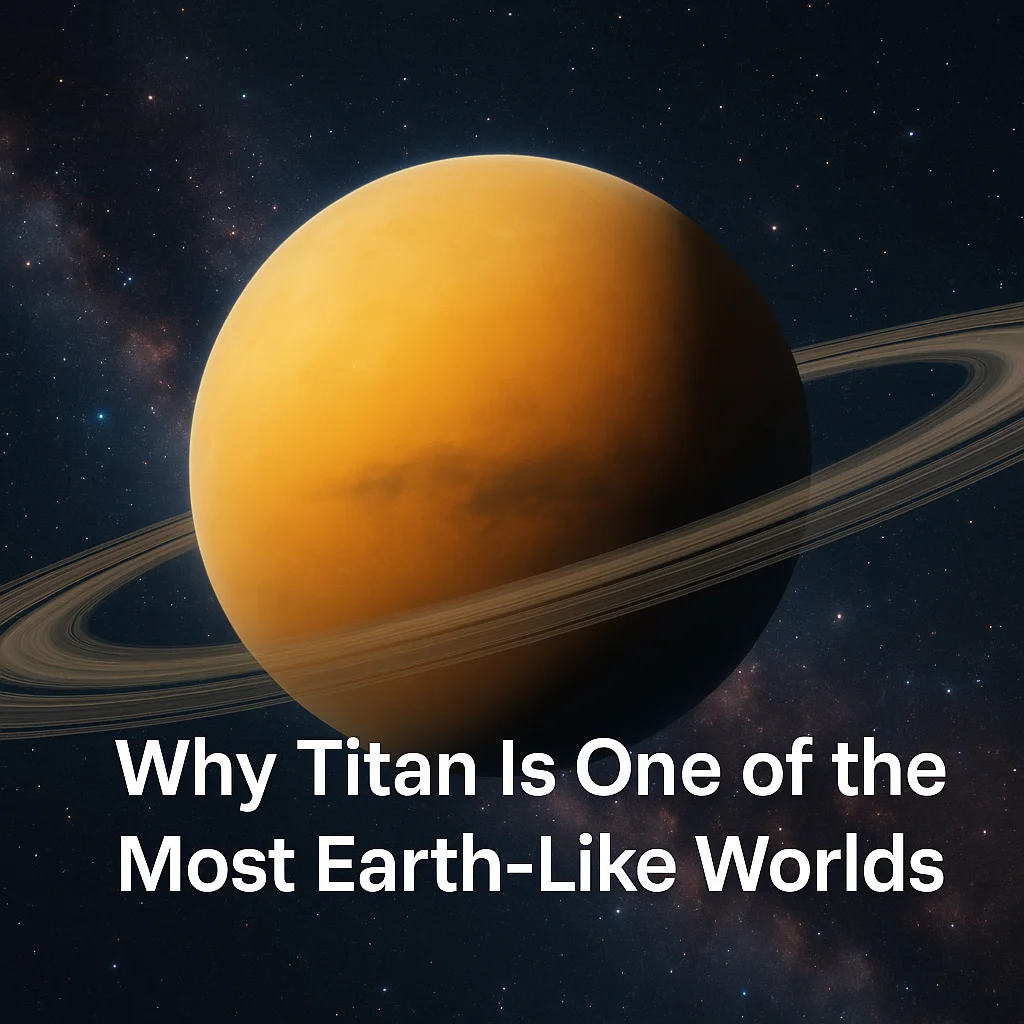
As a moon, Titan orbits around Saturn, the second-largest planet in our Solar System. Titan is classified as an icy body, and its intriguing surface features and atmosphere make it an exciting subject of study.
In this article, you will learn about Titan's location, composition, atmosphere, surface features, and its similarities and differences with Earth, along with the missions that have helped us understand this enigmatic moon.
📍 Where It Is and How Far Away
Titan resides in the outer reaches of our Solar System, orbiting Saturn. Saturn itself is located approximately 1.4 billion kilometers, or about 9 astronomical units (AU), from the Sun. One AU is the average distance from Earth to the Sun, meaning Titan is about nine times farther away from the Sun than Earth is.
This immense distance from the Sun means that Titan receives only a fraction of the sunlight that Earth does. As a result, Titan is a very cold world, with surface temperatures averaging around -179 degrees Celsius. The low temperatures play a significant role in the unique weather and surface processes observed on Titan.
With such distance from Earth, reaching Titan requires advanced space travel technology, which has been achieved through a few remarkable space missions that have provided valuable data about this intriguing moon.
🧱 Size, Mass, and Gravity (Made Simple)
Titan is the second-largest moon in the Solar System, slightly smaller than Jupiter's moon Ganymede. It has a diameter of about 5,150 kilometers, making it larger than the planet Mercury. However, due to its icy composition, it is less massive than Mercury.
The surface gravity on Titan is around 0.14 times that of Earth's, meaning you would weigh much less on Titan than on Earth. If you weigh 100 kilograms on Earth, you would weigh only about 14 kilograms on Titan.
The concept of "standing" on Titan is different from Earth. While Titan has a solid surface, it is covered with a mixture of ice and complex organic compounds, making the terrain quite unique compared to rocky bodies like Earth.
🌡️ Atmosphere and Weather
Titan’s atmosphere is one of its most Earth-like features. It is primarily composed of nitrogen, just like Earth's atmosphere, but also contains significant amounts of methane and small amounts of other gases. This thick atmosphere creates a surface pressure 1.5 times that of Earth.
Titan experiences clouds and rain, but instead of water, the rain consists of liquid methane. This methane rain contributes to the moon's lakes and rivers, which are also made of liquid methane and ethane, shaping the landscape similarly to how water shapes Earth’s.
The weather on Titan is largely influenced by its distance from the Sun, which results in cold surface temperatures. The slow rotation and orbital period also contribute to the long-lasting seasons, which are vastly different from those on Earth.
🪨 Surface and Interior
Titan's surface is a fascinating mix of ice and organic compounds, with vast plains, sand dunes, and liquid lakes primarily of methane and ethane. It also features significant geological formations such as mountains and possible cryovolcanoes, which spew icy materials instead of lava.
Understanding the surface of Titan is complex because it is obscured by the thick atmosphere. However, radar and infrared observations have provided a glimpse of its diverse landscape.
Beneath the surface, Titan is thought to have a layered structure with an icy crust covering a subsurface ocean, followed by a rocky core. This subsurface ocean could potentially harbor some form of life, protected by the icy crust.
🌀 Rotation, Orbit, and Seasons
Titan takes about 16 Earth days to complete one orbit around Saturn, and it rotates synchronously with its orbit, meaning the same side always faces Saturn. This is similar to how our Moon shows only one face to Earth.
The axial tilt of Titan is minimal, resulting in less pronounced seasons compared to Earth. However, due to the orbit of Saturn around the Sun, Titan experiences long seasons, each lasting over seven Earth years.
The combination of its rotation and orbit contributes to the unique environmental conditions on Titan, influencing both its climate and geological activity.
🧲 Magnetic Field and Radiation
Unlike Earth, Titan itself does not have a significant magnetic field. However, it is affected by Saturn's strong magnetic field, which helps to shape its atmosphere and ionosphere.
This interaction can lead to auroras on Titan, similar to those on Earth, but they appear as faint glimmers due to the thick atmosphere. The magnetic environment also contributes to the shielding of Titan’s surface from cosmic radiation, offering some protection.
Saturn's magnetic field plays a crucial role in the study of space weather on Titan. Understanding this magnetic interaction is vital for future missions and any potential exploration efforts.
🌙 Moons, Rings, and Neighbors
While Titan is the largest of Saturn's moons, Saturn itself hosts a fascinating system of over 80 moons and a famous set of rings. Titan’s presence influences some of these moons, creating complex gravitational interactions.
The gravitational effects of Titan and other moons can induce tidal forces, shaping the surrounding environment and contributing to the dynamics of Saturn’s ring system.
Studying Titan in the context of its neighbors helps astronomers understand not just the moon, but also the entire Saturnian system and the intricate dance of celestial bodies within it.
🔭 How We Know (Missions and Observations)
Our understanding of Titan largely comes from spacecraft missions and telescopic observations. The Cassini-Huygens mission, launched by NASA and ESA, was pivotal in exploring the Saturn system and delivered a wealth of information about Titan.
The Huygens probe, which descended onto Titan's surface in 2005, provided the first direct data about the atmosphere and surface. Meanwhile, the Cassini orbiter mapped Titan's surface using radar, revealing lakes, seas, and dunes hidden by its thick atmosphere.
Telescopes, both on Earth and in space, continue to study Titan. They capture data in various spectrums, examining atmospheric composition and surface features to piece together the puzzle of this complex world.
❓ Common Questions and Misconceptions
Is Titan a planet? No, Titan is a moon, specifically Saturn's largest moon, and not classified as a planet.
Can people stand on Titan? Yes, people could stand on Titan’s solid surface, unlike gas giants where there is no solid ground.
Is Titan habitable for humans? Currently, Titan is too cold and lacks the necessary conditions for human habitation.
Why does Titan look orange? Titan appears orange due to complex organic molecules, known as tholins, in its atmosphere that scatter sunlight.
Are there real lakes and rivers on Titan? Yes, but they are composed of liquid methane and ethane rather than water.
Could there be life on Titan? Although not like life on Earth, some scientists speculate that life could exist in Titan’s subsurface ocean.
Why is Titan's atmosphere so thick? Titan’s gravity and cold temperature help retain a dense atmosphere, mostly composed of nitrogen and methane.
Does Titan have seasons like Earth? It has long seasons due to Saturn's long orbit around the Sun, but they are less extreme than on Earth.
📌 Summary
- Titan is the largest moon of Saturn, known for its Earth-like features such as a thick atmosphere and liquid on its surface.
- Located in the outer solar system, Titan is about 1.4 billion kilometers from the Sun.
- It has a diameter larger than Mercury, but much less gravity, with a surface gravity of 0.14 times that of Earth.
- Titan's atmosphere is primarily nitrogen and methane, resulting in methane rain and lakes.
- The surface is covered in ice and organic compounds, with geological features like mountains and dunes.
- Titan rotates synchronously with its orbit around Saturn, leading to long seasons that last over seven Earth years.
- While Titan lacks a magnetic field, it interacts with Saturn's, producing faint auroras.
- As Saturn's largest moon, Titan plays a role in the dynamics of its moon system and Saturn's rings.
- Key missions like Cassini-Huygens have expanded our knowledge with direct data and radar mapping.
- Titan’s orange hue, presence of liquid methane, and thick atmosphere make it a focus of astrobiological interest.