🪐 What Is an Icy Moon?
🌌 What It Is
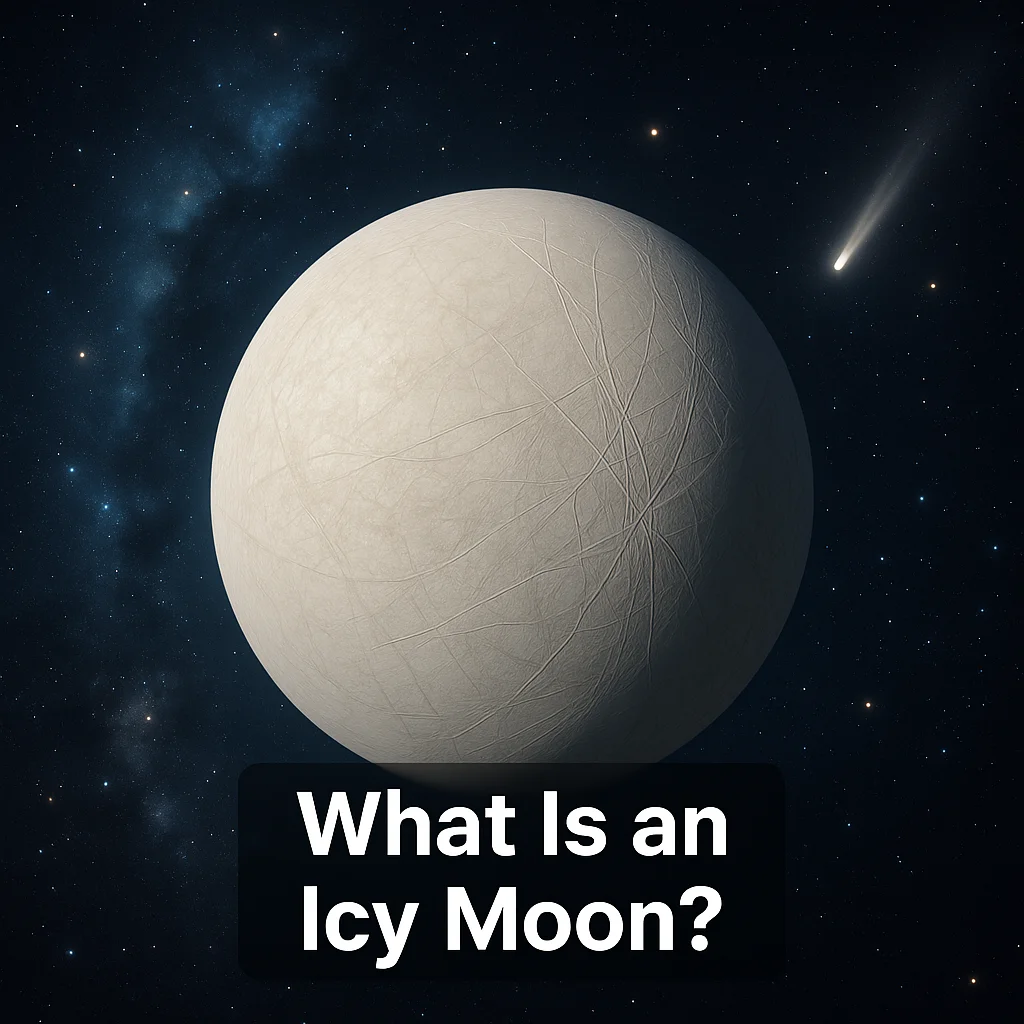
Icy moons are natural satellites that orbit planets in our Solar System, characterized by their ice-covered surfaces. Unlike rocky moons, these celestial bodies are primarily composed of water ice, sometimes mixed with rocky material. Their surfaces can be bright and reflective, indicating the presence of frozen water and other ices.
Many icy moons are located in the outer parts of the Solar System, where temperatures are low enough to keep water and other substances in a frozen state. This makes them distinct from moons closer to the Sun, which are often too warm to preserve ice over geological time scales.
In this article, we will explore what makes an icy moon, their locations in the Solar System, and notable examples. We'll also discuss their physical characteristics, atmospheres, and what makes them fascinating objects of study for scientists.
📍 Where It Is and How Far Away
Icy moons can be found orbiting both gas giants and some dwarf planets in the outer Solar System, such as Jupiter, Saturn, Uranus, and Neptune. The most famous icy moons include Europa around Jupiter and Enceladus around Saturn. These moons exist in regions far from the Sun where temperatures are cold enough for ices to remain solid.
The distance of these moons from Earth varies greatly, but they are generally located hundreds to thousands of millions of miles away. For example, Europa is about 484 million miles from the Sun, while Neptune's moon Triton is about 2.7 billion miles away. These distances make direct exploration challenging and typically require spacecraft missions to gather data.
Being so far from the Sun means these moons receive much less sunlight and heat, resulting in extremely cold surface temperatures. This lack of warmth allows exotic icy surfaces and, fascinatingly, may even support subsurface oceans insulated by thick ice layers, which is of great interest in the search for life beyond Earth.
🧱 Size, Mass, and Gravity (Made Simple)
Icy moons come in various sizes, from small potato-shaped objects to larger spherical bodies like our own Moon. For example, Europa is slightly smaller than Earth's Moon, while tiny moons like Saturn's Mimas are only about a fifth of that size.
The mass of these moons is generally low compared to their parent planets, exerting weak gravitational pulls. Europa's surface gravity, for instance, is only about 13% of Earth's, meaning you would feel much lighter there.
Despite their icy coatings, many large icy moons have enough mass to shape themselves into spheres. Smaller moons might have odd shapes due to insufficient gravity to pull them into a round form.
🌡️ Atmosphere and Weather
Most icy moons lack substantial atmospheres. Some, like Europa, have tenuous exospheres—very thin atmospheres made from particles ejected from their surfaces, often by solar radiation.
Weather patterns are minimal due to these sparse atmospheres. There are no storms or clouds like those on Earth. Instead, surface activity often involves subsurface geysers or plumes as observed on Saturn's Enceladus, where water vapor and ice particles are ejected into space.
These plumes can create an incredibly thin, temporary atmosphere when they occur. The presence and behavior of these features are influenced by the moon's position relative to its parent planet and any gravitational interactions.
🪨 Surface and Interior
Icy moons have surfaces characterized by smooth icy plains, craters, and ridges. The solid ice can shift and crack due to tidal forces from nearby gravitational bodies, leading to unique surface features.
Below the icy surface, scientists suspect many of these moons harbor oceans of liquid water warmed by the heat generated from tidal forces, created as the moon is stretched and squeezed by the gravity of its parent planet.
The interiors of icy moons may also include rocky layers and, in some cases, metallic cores. Understanding these structures helps scientists learn more about their potential for supporting life and the geophysical processes at work beneath their surfaces.
🌀 Rotation, Orbit, and Seasons
Most icy moons are tidally locked, meaning they always show the same face to their parent planet as they orbit, much like Earth's Moon. This synchronous rotation means a day on these moons is the same length as one orbit around their planet.
Orbital periods vary, with some moons taking hours to complete a single orbit and others taking days. The axial tilt of icy moons is often minimal, which results in weak seasonal changes compared to planets like Earth.
This synchronous rotation and minimal axial tilt result in a stable environment without the dramatic seasonal changes seen on Earth, providing consistent conditions over millions of years.
🧲 Magnetic Field and Radiation
While most icy moons lack their own magnetic fields, some are enveloped by the magnetic fields of their parent planets. For instance, Europa resides within Jupiter's powerful magnetic field, where its interaction generates electrical currents.
This interaction can produce phenomena such as auroras, although much less dramatic compared to Earth due to the thin atmospheres. Radiation belts around giant planets can also impact icy moons, affecting their surfaces and any potential life.
Understanding these electromagnetic forces is crucial for scientists planning missions, as the radiation environment can pose challenges to spacecraft. Shielding and strategic planning are necessary to protect onboard instruments and potential future crews.
🌙 Moons, Rings, and Neighbors
Icy moons themselves can have smaller moons or friend satellites orbiting them, though this is less common. They often share their space with other moons in complex systems around their planet, influencing each other through gravitational interactions.
Resonances, where moons exert regular, periodic gravitational influence on each other, are particularly interesting. These can lead to tidal heating, which keeps subsurface oceans liquid despite the cold environments.
While icy moons do not possess rings of their own, they may contribute material to planetary rings as their surfaces are eroded by collisions or geyser activity, like the material from Enceladus replenishing Saturn's E-ring.
🔭 How We Know (Missions and Observations)
Our understanding of icy moons comes from a combination of telescope observations and spacecraft missions. Telescopes on Earth and in orbit provide distant views, studying surface brightness and icy characteristics.
Spacecraft like NASA's Galileo and Cassini missions have provided detailed images and data on icy moons such as Europa and Enceladus. These missions gather invaluable information through flybys, taking photographs, and conducting measurements of magnetic fields and surface compositions.
The data collected help scientists understand the conditions and processes at play on these intriguing celestial bodies, paving the way for future missions aimed at unraveling the mysteries of the icy moons.
❓ Common Questions and Misconceptions
Is an icy moon a planet? No, icy moons are natural satellites that orbit planets.
Can you live on an icy moon? Probably not, though they may have the basic ingredients for life hidden beneath their icy shells.
Why are they called icy moons? Because their surfaces are mostly made of ice.
Can you stand on an icy moon? Yes, if the surface is solid enough, though lower gravity means you would weigh less.
Do icy moons have volcanoes? They may have icy volcanoes or geysers, but not traditional, rocky lava volcanoes.
Are icy moons habitable? There’s potential for life beneath the surface, but currently, no evidence proves habitability.
Why are some moons smooth? The ice can cover impacts over time, creating smoother surfaces.
Do icy moons have seasons? Seasons are minimal due to small axial tilts.
Can you see icy moons from Earth? Some, like Europa, can be seen with telescopes, appearing as small points of light.
Why study icy moons? They may hold clues to the origins of life beyond Earth.
📌 Summary
- Natural satellites with icy surfaces orbiting planets.
- Located in the outer Solar System, far from the Sun.
- Size varies; low gravity makes you feel lighter.
- Thin atmosphere; minimal weather activity, sometimes plumes.
- Surface craters and ridges; possible subsurface oceans.
- Typically tidally locked; minimal seasons.
- Often within parent planet's magnetic field; radiation impacts.
- Resonate with neighboring moons, but few rings.
- Explored through telescopes and spacecraft.
- Potential keys to understanding extraterrestrial life.