🪐 Understanding Conjunctions and Alignments
🌌 What It Is
Conjunctions and alignments are captivating events often observed in the night sky, where two or more celestial bodies appear to meet or come close to one another. This usually happens when planets, the Moon, and even distant stars align in the sky from our point of view on Earth. To the casual observer, these alignments can lead to stunning visual spectacles.
In astronomy, such alignments are primarily due to the positions of these celestial objects within the Solar System and their orbital paths. Planets travel in elliptical orbits at different speeds, which allows them to periodically appear near each other in the sky.
Throughout this article, we’ll explore what conjunctions mean in the context of planetary motion and what these alignments reveal about our Solar System. By the end, you will better understand how these celestial events occur and why they are significant to both amateur and professional astronomers.
📍 Where It Is and How Far Away
Conjunctions occur within our Solar System, a vast and dynamic environment that includes planets, moons, asteroids, and the Sun. The inner planets, such as Mercury and Venus, often partake in alignments with Earth due to their proximity to the Sun and faster orbital speeds.
Distance plays a vital role in these events. For instance, when Mercury aligns with Venus, both appearing in our sky, they can be millions of kilometers apart despite their apparent closeness. Celestial distances are often measured in astronomical units (AU), where one AU is the average distance from Earth to the Sun, approximately 150 million kilometers.
The relative positions of planets during alignments affect their visibility, brightness, and apparent size to observers on Earth. Sunlight reflecting off these planets enhances their brightness, making some conjunctions visible even to the naked eye.
🧱 Size, Mass, and Gravity (Made Simple)
Understanding the size, mass, and gravitational pull of planets involved in alignments gives us insight into their characteristics. For example, Jupiter, a frequent participant in planetary alignments, is the largest planet in the Solar System, with a diameter over 11 times that of Earth.
The mass of a planet directly influences its gravity. A planet like Jupiter has a strong gravitational pull because of its massive size, affecting its moons and any nearby celestial interactions during alignments.
Despite the immense gravitational forces, standing on a gas giant like Jupiter wouldn't be feasible. These planets lack solid surfaces, and their "gravity" would be experienced differently due to the gas and liquid layers.
🌡️ Atmosphere and Weather
When discussing planetary alignments, the atmospheres of the involved planets can often come into play. Gas giants like Jupiter and Saturn possess thick atmospheres filled with hydrogen, helium, and other elements, contributing to their dynamic weather systems.
Storms, such as Jupiter's Great Red Spot, demonstrate the intense meteorological activity possible on planets with substantial atmospheres. These features are often visible in alignment images, showing the entire planet in frame, offering clues about the atmospheric conditions.
The weather patterns we observe during alignments are driven by the planet's rotation, solar energy exposure, and atmospheric composition—all crucial for understanding planetary climates.
🪨 Surface and Interior
Planets involved in alignments can have vastly different surfaces and interiors. Terrestrial planets like Mars have solid surfaces with notable features like volcanoes and craters, shaped by volcanic and tectonic activity.
Gas giants, in contrast, lack solid surfaces but have complex internal structures with a variety of layers and cores. Conjunction imagery may show the whole object centered without a clear surface, illustrating the swirling cloud tops and atmospheric bands.
The depth and composition of these layers significantly influence how these planets interact gravitationally during alignments.
🌀 Rotation, Orbit, and Seasons
Rotation and orbital dynamics are pivotal in understanding how planets participate in alignments. Each planet has a unique rotation period, affecting its day length, and an orbit that determines its year.
Earth's axial tilt creates seasons, influencing our view of planetary alignments over the year. Some planets like Uranus have extreme tilts, leading to unique seasonal changes that can be observed during alignments.
Retrograde rotation, seen in planets like Venus, provides a unique twist on expected patterns, altering their apparent motion relative to Earth during conjunctions.
🧲 Magnetic Field and Radiation
Magnetic fields play a vital role in planetary science, especially during alignments observed closely with spacecraft. Jupiter, for instance, boasts a powerful magnetic field that can affect its radiation environment and the behavior of nearby particles.
Auroras on planets like Jupiter and Saturn provide visual evidence of magnetic interactions during alignments. These phenomena can be captured in images, showing the entire planetary disk with auroral bands glowing near the poles.
Understanding magnetic fields is crucial for evaluating the potential radiation risks these planets pose to spacecraft and for interpreting what we see during these celestial events.
🌙 Moons, Rings, and Neighbors
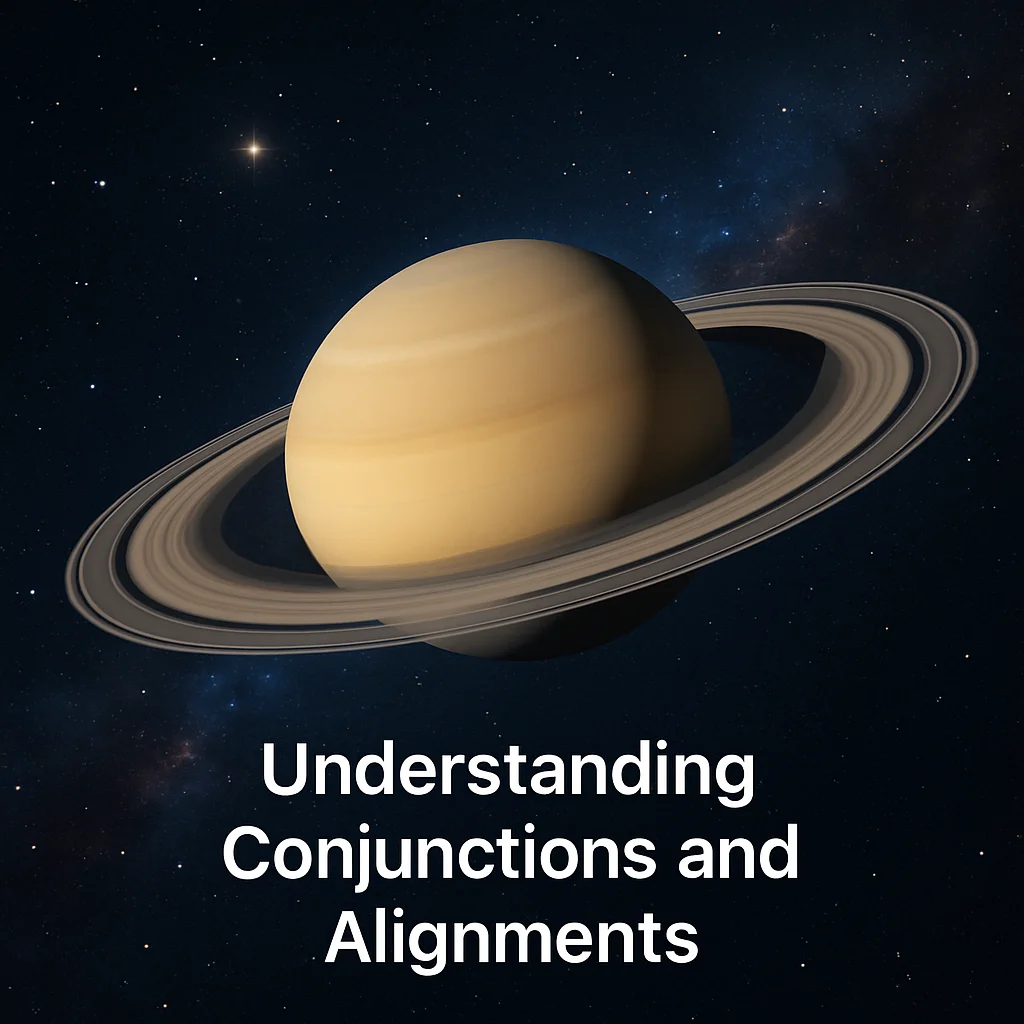
Many planets involved in alignments have fascinating moons and rings. Saturn is renowned for its stunning ring system, visible during alignments as the entire planet and its rings fit in one frame.
The gravitational interactions between planets and their moons often play a significant role in creating tidal forces and resonances, influencing planetary dynamics. These interactions are evident in images capturing the entire moon or ring system along with the primary planet.
In cases where planets lack significant moons or rings, the simplicity in gravitational interactions offers a different perspective on celestial mechanics.
🔭 How We Know (Missions and Observations)
The knowledge we have about planetary conjunctions and alignments largely comes from a blend of telescope observations and spacecraft missions. Telescopes can capture these events from Earth, observing the positions and movements of celestial bodies in great detail.
Spacecraft missions like Voyager, Cassini, and Juno have provided invaluable data on planetary systems. They take images, capture spectra of planetary atmospheres, and measure gravitational and magnetic fields to understand the dynamics of alignments.
This combination of data has extended our understanding, allowing scientists to make precise predictions about future celestial events and study them in real-time.
❓ Common Questions and Misconceptions
Is a conjunction the same as a planetary alignment? While related, a conjunction typically refers to two objects coming close in the sky, whereas an alignment can involve multiple celestial bodies.
Do planets actually touch during conjunctions? Planets are still vast distances apart; they only appear close from Earth's perspective.
Can we see conjunctions with the naked eye? Yes, many planetary conjunctions are visible without telescopes, though binoculars or a small telescope can enhance the view.
Do alignments influence Earth's weather or earthquakes? No scientific evidence supports this claim; these celestial events have negligible gravitational influence on Earth.
Why do planets look brighter during conjunctions? When aligned, sunlight reflects more directly towards Earth, making them appear more luminous.
Are conjunctions rare events? Some are relatively common, such as those involving inner planets, while others involving outer planets are less frequent.
Is astrology based on astronomical alignments? Astrology and astronomy differ; astrology is a belief system, while astronomy is a scientific study of celestial bodies.
📌 Summary
- Conjunctions are celestial alignments where planets appear close in the sky.
- These events occur within our Solar System and can be seen from Earth.
- Planets vary in size, mass, and gravity, influencing their alignments.
- Atmospheres and weather systems on these planets contribute to their distinct visual characteristics.
- Some planets lack solid surfaces, presenting unique challenges in understanding these alignments.
- Orbital patterns and rotations determine the frequency and appearance of these alignments.
- Magnetic fields can produce visible phenomena like auroras during conjunctions.
- Moons and rings add complexity to the gravitational dance of celestial bodies.
- We learn about alignments through telescopic observations and spacecraft missions.
- Common misconceptions include misunderstanding distances and the visibility of these events.