🪐 What Is Opposition? (Planet Viewing Explained)
🌌 What It Is
Opposition is an astronomical event that occurs when a planet is positioned directly opposite the Sun in the sky from Earth's perspective. This alignment places Earth between the Sun and an outer planet, making the planet appear brighter and larger than usual. It’s akin to standing between two people; you can see both clearly.
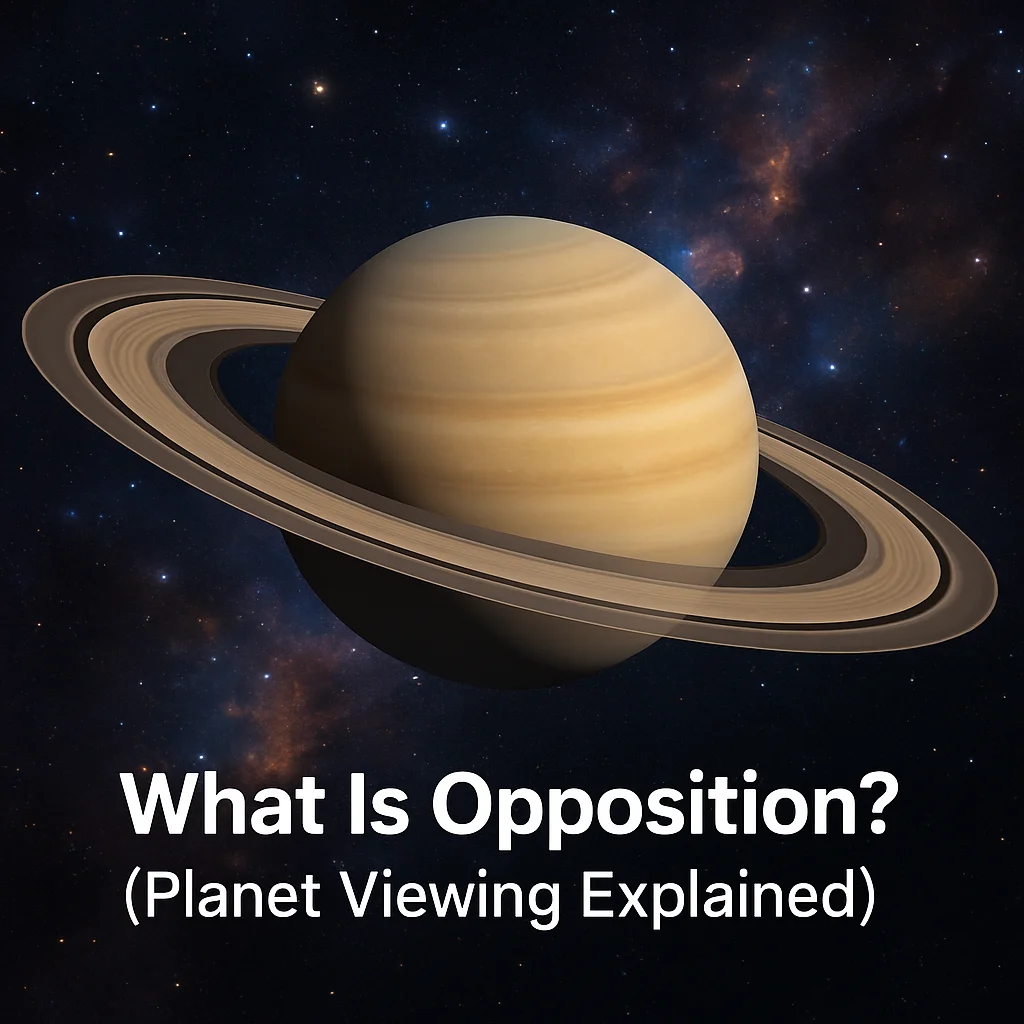
Outer planets like Mars, Jupiter, Saturn, Uranus, and Neptune can reach opposition. These planets are located outside Earth's orbit and are known for their gaseous or icy compositions. In contrast, inner planets like Mercury and Venus, which are closer to the Sun, do not experience opposition.
During opposition, a planet is best placed for observation as it rises at sunset and is visible throughout the night. This article aims to explain how opposition affects planet visibility and why it's a prime time for viewing these celestial bodies.
📍 Where It Is and How Far Away
Outer planets orbit the Sun at varying distances. For instance, when Jupiter is at opposition, it is approximately 4 to 6 astronomical units (AU) from Earth. One AU is the distance from Earth to the Sun, about 93 million miles or 150 million kilometers.
Opposition occurs as Earth, on its faster, inner orbit, overtakes an outer planet. As a result, the Sun's light illuminates the full face of the planet visible from Earth, similar to a full moon.
The proximity during opposition allows these planets to receive more sunlight, hence appearing brighter. Oppositions happen roughly once a year for each of these outer planets, although distances vary due to elliptical orbits.
🧱 Size, Mass, and Gravity (Made Simple)
Each outer planet has its distinct size and mass. For example, Jupiter, the largest planet, is so massive that it could fit over 1,300 Earths inside it. Despite its size, standing on Jupiter is not possible because it's a gas giant without a solid surface.
Gravity on these planets varies. Jupiter’s gravity is 2.5 times that of Earth’s, meaning you’d feel much heavier. In contrast, Mars, which also reaches opposition, has about 38% of Earth's gravity, so you'd feel much lighter.
🌡️ Atmosphere and Weather
Planets that can reach opposition have diverse atmospheres. Jupiter and Saturn, for instance, have thick hydrogen and helium atmospheres with storm systems, including Jupiter's Great Red Spot.
Mars, a rocky planet, has a thin carbon dioxide atmosphere with dust storms that can engulf the planet for months. These weather patterns result from solar energy, rotation speeds, and atmospheric compositions.
Extreme weather activities are visual highlights during oppositions, allowing observers to see more dynamic surface and atmospheric changes through telescopes.
🪨 Surface and Interior
Rocky planets like Mars showcase surface features such as craters, volcanoes, and canyons, all shaped by past geological activity and impacts. Olympus Mons on Mars is the tallest volcano known in our solar system.
Gas giants like Jupiter and Saturn have no defined solid surface. Instead, they have atmospheric layers with increasingly dense gases that transition to liquid and possibly metallic states as you go deeper.
Their interiors are believed to consist of rock and metal cores surrounded by liquid metallic hydrogen, contributing to their intense magnetic fields.
🌀 Rotation, Orbit, and Seasons
Each planet’s day and year differ greatly. Jupiter has the shortest day, taking only about 10 hours to complete a rotation, while Mars takes just over 24 hours. Yet, a year on Mars is 687 Earth days because it's farther from the Sun.
Seasons occur due to axial tilt. Mars has seasons similar to Earth but they are longer due to its extended orbit. Conversely, Jupiter and Neptune's minimal tilt results in barely noticeable seasonal changes.
Unusual rotations, like Venus's retrograde spin, don't apply to opposition planets, but these rotational characteristics can influence atmospheric dynamics and magnetic fields.
🧲 Magnetic Field and Radiation
Magnetic fields are created by the movement of electrically conductive materials inside a planet. Jupiter has the strongest magnetic field, with radiation belts that could harm unprotected spacecraft.
Such fields trap charged particles and create phenomena like auroras at their poles, visible during oppositions when juxtaposed against the dark space.
Studying these magnetic fields helps scientists understand the planet's internal structure and how they protect possible atmospheres from solar wind stripping.
🌙 Moons, Rings, and Neighbors
Planets at opposition often display captivating moons and rings. Saturn, famous for its rings, showcases a spectacular full ring view during opposition. Jupiter's largest moons, or Galilean moons, are visible even with small telescopes.
These moons and rings interact gravitationally. Moons cause tidal forces that can affect tectonics or maintain ring structures through shepherding effects.
These accompanying features offer rich observational targets during opposition, providing glimpses into diverse celestial mechanics.
🔭 How We Know (Missions and Observations)
Telescopes on Earth capture images and spectra of planets during opposition, when they are brightest. Detailed photographs reveal surface and atmospheric features best seen when the full disk is illuminated.
Space missions like Voyager, Galileo, and Cassini have flown by or orbited these planets, gathering detailed data on magnetic fields, ring systems, and moons.
Such data helps scientists understand planetary compositions and dynamics, revealing insights into the early solar system and its evolution.
❓ Common Questions and Misconceptions
Is it a star? No, planets shine by reflecting sunlight, unlike stars, which emit their own light.
Can you stand on it? Only rocky planets like Mars can be stood on; gas giants have no solid surface.
Is it habitable? As far as we know, none of these outer planets or their moons are habitable.
Why is it that color? The colors come from atmospheric gases and clouds, like Mars’s iron oxide dust creating its red hue.
Does it always shine brighter? Only during opposition does it shine its brightest in our sky.
Can it affect Earth? No, the gravitational effects of these distant planets during opposition are minuscule.
📌 Summary
- What it is: A planet opposite the Sun in Earth's night sky.
- Where it is: Outer planets beyond Earth's orbit, like Mars and Jupiter.
- Size/gravity takeaway: Gas giants are much larger and have diverse gravitational effects.
- Atmosphere/weather: Diverse, with thick gases and storms or thin and cold like Mars.
- Surface/interior: Rocky features or gas layers without a clear surface.
- Orbit/rotation: Fast or slow rotations; long or short years depending on distance from the Sun.
- Magnetic/radiation: Strong magnetic fields, radiation belts, impact space weather.
- Moons/rings: Notable moons like Jupiter's Galilean moons; Saturn’s rings.
- How we know: Observations from telescopes and missions like Voyager and Galileo.
- One memorable fact: Opposition makes planets appear brightest and largest in the night sky.