🪐 How to Start Stargazing (Beginner Setup)
🌌 What It Is
Stargazing is the practice of observing celestial objects in the night sky, such as stars, planets, the Moon, and other astronomical phenomena. It offers a chance to connect with the universe on a personal level, and it can be as simple as looking up from your backyard or as complex as setting up a telescope for deeper exploration.
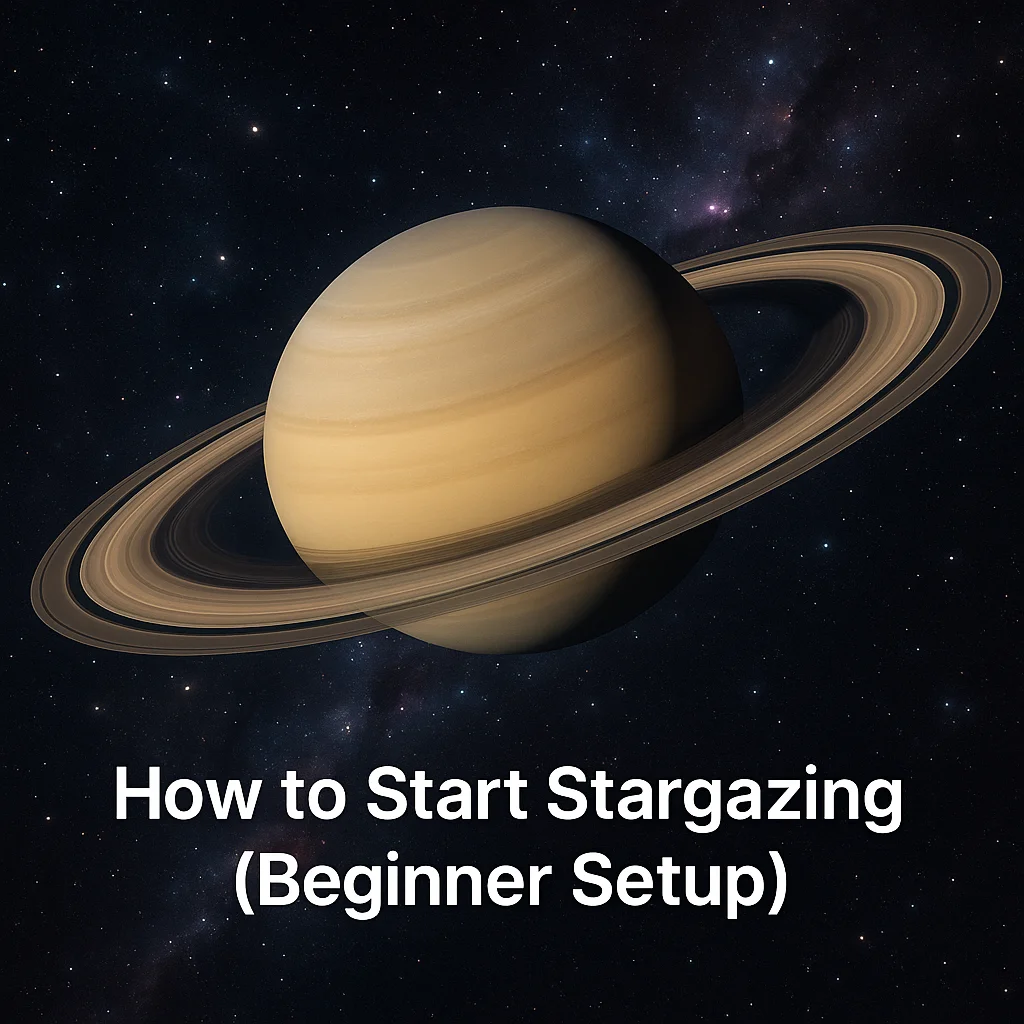
For beginners, stargazing often starts with familiarizing oneself with constellations, recognizing visible planets, and understanding the phases of the Moon. It's a hobby that merges science with beauty, inviting curiosity and wonderment as one learns about the vastness of space.
This guide will cover the essential aspects beginners need to know to start their stargazing journey, including equipment recommendations, basic astronomy concepts, and tips for observing the night sky effectively and safely.
📍 Where It Is and How Far Away
Stargazing is an activity that can take place anywhere with a dark enough sky. Ideally, stargazers seek locations away from city lights to better see celestial objects, which are often many light-years away.
Distances in space are vast, so we use units like light-years and astronomical units (AU). One astronomical unit is the average distance from the Earth to the Sun, about 93 million miles. Light from the Sun takes about 8 minutes to reach Earth, and yet the nearest star system, Alpha Centauri, is over 4 light-years away.
The positions of stars and planets shift slightly due to Earth's orbit around the Sun. Understanding these movements helps in planning observations to capture the best views of different celestial events throughout the year.
🧱 Size, Mass, and Gravity (Made Simple)
The celestial objects we observe vary greatly in size and mass. For instance, the Sun contains over 99% of all mass in the Solar System, exerting the strongest gravitational pull.
Planets, like Earth, have a solid surface we can stand on, while gas giants like Jupiter do not. On these gas giants, "gravity" feels different because there's no solid ground to stand on. Instead, you'd experience intense atmospheric pressure and a thick gaseous composition.
This means that while a planet's mass and gravity keep it in its orbits, the experience of gravity is influenced by whether it has a solid or gaseous surface.
🌡️ Atmosphere and Weather
Atmospheres on planets determine weather and climate. Earth’s atmosphere is a mix of nitrogen and oxygen, conducive to life, while Venus’s dense atmosphere traps heat, creating extremely hot conditions due to a runaway greenhouse effect.
Gas giants like Jupiter have no solid surface but are known for their large storms, such as the Great Red Spot, a giant storm persisting for over 300 years. These storms are fueled by the planet's fast rotation and thick gaseous composition.
Weather patterns on planets vary significantly due to differences in atmosphere, distance from the Sun, and rotational dynamics, all of which affect temperature ranges and climatic phenomena.
🪨 Surface and Interior
Rocky planets such as Earth, Mars, and Mercury have solid surfaces characterized by features like craters, mountains, and valleys. These features are shaped by geological activity, impacts, and erosion over time.
In contrast, gas giants do not have a clear solid surface. Instead, they have layers of gases with increasing pressure and temperature until reaching a possible solid core. This lack of a distinct surface results in a fluid transition between their atmospheric layers.
The interiors of planets vary; rocky planets may have a crust, mantle, and core, while gas giants might exhibit more complex fluid dynamics between their layers.
🌀 Rotation, Orbit, and Seasons
The length of a planet’s day is determined by its rotation on its axis, while the year is defined by its orbit around the Sun. Earth takes 24 hours to rotate, creating day and night, and 365 days to orbit the Sun, defining the year.
Seasons on Earth are caused by its axial tilt. Different orbital characteristics and axial tilts on other planets create unique seasonal patterns, influencing their climate and weather over long periods.
Some planets may have retrograde rotation, where they rotate in the opposite direction to their orbit, or extreme tilts, affecting the severity and duration of their seasons.
🧲 Magnetic Field and Radiation
A planet's magnetic field is crucial for shielding it from harmful solar and cosmic radiation. Earth's magnetic field results in phenomena like the northern and southern lights, where charged particles from the Sun interact with our atmosphere.
Strong magnetic fields, like those on Jupiter, trap particles and create intense radiation belts. These belts are a significant concern for spacecraft, requiring careful planning to safely navigate through or around them.
Magnetic fields can also indicate internal dynamics, like liquid metallic cores needed to generate these fields, hinting at the planet's interior processes.
🌙 Moons, Rings, and Neighbors
Many planets have moons that impact their gravitational interactions. Earth's moon influences tides. Jupiter and Saturn have numerous moons, each with distinct characteristics.
Rings are another celestial feature seen around planets like Saturn, composed of ice and rock particles, reflecting sunlight beautifully when the entire ring system is visible.
The gravitational interactions between planets, moons, and rings can lead to phenomena like orbital resonances, affecting their orbits and sometimes leading to cycles of heating and eruptions on moons.
🔭 How We Know (Missions and Observations)
Astronomers use telescopes on Earth and space-based telescopes to observe planets, stars, and galaxies, capturing images, spectral data, and more to understand celestial bodies.
Space missions, like the Voyager, Galileo, and more recently, Mars rovers, provide in situ data, such as chemical composition, weather conditions, and surface interactions, offering invaluable insights.
These missions help us learn about planets' atmospheres, surface features, and magnetic fields, supplementing remote observations with concrete data.
❓ Common Questions and Misconceptions
Is a planet a star? No, planets do not emit light. They are illuminated by stars like our Sun.
Can you stand on a gas giant? No, they lack a solid surface.
Is it habitable? Habitability depends on conditions like those on Earth, with water, suitable atmosphere, and temperature.
Why do some planets have rings? Ring systems occur due to particles trapped in orbit, usually due to moon interactions.
Is the Great Red Spot permanent? It's a long-lasting storm that may change or dissipate over time.
📌 Summary
- Stargazing is observing celestial objects in the night sky.
- Best done in dark areas away from city lights for clear views.
- Planets and stars vary greatly in size, mass, and gravity experiences.
- Atmospheres significantly affect weather and climate.
- Many celestial bodies have complex surfaces or lack clear surfaces entirely.
- Rotational dynamics determine length of days and years; axial tilt affects seasons.
- Magnetic fields protect planets from harmful radiation.
- Moons and rings are common in larger planets, impacting gravity and stability.
- Astronomy uses telescopes and space missions for research and discovery.
- Jupiter's Great Red Spot is a key example of enduring extraterrestrial storms.