🪐 Telescope Basics: What to Buy and Why (Evergreen)
🌌 What It Is
Understanding telescopes is essential for anyone who wishes to explore the night sky. A telescope is an optical instrument designed to make distant objects appear closer and more detailed. This article will guide you on what to look for when buying a telescope, ensuring you select one that meets your stargazing needs.
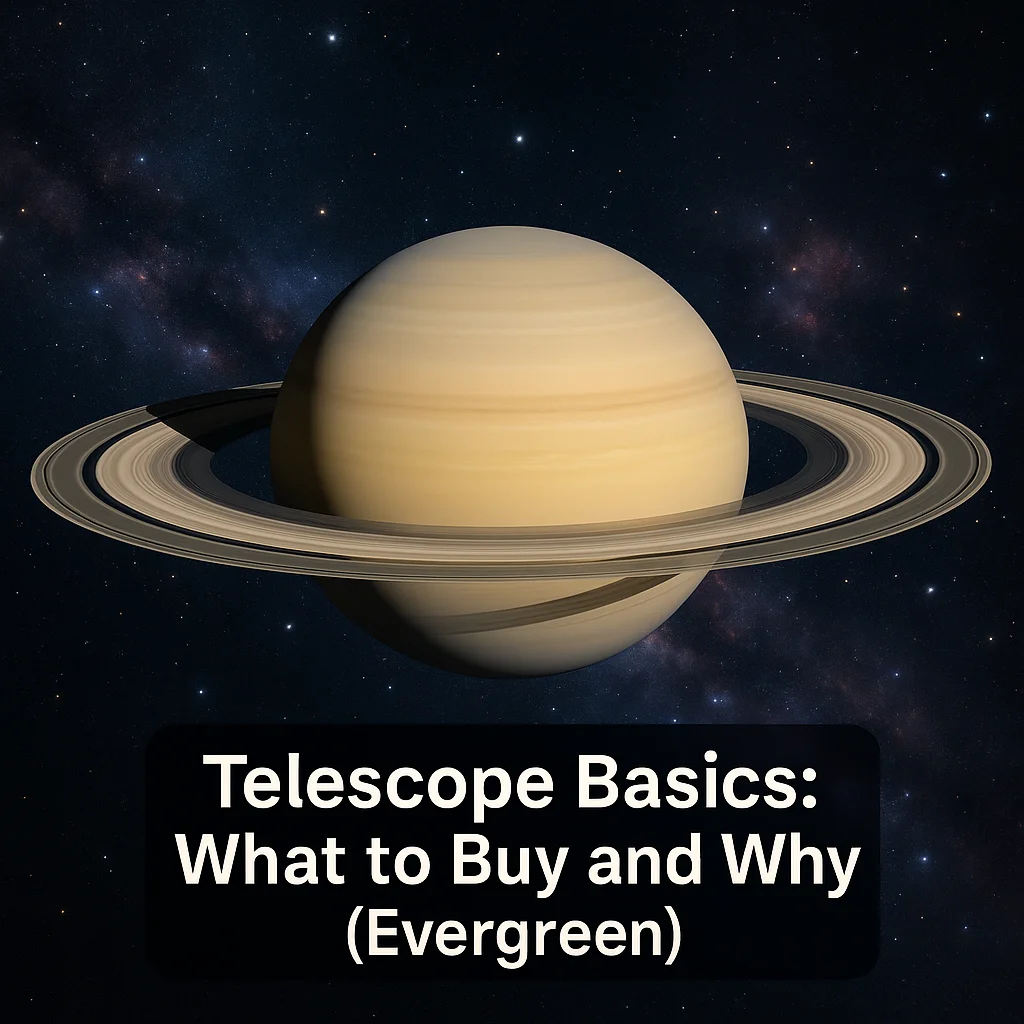
Telescopes use lenses or mirrors to gather light and magnify objects like planets, stars, and galaxies. This magnifying power allows for the study of celestial objects that are otherwise invisible to the naked eye.
By the end of this article, you will know more about different types of telescopes, what features are important to consider, and how to make an informed purchase decision.
📍 Where It Is and How Far Away
In simple terms, the observable universe is vast, and telescopes help to bring a small part of it into focus. From viewing the moon's craters to observing distant galaxies millions of light-years away, telescopes serve as our window to the cosmos.
The distance to celestial objects can be immense. For example, the moon is about 238,855 miles away from Earth, which telescopes can help bring into view with incredible detail. Planets like Jupiter are even farther, averaging 484 million miles from Earth.
Understanding the distance and location of these celestial objects helps appreciate the significant role telescopes play in observing and studying them, given the faintness and remoteness of light sources in the night sky.
🧱 Size, Mass, and Gravity (Made Simple)
When considering a telescope, size often refers to the aperture—the diameter of the main lens or mirror. A larger aperture allows more light to enter, improving image clarity and brightness. Think of it as a window: a bigger window lets in more light.
The mass of a telescope isn't about its weight; rather, it's about its ability to withstand environmental factors like wind or vibrations. While a sturdy, heavier telescope can be more stable, it may be less portable.
Gravity influences the types of stands and mounts that come with your telescope. A solid mount keeps the telescope steady and allows for smooth tracking of celestial objects as they move across the sky.
🌡️ Atmosphere and Weather
The Earth's atmosphere can affect the observations made with a telescope. Atmospheric conditions such as weather or air turbulence can distort the view, which is why some telescopes are placed on mountains or even launched into space.
Weather plays a significant role in astronomy. Cloud cover, humidity, and atmospheric stability are crucial factors to consider when choosing the time and place for stargazing.
An understanding of local weather patterns can improve the chances of clear and consistent views, enhancing the overall experience of using a telescope.
🪨 Surface and Interior
For ground-based telescopes, the 'surface' refers to where they are positioned. A stable surface, free from vibrations, allows for better and clearer observations.
The interior design of a telescope involves mirrors or lenses arranged in such a way as to collect and focus light efficiently. Reflecting telescopes use mirrors, while refracting telescopes use lenses. Each design has its own advantages and disadvantages.
Understanding these basic components helps when choosing between different types of telescopes for specific observing goals, such as viewing planets versus deep-sky objects.
🌀 Rotation, Orbit, and Seasons
A telescope's ability to rotate smoothly across the celestial sphere is crucial for tracking objects as the Earth rotates, affecting the apparent motion of stars and planets in the sky.
Telescopes with computerized mounts can automatically track objects, considering Earth's rotation and the changing positions of celestial objects due to their orbits around the Sun.
Understanding how seasons affect the visibility of certain stars and constellations can guide when to observe specific celestial phenomena or objects.
🧲 Magnetic Field and Radiation
Telescopes themselves don't have magnetic fields, but they are used to study things in space that do. Observing the effects of celestial magnetic fields, like those around planets or the sun, is an area where telescopes provide valuable data.
Radiation in space, such as light across different wavelengths, can be observed using specialized telescopes. This includes visible light, as well as infrared, ultraviolet, and other forms of electromagnetic radiation.
By capturing a range of wavelengths, telescopes help scientists study the temperature, composition, and motion of celestial objects, enhancing our understanding of the universe.
🌙 Moons, Rings, and Neighbors
Telescopes allow us to explore the moons and ring systems of outer planets, like the rings of Saturn or the moons of Jupiter and Saturn. These distant objects provide clues about planetary formation and the dynamics of the solar system.
Observing moons and rings requires higher magnification and resolution capabilities, which underline the importance of choosing an appropriate telescope for such detailed observations.
Gravitational interactions between planets and their moons or rings can also be studied with telescopes, showing how these celestial neighbors influence each other.
🔭 How We Know (Missions and Observations)
Traditional telescopes on Earth gather light to provide images and data. With advancements, telescopes are now placed in space, like the Hubble Space Telescope, to eliminate atmospheric interference.
Space missions send instruments and telescopes to observe various celestial phenomena up close. These missions have expanded our knowledge of planets, stars, and distant galaxies.
Through various tools, from spectrometers to cameras, telescopes gather different types of data that scientists analyze to understand the composition, motion, and history of celestial bodies.
❓ Common Questions and Misconceptions
Is a larger telescope always better? While a larger aperture provides better image quality, portability and budget are important considerations too.
Can telescopes see in daylight? Telescopes can technically be used during the day, but light pollution from the Sun makes it difficult to observe most celestial objects.
Do telescopes only view visible light? Modern telescopes can detect a range of electromagnetic waves, including infrared and ultraviolet light, to study space comprehensively.
Is a telescope useful in a city? While urban areas have light pollution, planets and the Moon are still visible. Darker areas are better for viewing distant galaxies and nebulae.
Does a telescope need a computer? Computerized mounts help track objects automatically, but manual telescopes can be equally effective with practice.
Can you observe the surface of Jupiter? Jupiter is a gas giant, so there's no solid surface visible, but telescopes reveal dynamic cloud patterns and prominent features.
📌 Summary
- Telescopes are instruments for observing distant celestial objects by gathering light.
- They help bridge the vast distances in space, from the Moon to galaxies far away.
- Larger apertures gather more light, but size must be balanced with portability.
- Atmospheric conditions impact clarity, with space telescopes bypassing this limitation.
- Reflecting and refracting designs offer different benefits for surface and interior views.
- Smooth rotation and automated tracking enhance observational accuracy.
- Observation of electromagnetic waves reveals data beyond visible light.
- Moons and rings, like those of Saturn, can be explored with appropriate magnification.
- Space missions complement telescopic observations for comprehensive understanding.
- Telescopes provide a means to explore and understand the dynamic universe around us.