🪐 Jupiter Facts for Beginners
🌌 What It Is
Jupiter is the largest planet in our solar system and is classified as a gas giant. Unlike Earth, which is a rocky terrestrial planet, Jupiter is made mostly of gases and lacks a solid surface. It is one of the four outer planets, located beyond the asteroid belt. Being a gas giant means it's primarily composed of hydrogen and helium.
Exploring Jupiter provides insights into the conditions of the early solar system and helps scientists understand the nature of other gas giants both in our solar system and beyond. Throughout this article, you'll learn fascinating facts about Jupiter, including its location, size, atmosphere, and more.
Jupiter's immense size and unique characteristics make it a subject of interest for many astronomers and space enthusiasts. By learning about Jupiter, we can better appreciate the diversity of planetary bodies that orbit our Sun.
📍 Where It Is and How Far Away
Jupiter resides in the outer region of our solar system. It's the fifth planet from the Sun, positioning it beyond the orbit of Mars and the asteroid belt. On average, it lies about 484 million miles from the Sun, which is roughly 5.2 astronomical units (AU). One AU is the average distance from the Earth to the Sun, around 93 million miles.
Due to its distance, sunlight takes about 43 minutes to reach Jupiter. This distant position from the Sun means it receives much less sunlight compared to Earth, resulting in generally colder temperatures across the planet.
Jupiter's location also impacts its visibility from Earth. With the right conditions and timing, Jupiter appears as a bright object in the night sky, distinguishable without the need for a telescope.
🧱 Size, Mass, and Gravity (Made Simple)
Jupiter is truly enormous, with a diameter of about 86,881 miles. This makes it more than 11 times wider than Earth. In fact, if Earth were the size of a grape, Jupiter would be comparable to the size of a basketball.
The planet's mass is equally impressive. It's more than 300 times the mass of Earth. Despite its massive size, Jupiter's atmosphere is incredibly thick and dense, which influences its gravity. The surface gravity on Jupiter is much stronger than Earth's, about 2.5 times more. So, if you could stand on Jupiter (which you can't because it has no solid surface), you would feel significantly heavier.
This immense gravity also plays a role in shaping the paths of comets and asteroids in our solar system, protecting the inner planets from potential impacts.
🌡️ Atmosphere and Weather
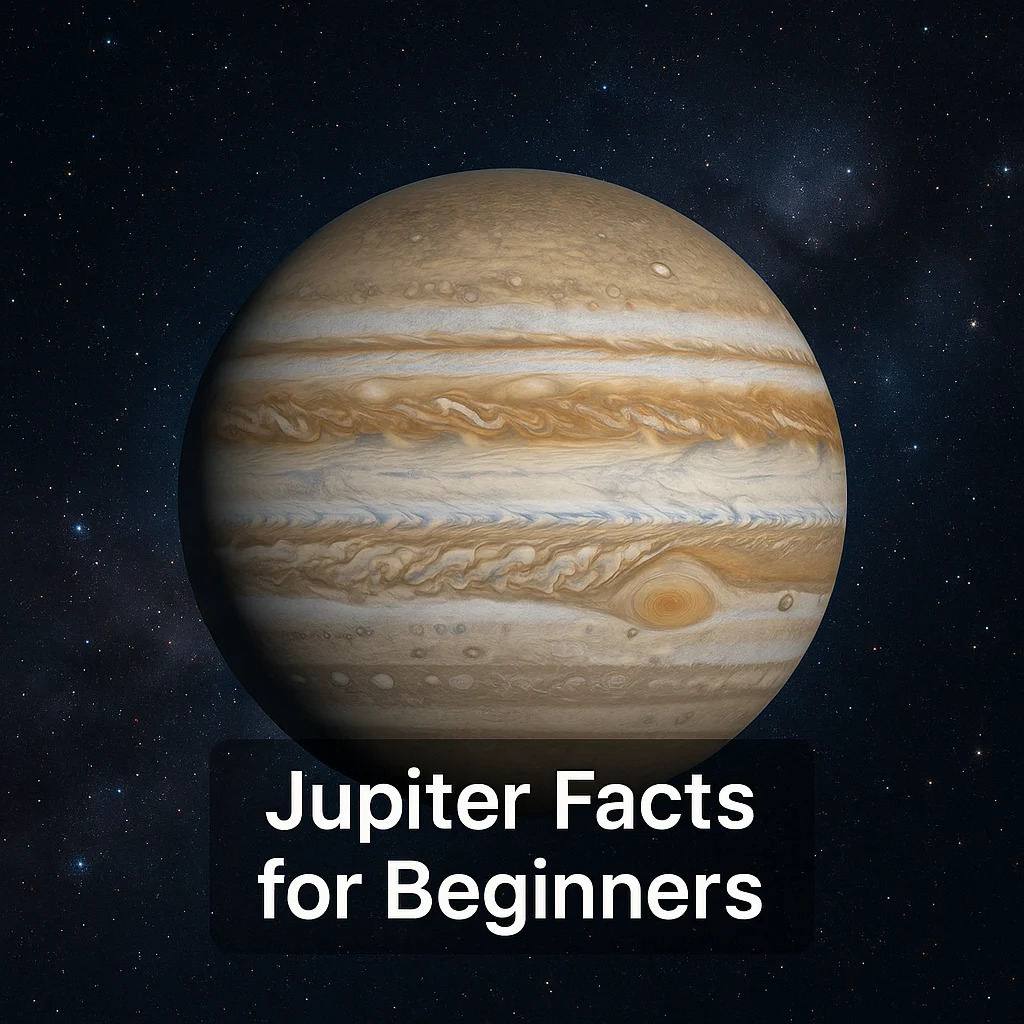
Jupiter's atmosphere is primarily composed of hydrogen and helium, with traces of methane, water vapor, ammonia, and other gases. This composition gives rise to its distinct banded appearance, characterized by alternating dark and light stripes.
The planet's rapid rotation fuels powerful jet streams which contribute to extreme weather patterns. These include the Great Red Spot, a massive storm larger than Earth that has raged for centuries. On Jupiter, winds can reach speeds of up to 400 miles per hour.
Temperature across Jupiter varies significantly, with the outer layers of its atmosphere being much colder due to its distance from the Sun. Deeper into the atmosphere, however, the compression and friction of gases generate higher temperatures.
🪨 Surface and Interior
Unlike rocky planets, Jupiter doesn't have a solid surface. Instead, it features a dense, cloud-laden atmosphere surrounding its interior. Scientists describe Jupiter as having layers because its composition changes as you move inward, with gases becoming increasingly dense and gradually transitioning into a fluid-like state.
Its core is believed to be composed of heavier elements, possibly a combination of rock and metallic hydrogen, though this remains a topic of investigation. The lack of a solid surface means traditional concepts like mountains or valleys do not apply to Jupiter.
The study of Jupiter's interior relies on data from space missions and observations, providing clues to its complex structure and formation history.
🌀 Rotation, Orbit, and Seasons
Jupiter boasts a rapid rotation, spinning once on its axis approximately every 10 hours. This rapid rotation contributes to its flattened shape and affects the dynamics of its atmosphere. Its orbit around the Sun, however, is much longer. A single Jovian year, or one full orbit around the Sun, takes about 11.86 Earth years.
Unlike Earth, Jupiter has a very small axial tilt of just 3 degrees. This means that it experiences hardly any seasonal changes compared to our planet. As a result, Jupiter's climate remains relatively stable year-round.
Jupiter's fast rotation is one reason for its strong magnetic field, influencing its surroundings in various ways.
🧲 Magnetic Field and Radiation
Jupiter has an extremely powerful magnetic field, the strongest of any planet in our solar system. This magnetic field is generated by the rapid rotation and movement of metallic hydrogen within its interior.
The planet's magnetic field traps charged particles, creating intense radiation belts around the planet. These belts present significant challenges for spacecraft, requiring specially designed shielding to protect instruments and electronics.
Jupiter's auroras are another fascinating aspect of its magnetic field. Similar to Earth's northern and southern lights, these auroras occur when charged particles interact with the planet's atmosphere, creating light displays at its poles.
🌙 Moons, Rings, and Neighbors
Jupiter has a diverse collection of moons, with at least 79 known as of now. The largest and most famous are the Galilean moons—Io, Europa, Ganymede, and Callisto—discovered by Galileo Galilei in 1610. Each of these moons has unique characteristics, from volcanic activity on Io to the potential subsurface ocean on Europa.
Jupiter also has a faint ring system, composed mainly of dust particles created from meteoroid impacts on its smaller moons. Unlike the prominent rings of Saturn, Jupiter's rings are thin and harder to detect.
The gravitational influence of Jupiter is significant, impacting the orbits of these moons and contributing to phenomena such as tidal heating, which affects the geological activity of some moons.
🔭 How We Know (Missions and Observations)
Our knowledge of Jupiter comes from both telescopic observations and numerous space missions. Ground-based telescopes provide valuable information on Jupiter's atmosphere, rotation, and storms, while spacecraft offer closer, more detailed observations.
The Pioneer and Voyager missions in the 1970s were among the first to visit Jupiter, sending back essential data on its atmosphere and moons. Later, the Galileo spacecraft orbited Jupiter in the 1990s, providing extensive information on the planet and its major moons.
In recent years, NASA's Juno mission has focused on studying Jupiter's atmosphere, magnetic field, and interior structure, delivering new insights into this complex planet.
❓ Common Questions and Misconceptions
Is Jupiter a star? No, Jupiter is not a star. Although it shares some compositional similarities with stars, it does not have enough mass to initiate nuclear fusion, the process powering stars.
Can you stand on Jupiter? You cannot stand on Jupiter because it lacks a solid surface. Its outer layer is made of thick clouds and gas.
Is Jupiter habitable? Jupiter itself is not habitable, but some of its moons, like Europa, may have conditions suitable for life.
Why is Jupiter that color? The distinctive colors of Jupiter's atmosphere come from its composition and the chemical interactions in its clouds.
Does Jupiter have seasons? Due to its minimal axial tilt, Jupiter does not experience significant seasonal changes like Earth does.
How big is the Great Red Spot? The Great Red Spot is a massive storm larger than Earth, and it has been raging for centuries.
What causes Jupiter's auroras? Jupiter's auroras are caused by charged particles interacting with its magnetic field, similar to Earth's auroras.
Does Jupiter protect Earth? Jupiter's gravity can alter the paths of comets and asteroids, reducing potential impacts with Earth, though not all threats are eliminated.
Can we see Jupiter's rings? Jupiter's rings are faint and not easily visible from Earth without telescopes.
Is Jupiter hotter than Earth? While Jupiter is cold on its outer layers, it radiates more heat than it receives due to internal heat from its formation and compression.
📌 Summary
- Jupiter is the largest planet and a gas giant in our solar system.
- It is the fifth planet from the Sun, located beyond the asteroid belt.
- Jupiter is more than 11 times the size of Earth, with intense gravity.
- The planet's atmosphere features powerful winds, storms, and the Great Red Spot.
- Jupiter lacks a solid surface but has a layered atmosphere and potential core.
- It has a rapid rotation and long orbit, resulting in little seasonal change.
- Jupiter's strong magnetic field creates intense radiation belts and auroras.
- Home to at least 79 moons, including the notable Galilean moons, and a faint ring system.
- Information about Jupiter comes from telescopes and missions like Juno and Galileo.
- Jupiter's massive size, storms, and moons make it an intriguing subject for study.