🪐 Jupiter’s Great Red Spot Explained
🌌 What It Is
The Great Red Spot on Jupiter is a gigantic storm that has been swirling on the planet for at least 350 years. Its reddish hue and enormous size make it one of the most striking features in our Solar System. This storm is so large that it can easily accommodate two to three Earths across its width.
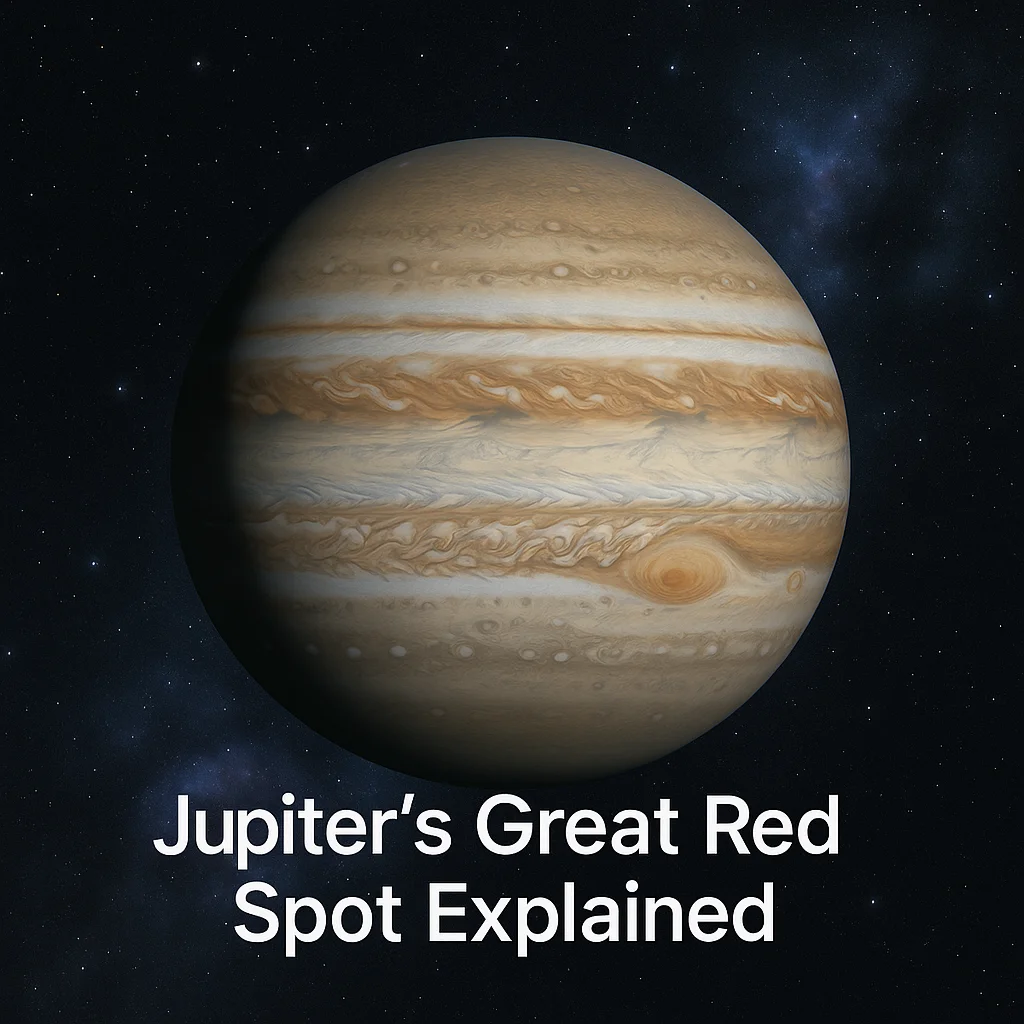
Jupiter itself is a gas giant, meaning it does not have a well-defined solid surface like Earth. It is primarily made up of hydrogen and helium, much like a star, but it lacks the mass to ignite fusion and become a star. Jupiter is classified as an outer planet, lying beyond the asteroid belt, and it is the largest planet in our Solar System.
In this article, you will learn about the location, size, atmosphere, and other fascinating aspects of the Great Red Spot and Jupiter itself. We will also explore common misconceptions and share how scientists have gathered information about this colossal storm.
📍 Where It Is and How Far Away
Jupiter is located in the outer region of our Solar System. It orbits the Sun at a distance of about 5.2 astronomical units (AU), where one AU is the average distance from the Earth to the Sun. To put it into perspective, light from the Sun takes about 43 minutes to reach Jupiter.
The vast distance from the Sun means that Jupiter receives much less sunlight compared to Earth, resulting in cooler temperatures, especially in the upper atmosphere. However, Jupiter generates a lot of heat internally, which influences its weather systems, including the Great Red Spot.
Being one of the outer planets, Jupiter's orbit places it far from the inner planets, affecting the way it reflects sunlight and captures material in its gravitational pull. The immense gravitational force of Jupiter also helps protect the inner planets by pulling in many asteroids and comets that might otherwise head towards the inner Solar System.
🧱 Size, Mass, and Gravity (Made Simple)
Jupiter is the behemoth of the Solar System. With a diameter of about 142,984 kilometers, it is over 11 times the width of Earth. Despite being made mostly of gas, it is incredibly massive, being 318 times heavier than Earth.
The gravity on Jupiter is much stronger than on Earth. If you weigh 100 pounds on Earth, you'd weigh about 253 pounds on Jupiter. However, because it lacks a solid surface, you wouldn't technically "stand" on Jupiter. It would feel more like being steadily drawn into the dense atmosphere without ever reaching a solid ground.
Gravity on Jupiter also plays a crucial role in its atmosphere and weather systems, including the Great Red Spot. The intense gravitational pull contributes to the swirling storms and fast-moving winds that can reach up to 432 kilometers per hour.
🌡️ Atmosphere and Weather
Jupiter's atmosphere is a complex and dynamic system predominantly composed of hydrogen and helium, with traces of other gases like methane, water vapor, and ammonia. The presence of these gases contributes to the planet's dramatic weather patterns and vivid cloud bands.
The weather on Jupiter is characterized by strong winds and massive storms, with the Great Red Spot being the most famous of them all. This is a high-pressure region, much like an anticyclone on Earth, but far larger and more powerful.
The rotation of Jupiter, which is the fastest of any planet in our Solar System, causes the rapid movement of gases, giving rise to the colorful cloud bands. The combination of heat rising from the planet's interior and the rapid rotation fuels the persistent and extreme weather patterns.
🪨 Surface and Interior
Jupiter does not have a solid surface like Earth or Mars. Instead, as you descend through the thick atmosphere, the gas gradually becomes denser and transitions into a liquid state due to the immense pressure. This means there's no clear boundary where sky turns to ground.
Deep inside Jupiter, scientists believe there is a core composed of heavier elements, though its exact nature remains uncertain. Surrounding this core lies a mantle of liquid metallic hydrogen, which is an exotic state of matter that can conduct electricity and generates Jupiter's powerful magnetic field.
The lack of a traditional surface changes our perception of what a planet's "ground" could be like. Instead of rock or soil, Jupiter's layers transition from gaseous to liquid, showcasing the unique nature of gas giants in the Solar System.
🌀 Rotation, Orbit, and Seasons
Jupiter spins rapidly, with a rotation period of just about 10 hours. This fast rotation means that, despite its enormous size, a day on Jupiter is quite short compared to Earth. Just imagine how quickly day turns to night!
A year on Jupiter, however, is much longer. It takes about 12 Earth years for Jupiter to complete one orbit around the Sun due to its greater distance from our star.
Jupiter’s axial tilt is minimal, only about 3 degrees, which means it does not experience significant seasonal changes like Earth does. The lack of seasons combined with its rapid rotation play key roles in shaping the planet's dynamic weather systems.
🧲 Magnetic Field and Radiation
Jupiter hosts the strongest magnetic field of any planet in the Solar System, about 20,000 times stronger than Earth's. This magnetic field is generated by the rapid rotation and the movement of liquid metallic hydrogen in its interior.
The magnetic field traps particles and creates intense radiation belts around the planet, making the space environment near Jupiter particularly hostile to spacecraft. However, these same processes give rise to spectacular auroras at Jupiter's poles, more than a thousand times brighter than Earth's.
The magnetic environment affects not only Jupiter itself but also its moons and the surrounding space, influencing how these bodies interact with each other through gravitational forces and magnetic connections.
🌙 Moons, Rings, and Neighbors
Jupiter is orbited by 79 known moons, with the four largest being the Galilean moons: Io, Europa, Ganymede, and Callisto. These moons are fascinating worlds on their own, each with unique characteristics and features.
Though not as prominent as those of Saturn, Jupiter also has a faint ring system composed mostly of dust particles ejected from its moons. These rings are difficult to see without the aid of spacecraft observations.
The gravitational interactions between Jupiter and its moons result in interesting phenomena, such as the tidal heating of Io, which leads to its intense volcanic activity. Additionally, the moons resonate in orbital tune with each other, creating stable configurations over billions of years.
🔭 How We Know (Missions and Observations)
A variety of spacecraft have visited Jupiter and its surroundings, providing invaluable data about the planet and its Great Red Spot. The most famous missions include Voyager 1 and 2, Galileo, and Juno, each offering unique insights into different facets of Jupiter’s complex system.
Telescopes from Earth have also been instrumental in studying Jupiter. They can capture images of the planet, track its storms, and observe its moons. Spectroscopy from telescopes allows scientists to analyze the composition of Jupiter’s atmosphere and measure temperature variations.
In-situ measurements by spacecraft complement observations from Earth, providing a clearer understanding of the dynamics at play on Jupiter. Data on magnetic fields, gravity, and imaging from up close help paint a comprehensive picture of this gas giant.
❓ Common Questions and Misconceptions
Is Jupiter a star? No, Jupiter is not a star because it lacks the mass necessary to ignite nuclear fusion reactions in its core.
Can you stand on Jupiter? No, Jupiter doesn't have a solid surface, so standing on it is impossible. You would sink into its dense atmosphere.
Is the Great Red Spot a permanent feature? While it has persisted for centuries, the Great Red Spot is slowly shrinking and may eventually disappear.
Is Jupiter habitable? Jupiter itself is inhospitable to life as we know it, but some of its moons, like Europa, may possess conditions suitable for life.
Why is it red? The exact cause of the Great Red Spot's color is unknown, but it could be due to complex chemical reactions in the atmosphere's upper layers.
Does Jupiter have weather like Earth? Jupiter's weather is more extreme, with stronger storms and high-speed winds, due to its massive size and rapid rotation.
Does Jupiter protect Earth? Yes, Jupiter's massive gravitational pull helps capture or deflect comets and asteroids that could otherwise threaten Earth.
📌 Summary
- The Great Red Spot is a giant storm on Jupiter.
- Jupiter orbits the Sun at a distance of about 5.2 AU.
- Jupiter is over 11 times the size of Earth with strong gravity.
- The atmosphere consists of hydrogen and helium with turbulent weather.
- Jupiter has no solid surface, only dense gaseous layers.
- Jupiter rotates rapidly with a short day and long year.
- Its magnetic field is the strongest of any planet, influencing space weather.
- Jupiter has many moons, including the four large Galilean moons.
- We've learned about Jupiter through spacecraft missions and telescopic observations.
- One memorable fact: The Great Red Spot could fit two or three Earths inside it.