🪐 Jupiter’s Moons Overview: Why They Matter
🌌 What It Is
Jupiter is the largest planet in our Solar System, known for its massive size and iconic Great Red Spot. It is classified as a gas giant, which means it is primarily composed of hydrogen and helium and lacks a well-defined solid surface.
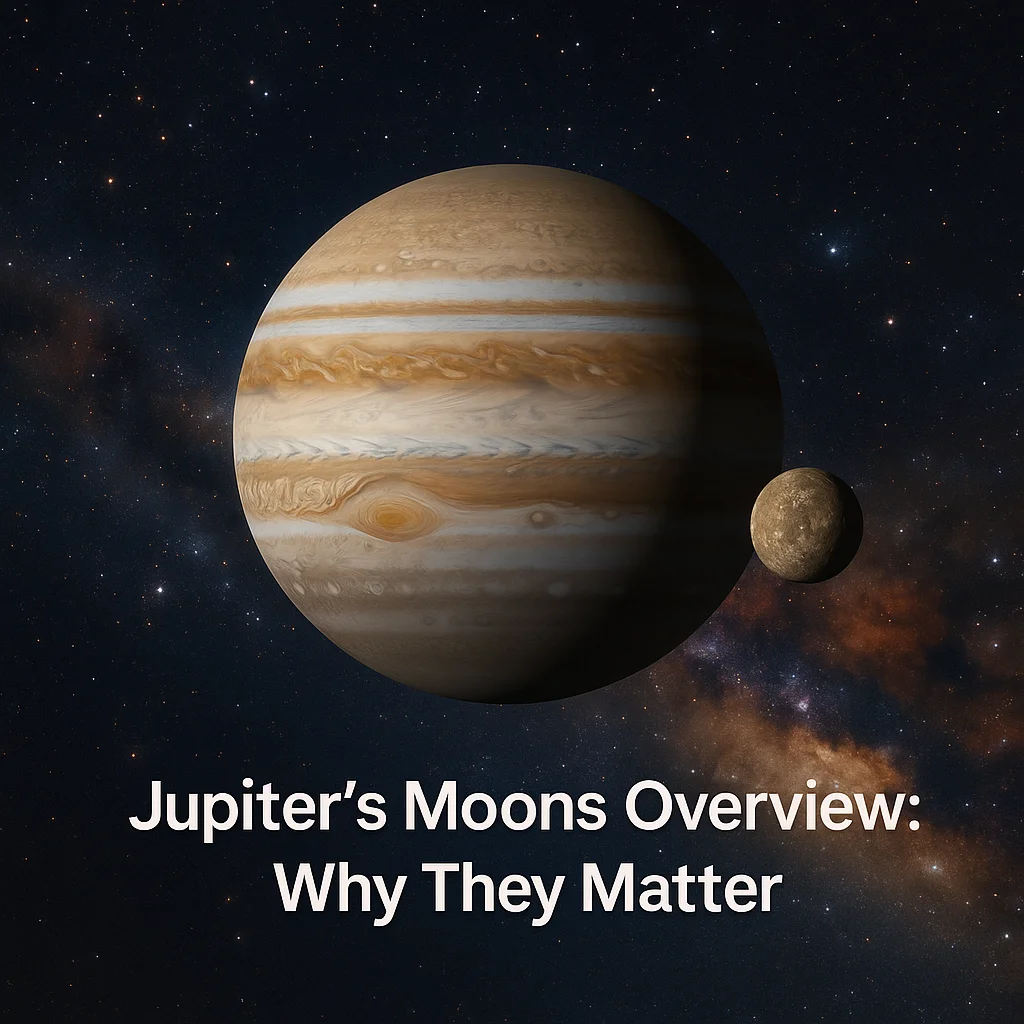
Jupiter is surrounded by a vast number of natural satellites, commonly referred to as moons. There are at least 79 known moons orbiting Jupiter, each varying in size, composition, and origin.
The many moons of Jupiter each have unique characteristics, making them fascinating objects of study. This article will guide you through Jupiter’s moons, helping you understand why they are so significant to astronomers and the wider scientific community.
📍 Where It Is and How Far Away
Jupiter is the fifth planet from the Sun, located approximately 484 million miles away. It lies beyond the asteroid belt, distinguishing it from the inner terrestrial planets.
In terms of astronomical units (AU), which is the average distance between the Earth and the Sun, Jupiter is about 5.2 AU away. This enormous distance means sunlight takes around 43 minutes to reach Jupiter, making temperatures in its region much colder than on Earth.
The great distance from the Sun is one reason why Jupiter and its moons have such cold environments, which is crucial for understanding the physical conditions on these moons.
🧱 Size, Mass, and Gravity (Made Simple)
Jupiter is enormous, with a diameter of about 86,881 miles, making it 11 times wider than Earth. Its mass is over 300 times that of our planet, providing it with a powerful gravitational pull.
The strong gravity of Jupiter affects the dynamics of its moons, keeping them in orbit and shaping some of their features. Despite Jupiter's lack of a solid surface, standing on the "surface" of Jupiter would feel intense due to its crushing gravity.
The planet’s gravity is so strong that it can even affect passing asteroids and comets, occasionally pulling them into its orbit or altering their paths through space.
🌡️ Atmosphere and Weather
Jupiter's atmosphere is thick and tumultuous, composed mostly of hydrogen and helium. It is home to immense storm systems, the most famous of which is the Great Red Spot – a gigantic storm that could engulf the Earth multiple times.
The rapid rotation of Jupiter, completing a spin in just under 10 hours, contributes to intense wind systems and turbulent weather patterns. This results in the banded appearance of the planet's atmosphere, with various cloud layers and colors.
Beneath the visible cloud layers, the atmosphere transitions smoothly into liquid hydrogen, as pressures and temperatures increase with depth.
🪨 Surface and Interior
As a gas giant, Jupiter does not have a solid surface like Earth or Mars. Instead, its gaseous atmosphere gradually thickens into a liquid layer as you move deeper into the planet.
Beneath this liquid layer, it is believed that Jupiter has a dense core that may be composed of heavy elements, such as rock and ice. This core is estimated to be surrounded by metallic hydrogen, a form that occurs under immense pressure.
The lack of a true surface means there are no mountains or craters on Jupiter, but the fluid dynamics create fascinating patterns and structures in its atmosphere.
🌀 Rotation, Orbit, and Seasons
Jupiter rotates extremely fast, completing one rotation approximately every 10 hours. This rapid spin is responsible for the flattened shape of the planet, known as an oblate spheroid.
A year on Jupiter, or the time it takes to complete one orbit around the Sun, is roughly 12 Earth years. Despite this long orbital period, the concept of seasons is less pronounced on Jupiter compared to Earth, due to its small axial tilt of just 3 degrees.
The planet’s consistent climate is mainly a result of its minor axial tilt, which maintains a more uniform exposure to sunlight throughout its year.
🧲 Magnetic Field and Radiation
Jupiter possesses a powerful magnetic field, much stronger than Earth's. This magnetic field is generated by the movement of metallic hydrogen inside the planet.
The magnetic field traps charged particles, creating intense radiation belts around the planet. Spacecraft orbiting or passing by Jupiter need to be specially equipped to withstand these high radiation levels.
Jupiter’s magnetic field also produces spectacular auroras, similar to Earth's northern and southern lights, but far more powerful and visible even in ultraviolet light.
🌙 Moons, Rings, and Neighbors
Among Jupiter's numerous moons, the four largest, known as the Galilean moons, are Io, Europa, Ganymede, and Callisto. Each of these moons has distinct characteristics worth noting.
Io is the most volcanically active body in the Solar System, with its surface constantly reshaped by lava flows. Europa is an ice-covered moon that scientists think harbors a subsurface ocean, making it a potential candidate for finding extraterrestrial life.
Ganymede, the largest moon in the Solar System, is even bigger than the planet Mercury. Callisto is heavily cratered, reflecting a history of impacts. Jupiter also has a faint ring system, overshadowed by Saturn's but interesting in its own right.
🔭 How We Know (Missions and Observations)
Our understanding of Jupiter and its moons has been significantly enhanced by a combination of telescopic observations and space missions. Telescopes provide detailed images and spectra from afar, showing us the colors and features of the planet and its moons.
Notable missions include the Galileo spacecraft, which orbited Jupiter and sent back a wealth of information about its composition and dynamics. The Juno spacecraft, still studying Jupiter, is focused on understanding its interior structure and magnetic field.
Information from these missions helps scientists piece together the complex puzzle of Jupiter's environment and the roles its moons play in the broader Solar System.
❓ Common Questions and Misconceptions
Is Jupiter a star? No, Jupiter is not a star. It didn't acquire enough mass to trigger nuclear fusion, the process that powers stars.
Can you stand on Jupiter? No, because it lacks a solid surface. It's mostly composed of gas and liquid.
Is Jupiter habitable? Jupiter itself is not, due to its extreme pressure, temperature, and composition, but some of its moons might harbor life.
Why does Jupiter have stripes? Its rapid rotation and atmospheric composition create bands of different storms and clouds.
Is the Great Red Spot shrinking? Yes, observations suggest this massive storm has been gradually reducing in size over the years.
How old is Jupiter? Jupiter formed around 4.5 billion years ago, roughly the same time as the rest of our Solar System.
Does Jupiter affect Earth's orbit? Not directly, but its massive gravity does influence the paths of other Solar System bodies.
📌 Summary
- Jupiter is the biggest planet in our Solar System, a gas giant mainly composed of hydrogen and helium.
- Located beyond the asteroid belt, it's 5.2 AU from the Sun, making it a cold environment.
- Jupiter’s immense size and mass give it significant gravitational influence over its moons and surrounding space.
- The atmosphere is thick and stormy, with features like the Great Red Spot.
- Lacks a solid surface; instead, the gaseous atmosphere transitions into liquid hydrogen.
- It spins rapidly, resulting in a short day and nearly uniform seasons due to its small axial tilt.
- Possesses a strong magnetic field that creates intense radiation belts and auroras.
- Home to at least 79 moons, with the Galilean moons being the most noteworthy.
- We know much about Jupiter thanks to telescopic observations and missions like Galileo and Juno.
- The Galilean moons each offer unique clues about the history and potential for life in the Solar System.