🪐 Saturn Facts for Beginners
🌌 What It Is
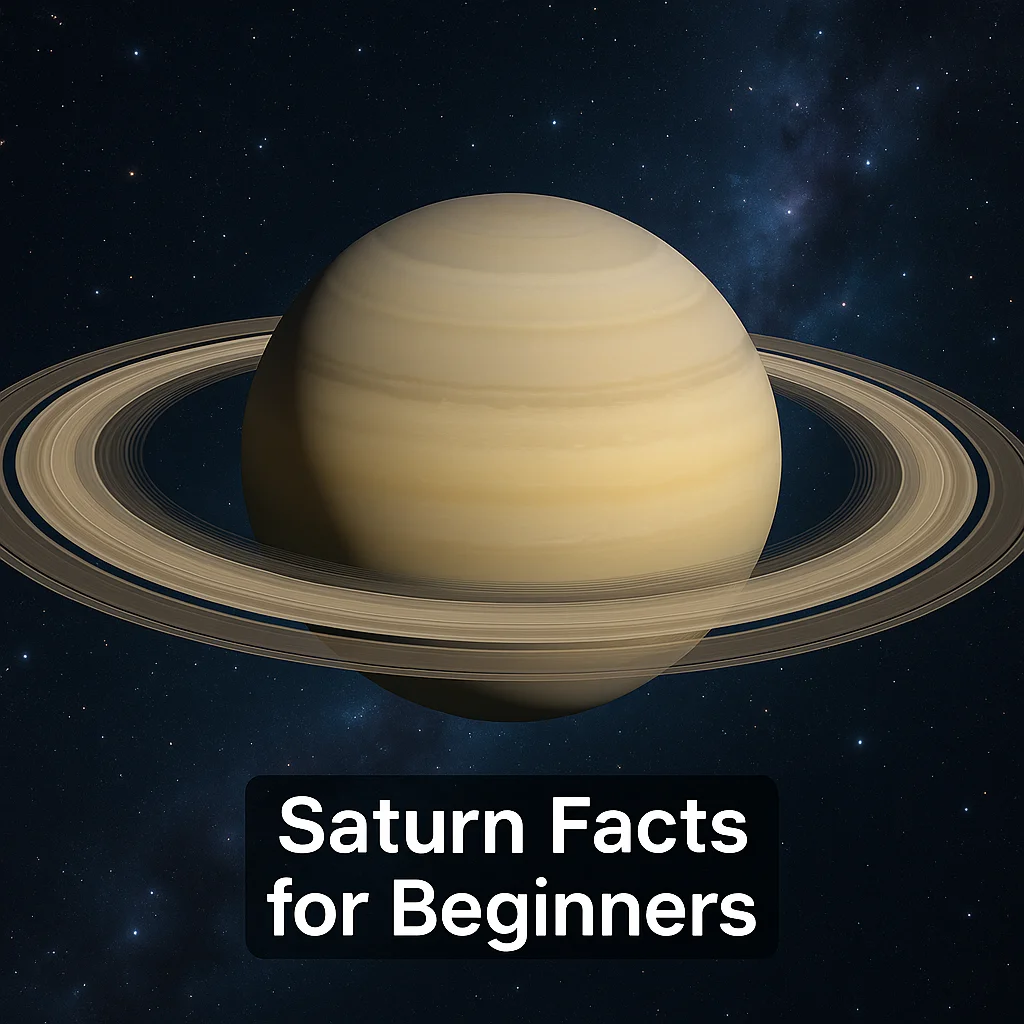
Saturn is the sixth planet from the Sun and the second-largest planet in our Solar System. It is classified as a gas giant, which means it is primarily composed of hydrogen and helium gases rather than having a solid surface like Earth or Mars.
Gas giants are sometimes referred to as jovian planets, named after Jupiter, the largest planet of this kind. Saturn, along with Jupiter, Uranus, and Neptune, forms the group known as the outer planets, which are located beyond the asteroid belt.
In this article, you'll learn about Saturn's structure, atmosphere, rings, moons, and much more. We'll demystify what makes Saturn such an intriguing planet and why it has captivated astronomers for centuries.
📍 Where It Is and How Far Away
Saturn occupies the sixth position from the Sun in our Solar System, nestled between Jupiter and Uranus. Because it is so far from the Sun, Saturn orbits at an average distance of about 9.5 astronomical units (AU). One AU is the distance from Earth to the Sun, so you could think of Saturn being nearly ten times farther from the Sun than Earth is.
This significant distance from the Sun means that Saturn receives much less sunlight compared to the inner planets. Consequently, its upper atmosphere is quite cold, with temperatures hovering around -285 degrees Fahrenheit (-175 degrees Celsius).
Due to its remote location within the Solar System, Saturn can often only be seen through careful observation or aid from telescopes, and it appears as a bright, non-twinkling object in the night sky.
🧱 Size, Mass, and Gravity (Made Simple)
Saturn is truly a giant among planets, second only to Jupiter. It has an average diameter of about 72,000 miles (116,000 kilometers), nearly nine times that of Earth. If Earth were the size of a nickel, Saturn would be like a basketball.
Despite its large size, Saturn is not as dense as Earth. If you could place it in a massive cosmic bath, Saturn would actually float! With a mass over 95 times that of Earth, it may sound overwhelming, but it's largely due to its enormous volume.
Saturn's gravity is weaker compared to what you might expect from its size. Because it is mostly composed of gases, you wouldn't be able to "stand" on Saturn, and you would experience almost no solid surface gravity. If you were as heavy as a child on Earth, you'd feel slightly lighter on Saturn.
🌡️ Atmosphere and Weather
Saturn's atmosphere is composed primarily of hydrogen and helium, with traces of other gases like methane and ammonia. These gases create a range of visible cloud layers that cover the entirety of the planet.
One of Saturn's most notable features is its bands of clouds, which are caused by different wind speeds at different latitudes. These clouds' movements give Saturn its unique striped appearance, similar to that of Jupiter.
The weather on Saturn is extreme and fast-paced. Wind speeds can reach up to 1,100 miles per hour (1,800 kilometers per hour), especially near the equator. These fierce winds and intense storms make Saturn one of the windiest places in the Solar System.
🪨 Surface and Interior
Unlike Earth, Saturn doesn't have a solid surface. Instead, as you move from the outer part of the planet inwards, the atmosphere becomes denser and the gases transition into liquid forms due to the immense pressure.
Beneath its turbulent atmosphere, Saturn has a core that's believed to be a dense hot sphere of metal and rock, surrounded by layers of liquid metallic hydrogen. Scientists think this core is similar to those of Jupiter and the other giant planets.
This core structure is surrounded by a thick mantle of hydrogen and helium in liquid form. This lack of a clear surface differentiates Saturn and its fellow gas giants from the terrestrial planets such as Earth and Mars.
🌀 Rotation, Orbit, and Seasons
Saturn has a relatively rapid rotation, completing a single rotation approximately every 10 hours and 33 minutes. This rapid rotation causes Saturn to bulge at the equator and flatten at the poles.
The planet takes about 29.5 Earth years to complete a single orbit around the Sun. Because of this long orbit, each season on Saturn lasts over seven Earth years.
Saturn's axial tilt of about 26.7 degrees is similar to Earth's, giving it seasons like we experience. However, because of its long orbit, these seasons last much longer than ours do.
🧲 Magnetic Field and Radiation
Saturn has a giant magnetic field, though it is weaker than Jupiter's. A magnetic field is a region around a planet in which magnetic forces operate, capable of protecting the planet from the solar wind and cosmic radiation.
The presence of Saturn's magnetic field results in dazzling auroras at its poles, similar to the northern and southern lights on Earth. These beautiful displays are caused by particles interacting with the magnetic field and the atmosphere.
Saturn also has radiation belts, zones filled with energetic particles trapped by its magnetic field. These belts pose challenges for spacecraft as they journey near the planet.
🌙 Moons, Rings, and Neighbors
Saturn is famed for its stunning ring system, a complex array of countless small particles that range in size from microscopic to kilometers wide, each orbiting the planet. The entire ring system is tilted relative to Saturn's orbit, creating spectacular views over time.
Saturn also boasts a remarkable collection of more than 80 moons. The largest, Titan, is significant due to its dense atmosphere and liquid methane lakes, making it a prime interest for scientists exploring the conditions for life.
These moons and rings create a dynamic environment with interactions between them causing shifts and ripples within the ring system through resonance and gravitational forces.
🔭 How We Know (Missions and Observations)
Most of what we know about Saturn has been gathered through a combination of telescope observations and spacecraft missions. Ground-based telescopes offer us views of Saturn's visible features, such as its rings and larger moons.
Spacecraft like Voyager 1 and 2, and most notably the Cassini mission, have provided detailed information about Saturn's structure, atmosphere, and moons. Cassini spent over a decade orbiting Saturn, sending back invaluable data and images of the rings and moons.
Observations include images, spectra for chemical analysis, and measurements of gravity and magnetic fields, painting a comprehensive picture of this fascinating world.
❓ Common Questions and Misconceptions
Is Saturn a star? No, Saturn is a planet. Unlike stars, planets do not produce their own light; they reflect the Sun's light.
Can you stand on Saturn? You cannot stand on Saturn because it's mostly composed of gas without a solid surface.
Is Saturn habitable? Saturn itself isn't habitable due to its harsh atmospheric conditions, but some moons like Titan are of interest in the search for life.
Why is Saturn that color? The pale golden color of Saturn is due to ammonia crystals in its upper atmosphere reflecting sunlight.
Are Saturn’s rings solid? No, they're composed of ice and rock particles, some as small as dust and others as large as mountains.
How do the rings stay in place? The gravitational interactions with Saturn and its moons keep the rings stable within a specific orbit.
Do the rings disappear? Over extremely long timescales, gravitational interactions may alter them, but they are stable for now.
📌 Summary
- Saturn is the sixth planet from the Sun, known as a gas giant.
- It orbits the Sun at about 9.5 AU, a significant distance affecting its cold temperatures.
- Though massive, Saturn has low density and would float in water.
- The atmosphere comprises hydrogen and helium with striking cloud bands.
- No solid surface; its interior has layers with a dense core.
- Daily rotation is quick; a Saturnian year takes about 29.5 Earth years.
- Features a strong magnetic field, resulting in beautiful polar auroras.
- Has an extensive and famous ring system with over 80 moons.
- Knowledge gained from telescopic observations and missions like Cassini.
- Saturn remains a source of wonder and scientific interest for its dynamic nature.