🪐 Saturn’s Rings Explained: What Are They Made Of?
🌌 What It Is
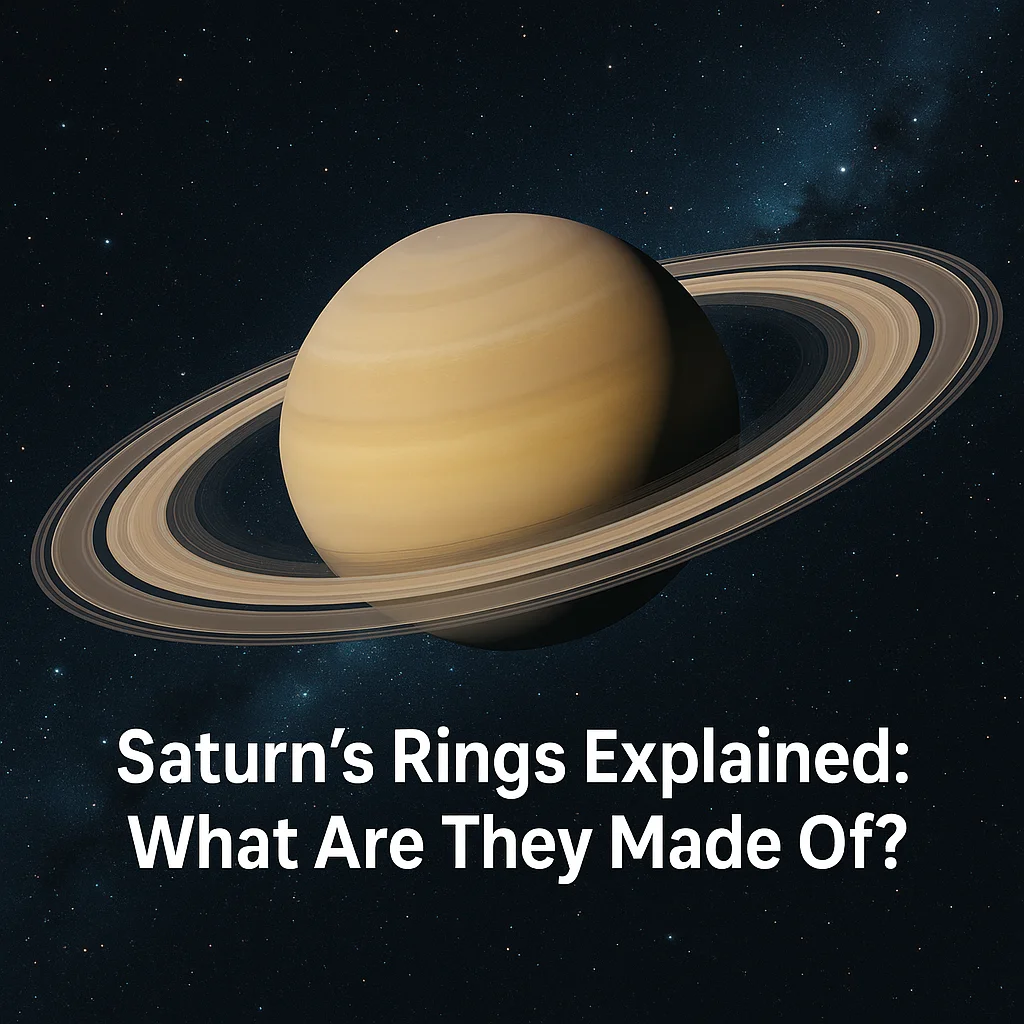
Saturn is the sixth planet from the Sun and is classified as a gas giant. It is known for its stunning ring system, which is the most extensive and observable in our Solar System. Being a gas giant means Saturn doesn't have a solid surface like Earth, and it is mostly composed of hydrogen and helium.
As one of the outer planets, Saturn's study can tell us much about the composition and evolution of our Solar System. In this article, we'll explore Saturn's rings, their composition, and the significance of these iconic structures.
Readers will learn what Saturn's rings are made of, how they remain so beautiful and intact, and the broader implications of their existence. Understanding Saturn's rings offers insights into planet formation and celestial dynamics.
📍 Where It Is and How Far Away
Saturn is located in the outer region of the Solar System, beyond the asteroid belt. It orbits the Sun at an average distance of about 9.5 Astronomical Units (AU), which means it is roughly 9.5 times farther from the Sun than Earth is. This vast distance places it at an average of around 1.2 billion kilometers (approximately 746 million miles) from the Sun.
This significant distance from the Sun affects how much sunlight Saturn receives, making it a cold planet with respect to temperature. In comparison, light from the Sun takes a little over an hour to reach Saturn, while it only takes about 8 minutes to reach Earth.
Saturn's position in the Solar System also means that it reflects sunlight distinctly, which contributes to the dazzling appearance of its rings when viewed from Earth or by passing spacecraft.
🧱 Size, Mass, and Gravity (Made Simple)
Saturn is the second-largest planet in our Solar System, surpassed only by Jupiter. It has a diameter of about 120,500 kilometers (approximately 74,900 miles). Despite its enormous size, Saturn is mainly composed of gases, thus it has a lower density; in fact, it is less dense than water.
Saturn's mass is approximately 95 times that of Earth. However, due to its large size and gaseous composition, its surface gravity is only slightly stronger than Earth's. If you could stand on Saturn (ignoring the issue of there being no solid surface), you would feel a gravitational pull a bit stronger than what you experience on Earth.
The lack of a solid surface is due to Saturn's being a gas giant. If you tried to stand on Saturn, you would descend into thicker layers of gas without ever touching a solid ground.
🌡️ Atmosphere and Weather
Saturn's atmosphere is primarily composed of hydrogen and helium, but it also contains traces of methane, ammonia, and other gases. These components create layers of clouds that swirl around the planet, giving rise to dynamic weather patterns.
Storms on Saturn can be colossal, with winds reaching speeds up to 1,800 kilometers per hour (about 1,118 miles per hour). The planet's rapid rotation contributes to these powerful wind currents.
The temperature in Saturn's upper atmosphere averages around minus 178 degrees Celsius (minus 288 degrees Fahrenheit), influenced by its distance from the Sun and its gaseous composition. The temperature and atmospheric conditions support delicate cloud patterns and long-lasting storms, including the famous hexagonal storm at its north pole.
🪨 Surface and Interior
Saturn, being a gas giant, lacks a true solid surface. Instead, it features a gradual transition from gaseous outer layers into denser fluid layers. As you move deeper into the planet, the pressure and temperature increase dramatically.
The structure of Saturn’s interior consists primarily of a small rocky core surrounded by metallic hydrogen and helium layers. This core is thought to be similar in size to Earth but much denser. The outer layers comprise a giant envelope of hydrogen and helium, with the metallic hydrogen layer believed to generate Saturn's magnetic field.
Without a concrete surface, exploring Saturn poses unique challenges. Scientists rely on data from spacecraft and telescopes to infer characteristics about its interior.
🌀 Rotation, Orbit, and Seasons
Saturn has a fast rotation speed, completing one spin on its axis approximately every 10.7 hours. This rapid rotation results in a noticeable flattening at its poles and a bulging equator known as an oblate spheroid shape.
One full orbit around the Sun takes Saturn about 29.5 Earth years, meaning a single year on Saturn is equivalent to nearly 30 years on Earth. This lengthy orbit contributes to the planet's long seasons.
Saturn's axis is tilted relative to its orbit around the Sun, similar to Earth. This axial tilt results in the occurrence of seasons, albeit each lasting over seven Earth years due to the planet's long orbital period.
🧲 Magnetic Field and Radiation
Saturn has a powerful magnetic field, second only to Jupiter in the Solar System. This magnetic field is generated by the swirling metallic hydrogen deep within the planet's interior.
The magnetic environment causes bright auroras at Saturn’s poles, similar to Earth's Northern and Southern Lights. The magnetic field also traps charged particles, creating radiation belts that pose risks to spacecraft.
Understanding Saturn's magnetic field helps scientists learn about the planet's internal structure and the behavior of its atmosphere. It also provides significant insight into space weather processes across the Solar System.
🌙 Moons, Rings, and Neighbors
One of the most captivating features of Saturn is its spectacular ring system. These rings are composed of countless small ice and rock particles, varying in size from tiny grains to large chunks. The rings are divided into seven main groups, designated alphabetically based on their order of discovery.
Saturn is also home to over 80 moons, with Titan being the largest. Titan is larger than the planet Mercury and has a dense atmosphere rich in nitrogen. These moons interact with Saturn's rings and magnetosphere, creating fascinating gravitational resonances and contributing to the rings' structure.
The complexity of the ring system and the extensive moon family make Saturn one of the most interesting objects in our Solar System to study gravitational interactions and celestial mechanics.
🔭 How We Know (Missions and Observations)
Telescope observations from Earth provided the first glimpse of Saturn's rings in the 17th century. Since then, advancements in technology have significantly improved our understanding of this magnificent planet.
The Pioneer and Voyager missions in the late 20th century provided crucial data on Saturn, including detailed images of its rings and moons. The Cassini-Huygens mission, launched in 1997, gave us a wealth of information over its 13-year journey around Saturn, capturing stunning photographs and spectroscopic data and deploying a probe to Titan's surface.
The data collected from these missions allow scientists to analyze Saturn's composition, atmospheric conditions, magnetic fields, and more, forming a comprehensive view of this ringed giant.
❓ Common Questions and Misconceptions
Is Saturn a star? No, Saturn is a planet, not a star. It does not produce its own light but reflects sunlight.
Can you stand on Saturn? No, Saturn lacks a solid surface. You cannot stand on the gaseous layers that make up the planet.
Is Saturn habitable for humans? No, Saturn's extreme conditions of low temperatures, high pressure, and lack of a solid surface make it uninhabitable for humans.
Why are Saturn's rings visible? Saturn's rings are visible due to reflective ice particles that scatter sunlight, making them shine brightly.
Do other planets have rings? Yes, other planets like Jupiter, Uranus, and Neptune also have ring systems, but Saturn's are the most prominent and visible from Earth.
What will happen to Saturn's rings? Scientists believe that Saturn's rings are relatively young and may eventually disperse over millions of years due to gravitational and erosive processes.
📌 Summary
- Saturn is a gas giant planet known for its extensive ring system.
- Located beyond the asteroid belt, it is about 9.5 times farther from the Sun than Earth is.
- Despite its enormous size, Saturn has only slightly stronger surface gravity than Earth.
- Its atmosphere is mostly hydrogen and helium, with extreme winds and storms.
- Saturn doesn’t have a true surface; it transitions into denser fluid layers.
- It rotates quickly, but a year on Saturn is almost 30 Earth years long, leading to long seasons.
- Saturn has a strong magnetic field that affects its entire system, producing auroras and radiation belts.
- The planet hosts a beautiful ring system and numerous moons, with Titan being the largest and most notable.
- Missions like Cassini have provided profound insights into Saturn's nature, structure, and rings.
- Among planets, Saturn is uniquely famed for its rings, offering a beautiful glimpse into the dynamics of celestial bodies in space.