🪐 Neptune Facts for Beginners
🌌 What It Is
Neptune is the eighth and farthest planet from the Sun in our Solar System. It is classified as an outer planet, which means it orbits beyond the asteroid belt. Specifically, Neptune is known as an ice giant, a type of gas giant, but with more ices like water, ammonia, and methane compared to gas giants like Jupiter.
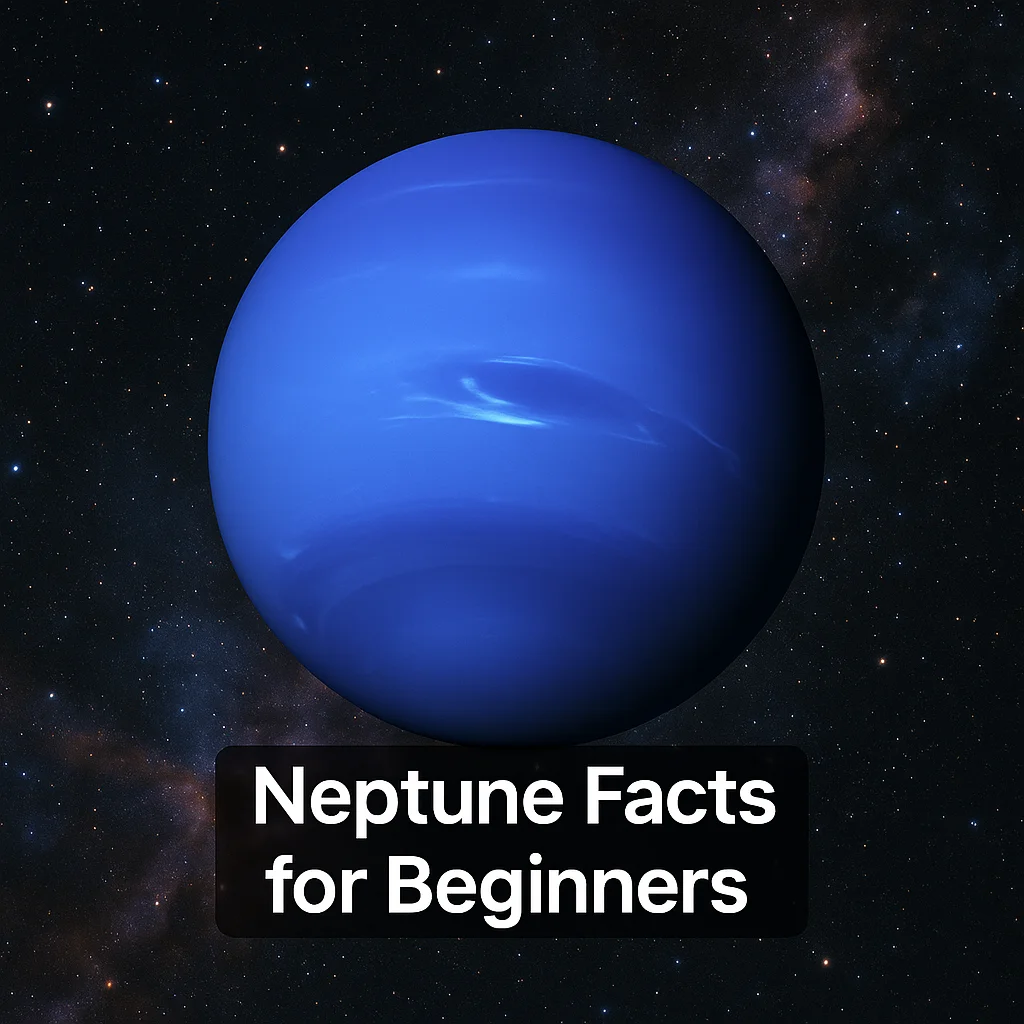
As one of the four gas giants, Neptune does not have a well-defined solid surface. Instead, it is composed primarily of thick layers of gases and ice with a possible solid core at its center. In this article, you'll learn about Neptune's appearance, location, size, atmosphere, and more!
Expect to explore the mysteries of this distant world, from its stunning blue hue to the powerful storms that rage across its atmosphere. We'll also look into its place in the Solar System and what makes Neptune such a fascinating planet.
📍 Where It Is and How Far Away
Neptune is situated in the outer realms of our Solar System. It is the eighth planet from the Sun and orbits at an average distance of about 30 astronomical units (AU). One astronomical unit is the distance from the Earth to the Sun, about 93 million miles (150 million kilometers).
Bringing things into perspective, light from the Sun takes over four hours to reach Neptune. This vast distance also means that Neptune receives much less sunlight than Earth does, resulting in extraordinarily cold temperatures.
The planet's position so far from the Sun contributes to its icy conditions and influences the atmospheric and surface temperatures, making it one of the coldest planets in the Solar System.
🧱 Size, Mass, and Gravity (Made Simple)
Neptune is the fourth largest planet in our Solar System by diameter, spanning about 49,000 kilometers (about 30,500 miles) across. Although similar in size to its neighbor Uranus, Neptune is more massive.
Its mass is 17 times that of Earth, meaning it has more material packed inside its volume. If you could stand on a solid surface within Neptune, you would feel a strong gravitational pull. However, like all gas giants, Neptune doesn't have a solid surface to stand on.
The planet's strong gravity affects its atmosphere, creating dynamic weather patterns, which we'll talk about next. Explore further to understand how Neptune's mass and size influence its environment.
🌡️ Atmosphere and Weather
Neptune's atmosphere is mostly hydrogen and helium, with traces of methane. It's the methane that gives Neptune its distinctive blue color, as it absorbs red light and reflects blue light.
Notably, Neptune's weather is extreme and dynamic. The planet hosts some of the fastest winds in the Solar System, with speeds reaching up to 1,200 miles per hour (about 2,000 kilometers per hour).
Large storm systems, such as the Great Dark Spot, are reminiscent of Jupiter's Great Red Spot. These storms occur due to the rapid rotation of the planet and temperature differences within its atmospheric layers, leading to turbulent weather patterns.
🪨 Surface and Interior
Interestingly, Neptune doesn't have a solid surface like Earth or Mars. Instead, its "surface" is considered the outermost layer of cloudy, dense gas.
Beneath Neptune's gaseous atmosphere lies an icy mantle composed of water, ammonia, and methane in a slushy mix. The planet likely has a core of rock and metal, although details about its composition are based on indirect evidence and scientific models.
The lack of a solid surface can be perplexing, but understanding Neptune's interior helps clarify why this ice giant behaves so differently from terrestrial planets.
🌀 Rotation, Orbit, and Seasons
Neptune takes about 16 hours to complete one rotation on its axis, meaning a day on Neptune is much shorter than a day on Earth. However, its orbit around the Sun is much longer.
A single year on Neptune, or one complete orbit around the Sun, takes about 165 Earth years. Neptune's axial tilt is similar to Earth's, resulting in seasons, although each season lasts over 40 Earth years due to its lengthy orbit.
This unique combination of rotation and orbit affects the weather and climate patterns we observe on Neptune.
🧲 Magnetic Field and Radiation
Neptune has a complex magnetic field, tilted at about 47 degrees from its axial rotation and offset from the planet's center. This results in a magnetic field that is both unusual and dynamic.
Like other planets with magnetic fields, Neptune experiences auroras near its poles, although they're much fainter than those on Earth.
Understanding Neptune's magnetic field helps scientists study the planet's internal structure and its interactions with the solar wind – a stream of charged particles emitted by the Sun.
🌙 Moons, Rings, and Neighbors
Neptune has 14 known moons, the most notable of which is Triton. Triton is unique due to its retrograde orbit, meaning it orbits in the opposite direction of Neptune's rotation.
Neptune also has a set of faint rings composed of ice particles and dust. The rings are less pronounced than Saturn's but are still a fascinating feature.
The gravitational interactions between Neptune and its moons, especially Triton, create interesting phenomena worth investigating further.
🔭 How We Know (Missions and Observations)
Most of what we know about Neptune comes from telescopic observations and the Voyager 2 spacecraft, which flew by in 1989. Voyager 2 provided detailed images and data about Neptune's atmosphere and moons, shedding light on its complex environment.
Ground-based and space telescopes continue to observe Neptune to gather data on its atmospheric conditions, moons, and magnetic field. By analyzing light spectra, scientists can determine the composition of Neptune's atmosphere and surface features.
Data from missions and telescopes help astronomers piece together a fuller picture of Neptune’s nature and its place in the Solar System.
❓ Common Questions and Misconceptions
Is Neptune a star? No, Neptune is a planet, not a star. It doesn't produce light or heat; it reflects sunlight.
Can you stand on Neptune? No, Neptune has no solid surface to stand on. It’s composed of gas and ice beneath its clouds.
Is it habitable? Neptune's extreme cold and lack of a solid surface make it inhospitable to life as we know it.
Why is Neptune blue? The blue color comes from methane in its atmosphere, which absorbs red light and scatters blue light.
Does Neptune have rings? Yes, Neptune has faint rings, though they aren't as prominent as those of Saturn.
How was Neptune discovered? Neptune's existence was mathematically predicted before it was directly observed through a telescope in 1846.
Does Neptune have severe weather? Yes, Neptune experiences fast winds and large storms due to its atmospheric conditions and rotation.
📌 Summary
- Neptune is an ice giant, the eighth planet from the Sun, and is farthest in our Solar System.
- It is located 30 astronomical units from the Sun, more than 4 light-hours away.
- Neptune is about 17 times the mass of Earth; its gravity influences its dynamic atmosphere.
- The atmosphere is primarily hydrogen and helium with methane, causing its blue tint.
- Neptune lacks a solid surface, with interior layers of gas, ice, and a possible rocky core.
- A day lasts 16 hours, and a year spans approximately 165 Earth years, affecting its long seasonal cycle.
- Neptune's unique magnetic field is tilted and offset from its core.
- Neptune has 14 moons, including Triton, and a faint ring system.
- Data from Voyager 2 and telescopic observations enrich our understanding of Neptune.
- Neptune's remarkable azure appearance and dynamic weather captivate scientists and enthusiasts alike.