🪐 Neptune’s Great Dark Spot and Extreme Winds
🌌 What It Is
Neptune, often called the "blue giant," is a planet in our Solar System known for its striking azure color and strong winds. Neptune is categorized as an "ice giant," setting it apart from its gas giant cousins like Jupiter and Saturn.
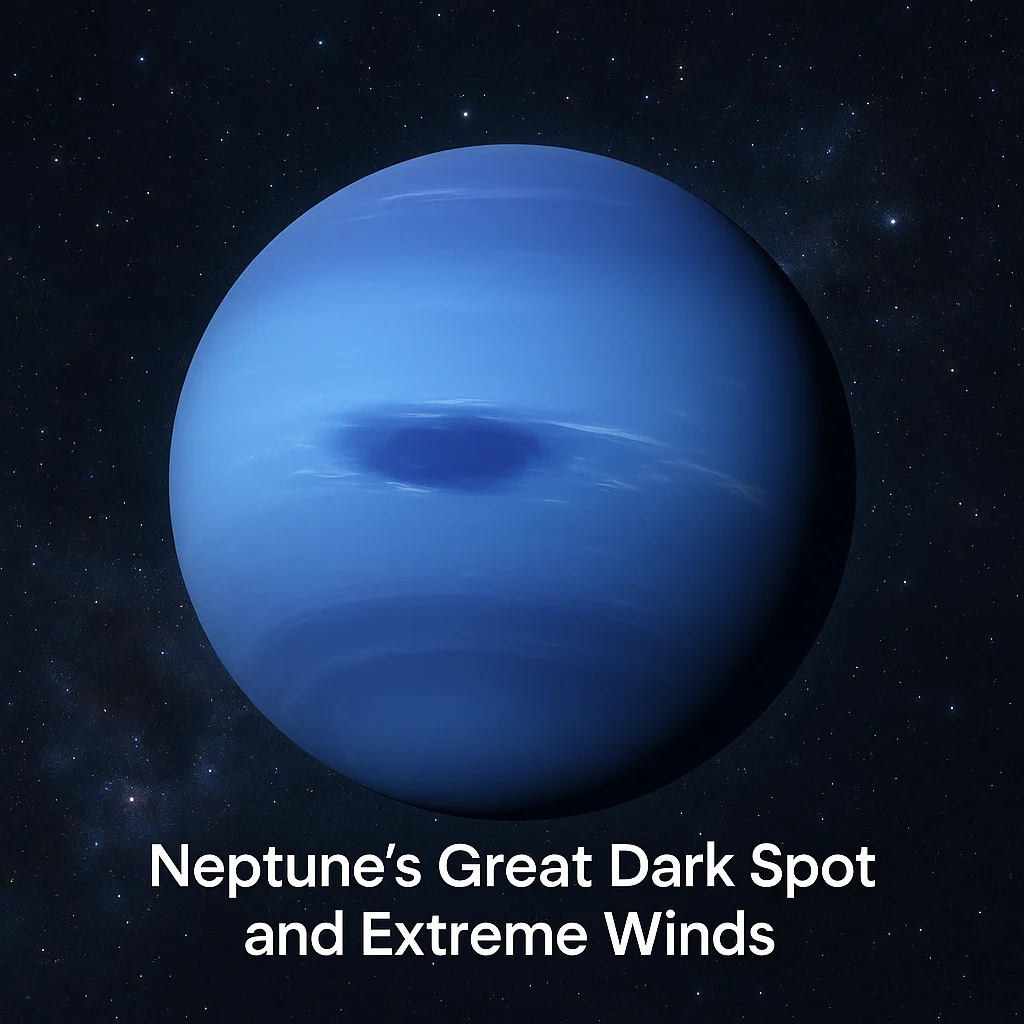
You might have heard of Neptune's famous Great Dark Spot. This feature is a massive storm similar to Jupiter’s Great Red Spot. It demonstrates the intense and dynamic weather systems that occur on this distant planet.
In this article, you'll learn about Neptune's position in space, its massive size, intriguing atmosphere, and why incredibly fast winds dominate its climate. We'll also delve into its moons, its unique magnetic field, and how scientists study such a remote world.
📍 Where It Is and How Far Away
Neptune is the eighth and most distant planet from the Sun in our Solar System. It orbits far beyond the asteroid belt, past Uranus, with only the dwarf planets like Pluto lying beyond it in our current system layout.
To give you an idea of its distance, Neptune is approximately 30 astronomical units (AU) away from the Sun. An astronomical unit is the average distance from Earth to the Sun, about 93 million miles or 150 million kilometers, making Neptune about 2.8 billion miles from the Sun.
Because of its colossal distance from the Sun, Neptune receives much less sunlight than Earth or even Jupiter. This equates to much colder temperatures and contributes to its complex weather patterns.
🧱 Size, Mass, and Gravity (Made Simple)
As the fourth largest planet, Neptune is nearly four times the diameter of Earth. However, it's much less dense, consisting heavily of gas and ice instead of solid rock and metal. Its mass is about 17 times that of Earth, which tells us just how much more material makes up this icy planet.
The gravity on Neptune, although substantial, would feel lighter to you compared to Earth because the planet has no solid surface to stand on. If you could "stand" on Neptune's cloud tops, you would weigh about the same as you do on Earth due to the planet's distribution of mass.
🌡️ Atmosphere and Weather
Neptune's atmosphere is mainly composed of hydrogen, helium, and a modest amount of methane. It is the methane that gives Neptune its unmistakably blue hue because methane absorbs red light and reflects blue back into space.
What stands out about Neptune's weather is its extreme winds, which can reach more than 1,200 miles per hour. These are the fastest winds recorded on any planet in the Solar System. Scientists think that these fierce winds are fueled by complex internal heating processes.
While Neptune is frigid due to its distance from the Sun, it shows intense storms like the Great Dark Spot, a giant storm system large enough to swallow Earth. These spots are temporary features, appearing and disappearing within the span of a few years.
🪨 Surface and Interior
Unlike terrestrial planets, Neptune has no solid surface. What we refer to as its "surface" is actually a dense layer of clouds. As you dive deeper into the planet, the gaseous atmosphere becomes a hot, dense fluid of water, ammonia, and other ices.
Below this layer is Neptune's core, which scientists believe is composed of rock and ice. The core is incredibly hot, producing much of Neptune's internal heat, which energizes its weather dynamics, despite the planet's cold outer layers.
🌀 Rotation, Orbit, and Seasons
Neptune takes about 16 hours to complete a rotation on its axis, meaning a day on Neptune is much shorter than on Earth. However, it takes about 165 Earth years to make a complete orbit around the Sun, which means that a year on Neptune is extremely long.
The planet's axis is tilted by about 28 degrees, quite similar to Earth's tilt, allowing Neptune to experience seasonal changes, albeit over vastly extended time periods compared to Earth.
🧲 Magnetic Field and Radiation
Neptune possesses a magnetic field, though much more tilted and offset relative to its rotational axis than Earth's. This unusual orientation results in complex and dynamic auroras at different locations than one would expect based on its poles.
The magnetic environment around Neptune, including its radiation belts, impacts any spacecraft that visits or observes the planet. However, this same magnetic shielding can help retain the planet's fragile atmosphere over immense timescales.
🌙 Moons, Rings, and Neighbors
Neptune has 14 known moons, with Triton being the largest and most interesting. Triton is unique because it orbits Neptune in the opposite direction of the planet's rotation, a situation called a retrograde orbit, suggesting it might be a captured object from the Kuiper Belt.
Besides moons, Neptune is surrounded by a system of rings, which are faint and fragmented compared to the prominent rings of Saturn. These rings are mostly composed of ice and dust particles, which may be continually replenished by impacts or collisions.
🔭 How We Know (Missions and Observations)
The Voyager 2 spacecraft is the only mission to have visited Neptune, providing a wealth of data about the planet in 1989. It gave us detailed images and measurements of Neptune's atmosphere, magnetic field, rings, and moons.
Telescopes like the Hubble Space Telescope continue to observe Neptune from afar, capturing images and spectra that help scientists study Neptune's ever-changing atmospheres and weather patterns. These observations are crucial for understanding the dynamics of distant, cold planets.
❓ Common Questions and Misconceptions
Is Neptune a star? No, Neptune is not a star but a planet. Unlike stars, planets do not emit light; they reflect the light of the Sun.
Can you stand on Neptune? Neptune has no solid surface; if you tried standing, you'd sink into increasingly dense gases and liquids.
Is Neptune habitable? Due to its frigid temperatures and lack of a solid surface, Neptune is not considered habitable for humans or known life forms.
Why is Neptune blue? Neptune appears blue because its atmosphere contains methane, which absorbs red light and reflects blue light.
Does Neptune have rings? Yes, although faint, Neptune has a system of rings made mostly of ice and dust.
Does Neptune have seasons? Yes, Neptune has seasons like Earth, but they last much longer due to its extended orbit around the Sun.
📌 Summary
- Neptune is an ice giant known for its blue color and extreme weather, including the famous Great Dark Spot.
- Located as the eighth planet from the Sun, Neptune is around 2.8 billion miles away.
- Four times Earth's size, Neptune has a mass 17 times greater than Earth's.
- The atmosphere is hydrogen, helium, and methane, fueling incredibly fast winds.
- Without a solid surface, Neptune has a core of rock and ice, surrounded by gaseous layers.
- A day on Neptune lasts about 16 hours, while its year spans 165 Earth years.
- Neptune has a complex magnetic field contributing to unique auroras.
- With 14 moons, Triton is the largest, and Neptune also possesses faint rings.
- Knowledge of Neptune primarily comes from the Voyager 2 mission and telescope observations.
- Neptune's extreme winds make it a dynamic and fascinating planet to study.