🪐 Neptune vs Uranus: What Makes Them Different?
🌌 What It Is
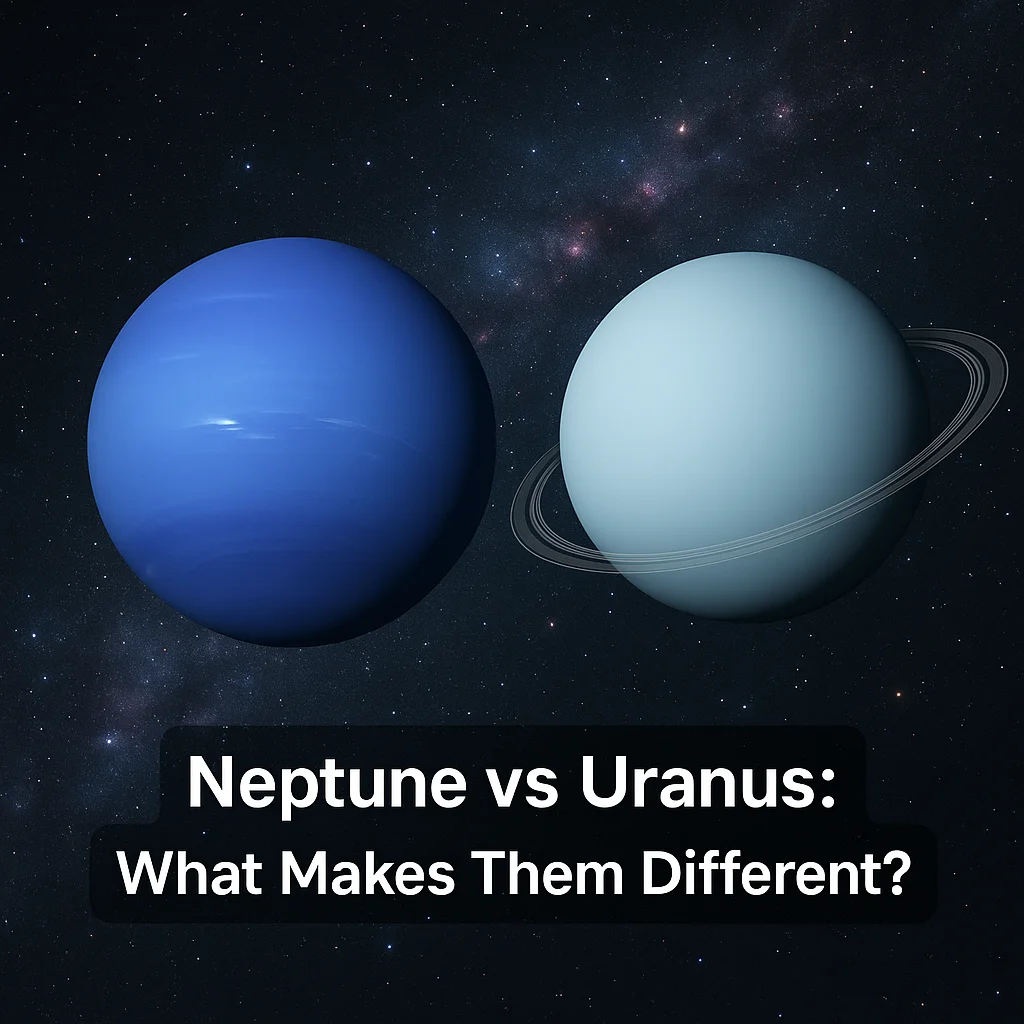
Neptune and Uranus are the seventh and eighth planets from the Sun, respectively, in our Solar System. They are classified as ice giants, a type of giant planet that predominantly consists of elements heavier than hydrogen and helium, such as water, ammonia, and methane ices.
These distant worlds captivate astronomers with their unique conditions that contrast with both the terrestrial planets and the larger gas giants in our Solar System. While they might appear similar at first glance, Neptune and Uranus have distinct characteristics that make them fascinating subjects of study.
In this article, we will explore the key differences between Neptune and Uranus in terms of their locations, sizes, atmospheres, and more. By the end, you'll gain a deeper understanding of what sets these icy giants apart.
📍 Where It Is and How Far Away
Located in the outer regions of our Solar System, Uranus is the seventh planet and Neptune is the eighth. They both orbit the Sun at a considerable distance, making them part of the outer planets group. This distant positioning means that they receive far less sunlight than Earth, contributing to their cold temperatures.
Neptune is approximately 30 astronomical units (AU) from the Sun, while Uranus is about 19 AU away. An astronomical unit is the average distance from Earth to the Sun, making these planets vastly removed from our immediate celestial neighborhood.
The significant distance from the Sun influences not only their chillier temperatures but also how we observe and study them, presenting challenges for light and radio signal travel times.
🧱 Size, Mass, and Gravity (Made Simple)
Neptune is slightly smaller in diameter than Uranus but is more massive. This additional mass gives Neptune a stronger gravitational field, which affects its overall density and structure. Despite their immense size, standing on either isn't possible as they lack a solid surface.
To imagine their size, Neptune has a diameter of about 49,500 kilometers (30,800 miles), whereas Uranus's diameter is around 50,700 kilometers (31,500 miles). This places them both vastly larger than Earth, yet smaller than gas giants like Jupiter and Saturn.
The concept of "gravity" won’t feel normal on these planets. While they both have a high gravitational pull due to their masses, you would sink into the gaseous layers rather than stand on a rocky surface.
🌡️ Atmosphere and Weather
The atmospheres of Uranus and Neptune are rich in hydrogen, helium, and methane. The presence of methane gives these planets their striking blue hues, with Neptune appearing a deep azure and Uranus a pale cyan.
Neptune is famous for its dynamic climate, boasting the fastest winds in the Solar System, which can approach speeds of up to 2,100 kilometers (1,300 miles) per hour. Its storm systems, including the Great Dark Spot, resemble the stormy patterns seen on Jupiter.
Conversely, Uranus has a more tranquil atmosphere but experiences unique seasonal variations due to its extreme axial tilt. This tilt means its poles receive sunlight for long periods, shaping its atmospheric dynamics differently from Neptune.
🪨 Surface and Interior
Neither Uranus nor Neptune have well-defined solid surfaces. Instead, they transition from gaseous atmospheres to deeper liquid layers of water, ammonia, and methane. These transitions create a diffuse boundary rather than a solid ground.
Beneath these layers, it's believed the planets have rocky cores surrounded by thick shells of ice and compressed gases. Understanding these interiors is crucial for comprehending their magnetic fields and atmospheric behaviors.
The absence of a solid surface means observers would gradually descend through increasingly dense layers of gases and ices if attempting to reach the core.
🌀 Rotation, Orbit, and Seasons
Uranus rotates on its side with an axial tilt of about 98 degrees, resulting in extreme seasonal variations where each pole faces high sunlight for years at a time. This tilt is one of the most unusual of any planet you find in our solar system.
In contrast, Neptune's axial tilt is similar to Earth's, at around 28 degrees, giving it more familiar seasonal patterns, though the seasons last much longer due to its lengthy orbit.
Neptune takes about 165 Earth years to complete one orbit around the Sun, while Uranus takes approximately 84 Earth years. Their rotation periods are around 16 hours and 17 hours, respectively, which creates rapid day-night cycles.
🧲 Magnetic Field and Radiation
Both Uranus and Neptune possess magnetic fields generated by motions within their icy mantles. However, their fields are notably off-center and tilted relative to their rotational axes, leading to complex magnetic dynamics.
These magnetic fields help protect the planets from solar and cosmic radiation and contribute to fascinating auroras that can be observed on these distant giants, albeit differently than those found on Earth.
For spacecraft navigating the vicinity of these planets, understanding the magnetic environment is crucial to ensure safe passage and operation.
🌙 Moons, Rings, and Neighbors
Uranus has a complex system of 27 known moons, with Titania and Oberon being the largest. It also possesses narrow rings, made primarily of dark particles that are difficult to see with telescopes from Earth.
Neptune has 14 moons, with Triton being the most significant due to its retrograde orbit and potential geological activity. It also features faint rings composed of ice and dust particles.
These natural satellites and rings contribute to the planets' gravitational dynamics and offer insights into the history and evolution of the outer Solar System.
🔭 How We Know (Missions and Observations)
Our understanding of Uranus and Neptune mainly stems from observations by telescopes and brief flybys by spacecraft. The most notable mission was Voyager 2, which provided valuable data during its flybys in the 1980s.
Ground-based and space telescopes continue to study these planets, capturing images and spectra that help refine our knowledge of their atmospheres, weather patterns, and moons.
Data collected from these observations include information about their magnetic fields, atmospheric compositions, and surface dynamics, incredibly vital for ongoing and future research.
❓ Common Questions and Misconceptions
Is it a star? No, both Uranus and Neptune are planets, not stars. They do not generate their own light through fusion but reflect sunlight.
Can you stand on it? No, both are gaseous giants without a solid surface, so "standing" in a conventional sense is impossible.
Is it habitable? No, neither planet is suitable for life as we know it due to extreme temperatures, pressures, and chemical compositions.
Why is it that color? Their stunning blue and cyan colors are due to methane in the atmospheres, which absorbs red light and reflects blue.
Can we see them with the naked eye? Uranus can occasionally be visible without a telescope, but Neptune cannot be seen without optical aid due to its distance.
Are there any new missions planned? While no missions are currently en route, there is ongoing scientific interest and proposals for future missions to these ice giants.
📌 Summary
- Neptune and Uranus are ice giants, part of the outer planets.
- They are located in the distant reaches of the Solar System.
- Neptune is more massive, though Uranus has a larger diameter.
- Both have blue atmospheres due to methane but different weather systems.
- They lack solid surfaces; instead, they have gaseous and icy layers.
- Uranus has a unique tilt, while Neptune's orbit is longer.
- Their magnetic fields are unusual and complex.
- Uranus has 27 moons and faint rings; Neptune has 14 moons.
- Most information we have comes from Voyager 2 and telescopic studies.
- Neptune boasts remarkably strong winds, unlike any other planet.