🪐 Uranus Facts for Beginners
🌌 What It Is
Uranus is one of the eight major planets in our Solar System. It's classified as an ice giant, setting it apart from terrestrial or rocky planets like Earth and Mars, as well as gas giants like Jupiter and Saturn. As an ice giant, Uranus is composed mostly of hydrogen, helium, and ices like water, ammonia, and methane.
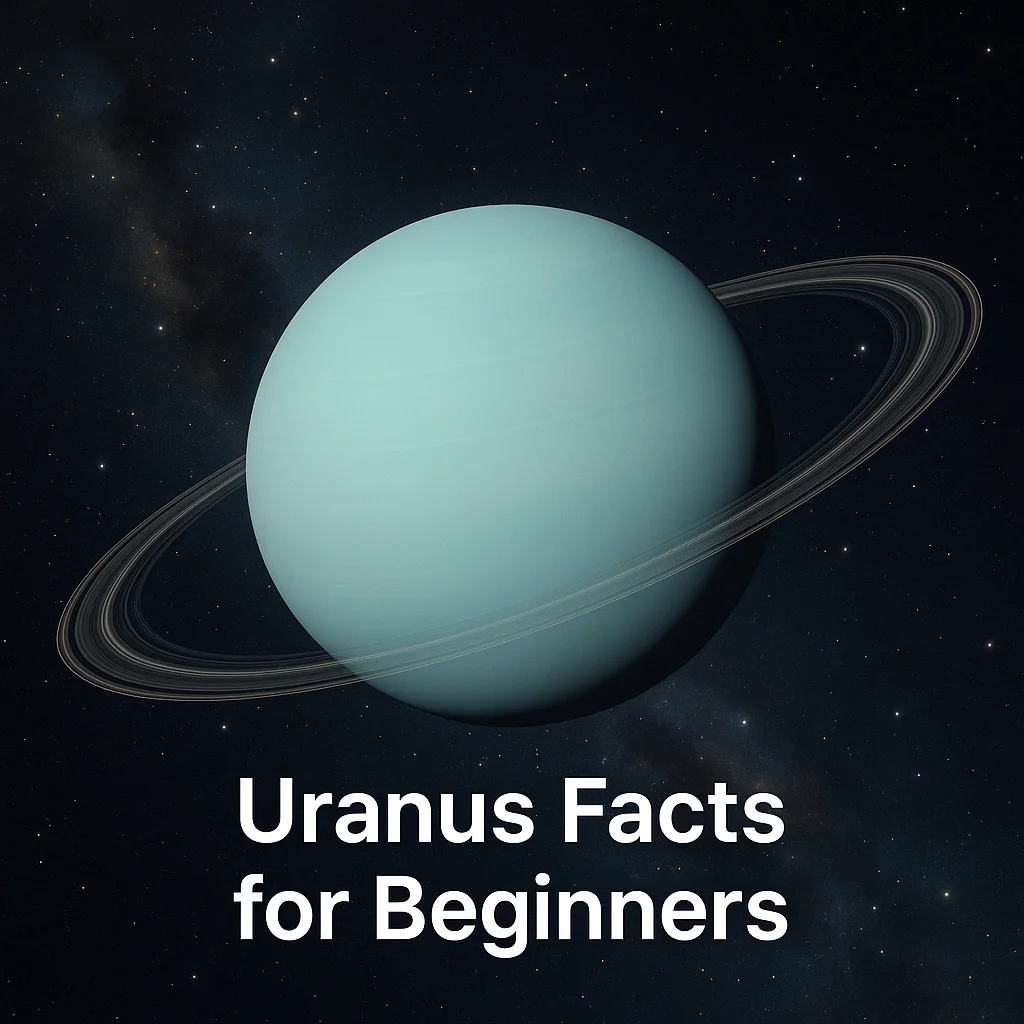
This article is designed to introduce you to the fascinating world of Uranus. You'll learn about its location, size, atmosphere, and more. We've prepared a beginner-friendly guide to help you understand this distant planet's unique features.
Understanding what makes Uranus special can widen your appreciation for the complexity and variety found within our Solar System.
📍 Where It Is and How Far Away
Uranus is the seventh planet from the Sun, located in the outer region of the Solar System. It's often hard to spot due to its distance and dimness. You'll find Uranus between Saturn and Neptune in this cosmic lineup.
When it comes to distance, Uranus is about 1.8 billion miles from the Sun. That's approximately 19.8 astronomical units (AU) where one AU is the average distance from the Earth to the Sun. Put another way, light takes about 2.7 hours to travel from the Sun to Uranus.
Being so far away from the Sun results in significantly less sunlight reaching Uranus, contributing to its very cold temperatures and comparative lack of light.
🧱 Size, Mass, and Gravity (Made Simple)
Uranus has a diameter of about 31,518 miles, making it about four times wider than Earth, although less massive than its neighbor, Saturn. If Earth were the size of a basketball, Uranus would be around the size of a large beach ball.
The surface gravity on Uranus is slightly lower than on Earth, about 90% as strong. This means a person who weighs 100 pounds on Earth would weigh just 90 pounds on Uranus. However, standing is a different matter since Uranus doesn't have a solid surface as we know it; it’s mostly layers of gas.
The concept of surface becomes abstract because the planet is composed mostly of gases and ices. If you tried to "land" on Uranus, there wouldn't be a solid ground to stand on.
🌡️ Atmosphere and Weather
The atmosphere of Uranus is composed mainly of hydrogen and helium, with a significant amount of methane, which gives the planet its distinct blue-green color. Methane is particularly adept at absorbing red light, causing the cyan hue we observe.
Weather conditions on Uranus are extreme by Earth standards. High-speed winds, reaching up to 560 miles per hour, whip through its atmosphere. Interestingly, the planet experiences both massive storms and tranquil regions, complicating scientists' understanding of its meteorological dynamics.
Temperature variations are linked to Uranus' distance from the Sun and its unique rotation. With an average temperature around -357 degrees Fahrenheit, Uranus is one of the coldest planets in the Solar System.
🪨 Surface and Interior
Unlike Earth, Uranus doesn't have a solid surface. Instead, what might be considered its "surface" is merely the outer layer of clouds. As you travel deeper, the planet becomes denser, transitioning into an icy interior composed mainly of water, ammonia, and methane ices.
Uranus’ interior is distinct from gas giants like Jupiter and Saturn. It features a rocky core surrounded by a thick layer of fluid ices. These layers are vital for maintaining the planet's magnetic field and other unique characteristics.
This layered structure doesn't allow for traditional geological features like mountains or valleys. Instead, the outer layers are shaped by atmospheric conditions.
🌀 Rotation, Orbit, and Seasons
Uranus has a unique rotation and orbit that sets it apart. It takes about 17 hours to complete one full rotation on its axis, making a Uranian day shorter than Earth’s.
What really distinguishes Uranus is its extreme axial tilt of about 98 degrees. This means it effectively rolls along its orbit, experiencing extreme seasons that last about twenty years each. This tilt causes the poles to be more directly exposed to the Sun than the equator for long stretches of time.
Uranus takes approximately 84 Earth years to complete one orbit around the Sun, setting its year considerably longer than on most other planets.
🧲 Magnetic Field and Radiation
The planet's magnetic field is another peculiar aspect of Uranus. Unlike Earth's magnetic field, which is closely aligned with its rotational axis, Uranus' magnetic field is tilted at about 59 degrees to the axis. Moreover, it's offset from the planet's center.
This unusual magnetic field creates striking auroras and affects its radiation belts, contributing to a complex space weather environment. These features are not only intriguing but also play a vital role in protecting the planet's thin atmosphere.
Uranus' magnetic field affects spacecraft that venture near it, necessitating careful navigation and shielding to withstand the radiation.
🌙 Moons, Rings, and Neighbors
Uranus is known for its impressive system of 27 known moons and faint rings. The moons are named after characters from the works of William Shakespeare and Alexander Pope, with Titania and Oberon being among the largest.
The rings of Uranus are much less prominent than those of Saturn but are still a fascinating feature. They are narrow and dark, composed of small particles possibly resulting from celestial collisions.
Interactions between Uranus’ moons, rings, and nearby planets create complex gravitational dynamics, influencing their orbits in ways that fascinate astronomers.
🔭 How We Know (Missions and Observations)
Much of what we know about Uranus comes from telescopic observations and the Voyager 2 mission. Voyager 2 remains the only spacecraft to have flown by Uranus, providing invaluable data during its brief encounter in 1986.
Modern telescopes, both ground-based and space-based, continue to study Uranus, obtaining images and spectra that reveal more about its atmosphere, rings, and moons. These observations help scientists piece together the story of this distant world.
Instruments onboard look at different parts of the spectrum to gain insights into chemical compositions, weather patterns, and magnetic properties.
❓ Common Questions and Misconceptions
Is Uranus a star? No, Uranus is a planet, not a star. It doesn't produce its own light like a star does; it reflects sunlight.
Can you stand on Uranus? Standing on Uranus isn't possible due to its lack of a solid surface; it's a gaseous planet.
Is Uranus habitable? Conditions on Uranus are far too extreme for life as we know it, with severe cold and intense radiation.
Why is Uranus blue-green? The blue-green appearance of Uranus is due to methane in its upper atmosphere which absorbs red light.
Does Uranus have seasons? Yes, Uranus experiences long and extreme seasons because of its tilted rotation axis.
Why doesn't Uranus have big, visible rings like Saturn? Uranus’ rings are faint and dark compared to Saturn's, composed of smaller, less reflective particles.
📌 Summary
- Uranus is an ice giant composed mostly of hydrogen, helium, and ices.
- It is the seventh planet from the Sun, about 1.8 billion miles away.
- Uranus has a lower surface gravity than Earth, but no solid surface.
- Its atmosphere is primarily hydrogen and helium, with visible methane clouds.
- The planet's interior is made up of ice and rock layers, lacking a clear surface.
- Uranus takes 84 Earth years to orbit the Sun and has extreme seasons.
- Its magnetic field is uniquely tilted and offset, affecting space weather.
- Uranus has 27 known moons and faint rings composed of dark particles.
- Information comes from Voyager 2 and ongoing telescope observations.
- Uranus' iconic feature is its tilted axis, causing unusual seasonal changes.