🪐 Uranus: Rings, Moons, and Atmosphere
🌌 What It Is
Uranus is a fascinating planet in our Solar System, classified as an ice giant due to its composition and size. Unlike the smaller rocky planets closest to the Sun or the larger gas giants, it has a unique blend of characteristics. Ice giants like Uranus are primarily made up of elements heavier than hydrogen and helium, such as water, ammonia, and methane.
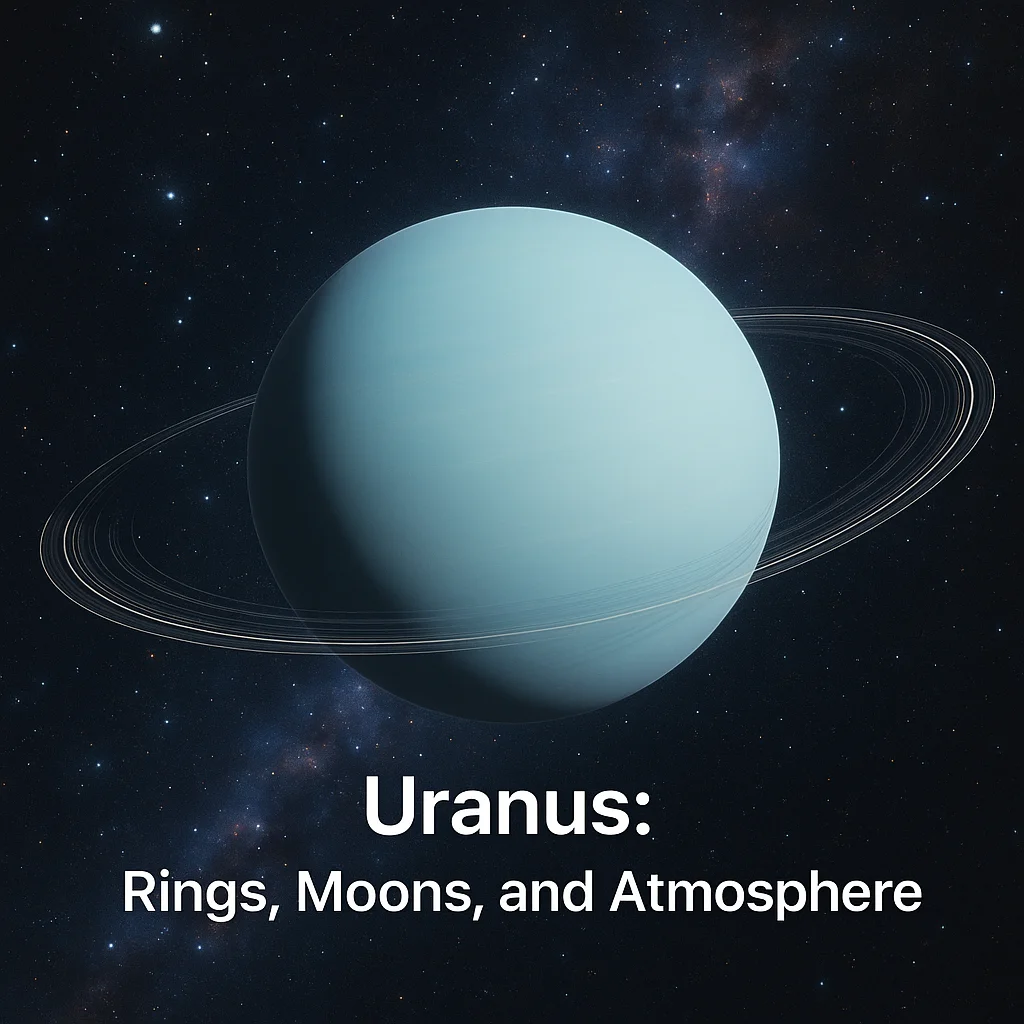
This article will explore key aspects of Uranus, including its rings, moons, and atmosphere. We'll dive into the planet's significant features and help you understand why Uranus stands out among the celestial bodies of our Solar System.
By examining its atmosphere and motion, as well as the intriguing aspects of its moons and rings, you'll gain a basic understanding of what makes Uranus unique. Let's start with where this ice giant is located and how far away it is from us.
📍 Where It Is and How Far Away
Located in the outer reaches of our Solar System, Uranus is the seventh planet from the Sun. It sits between Saturn and Neptune, its fellow giants, in terms of distance. Being an outer planet, it orbits far beyond the group of rocky inner planets like Earth.
The distance from the Sun significantly impacts how much sunlight and warmth Uranus receives. The planet is roughly 1.8 billion miles away from the Sun, meaning the sunlight it gets is much weaker and more diffuse than what we experience on Earth. This vast distance is about 19 times the average Earth-Sun distance, a measurement known as an astronomical unit (AU).
Because of its distance, sunlight takes about 2 hours and 40 minutes to travel from the Sun to Uranus. This is why the planet is extremely cold and has a unique environment that we'll explore further in the next sections.
🧱 Size, Mass, and Gravity (Made Simple)
Uranus is the third-largest planet in the Solar System by diameter, following Jupiter and Saturn. Its diameter is about four times that of Earth. However, its mass is significantly lighter than the gas giants due to its composition, which includes icy cores and fluid layers.
The surface gravity on Uranus is slightly less than that of Earth, even though Uranus is much bigger. If you could stand on a solid surface at the top of its atmosphere, you would feel a bit lighter than you do on Earth. But since it lacks a defined solid surface, standing on Uranus isn't possible; you would descend through its gaseous envelope instead.
Understanding these basics about size and gravity helps set the stage for exploring what Uranus is composed of and how its outer layers behave—topics we'll unpack under its atmosphere.
🌡️ Atmosphere and Weather
The atmosphere of Uranus is composed mainly of hydrogen and helium, with a significant amount of methane, which gives the planet its blue-green tint. This methane absorbs red light from the Sun and reflects the blue tones, creating the characteristic hue visualized in images where the entire planet is in the frame.
The weather on Uranus is marked by extreme temperatures and rapid winds. The planet experiences very low temperatures, as low as -224 degrees Celsius, making it one of the coldest places in the Solar System. Despite this, Uranus has surprisingly dynamic weather, with winds that can reach speeds of over 500 miles per hour.
These atmospheric conditions are influenced by its lack of internal heat and the limited sunlight reaching the planet. The unique rotation of Uranus also plays a role in its unusual weather patterns, a topic we'll discuss further in the rotation and orbit section.
🪨 Surface and Interior
Unlike rocky planets, Uranus does not have a solid surface. As an ice giant, it transitions from gaseous to icy and liquid layers as you move inward. The notion of "layers" refers to the gradual change from the atmospheric gases to denser compounds at lower depths.
The interior of Uranus is thought to consist of three main components: a rocky core, surrounded by an icy mantle, and an outer gaseous envelope. These layers are not sharply defined like layers of a tree but form a gradual transition from one state to another.
The way Uranus is built helps explain its magnetic field and the curious way it interacts with the environment around it. It's a complex planet full of mysteries just waiting to be explored further.
🌀 Rotation, Orbit, and Seasons
Uranus has a unique rotational feature—it spins on its side compared to most planets in the Solar System. This axial tilt of about 98 degrees means that its poles are often pointed toward the Sun, leading to unusual seasonal effects where each pole gets around 42 years of continuous sunlight followed by 42 years of darkness.
A day on Uranus, or its rotational period, lasts just over 17 hours. Meanwhile, its orbit around the Sun, or a Uranian year, takes about 84 Earth years. Hence, each season on Uranus lasts around 21 Earth years.
This extreme tilt contributes to distinct seasonal changes and affects the atmospheric processes, making Uranus's weather and climate highly peculiar. Understanding such dynamics is crucial for unraveling the complexity of this ice giant.
🧲 Magnetic Field and Radiation
Uranus possesses a magnetic field that is unique in several ways. It is tilted at nearly 60 degrees from the planet’s rotation axis and is offset from the center, unlike the more internally aligned fields seen on Earth and other planets. This unusual setup affects how radiation belts are structured around the planet.
Magnetic fields protect planets from cosmic radiation and solar winds by deflecting harmful particles, creating phenomena such as auroras. On Uranus, these auroras are not aligned with its poles due to the skewed magnetic field, painting a complex picture of its magnetic environment.
This skewed magnetic field is a result of the planet's unusual interior structure and could be integral to understanding how Uranus shields itself and its moons from the harsh solar environment.
🌙 Moons, Rings, and Neighbors
Uranus has a well-developed ring system, composed of narrow and dark rings that encircle the planet, visible in images with the entire planet and rings centered within the frame. Though less prominent than Saturn's, these rings present intriguing questions about formation and composition.
The planet also hosts 27 known moons, each with its unique characteristics. The largest moons, including Titania, Oberon, and Miranda, provide diverse landscapes with potential geological history, from ice features to impacts.
Uranus's moons and rings interact gravitationally, influencing the planet's rotation and internal structure. Their study allows scientists to learn about the planet's past and the formation of such systems in the outer Solar System.
🔭 How We Know (Missions and Observations)
Our understanding of Uranus has significantly expanded due to both telescopic observations and spacecraft missions. Space missions like Voyager 2 have provided invaluable data, including close-up images and scientific measurements of the planet and its moons.
Telescopes, both ground-based and space telescopes like Hubble, continue to study Uranus in detail by capturing images, spectra, and other data that reveal changes over time. These instruments help measure atmospheric conditions and further examine its magnetic field.
Through these methods, scientists can study a wide range of phenomena, improving our understanding of planets like Uranus and enabling us to make informed comparisons with other celestial bodies in the cosmos.
❓ Common Questions and Misconceptions
Is Uranus a star? No, Uranus is a planet. It doesn't produce its own light or heat like a star.
Can you stand on Uranus? No, Uranus lacks a solid surface; it's composed of gases and ices with no place to 'stand.'
Is Uranus habitable? Currently, no evidence suggests that Uranus is habitable, given its extreme cold and gaseous nature.
Why is it blue-green? The blue-green color is due to methane in its atmosphere, which reflects sunlight differently.
Does it have storms? Yes, despite its calm appearance, Uranus has storms due to rapid winds and atmospheric dynamics.
What's the temperature like? Uranus is one of the coldest planets, with temperatures plummeting near -224 degrees Celsius.
How many moons does Uranus have? As of now, Uranus has 27 known moons, each orbiting the planet at various distances.
Are its rings like Saturn's? While not as prominent or bright, Uranus's rings are dark and narrow but add to its fascinating structure.
📌 Summary
- Uranus is an ice giant planet characterized by its unique blue-green tint.
- Located in the outer Solar System, it is the seventh planet from the Sun.
- Uranus is large yet less massive compared to other giants, with mild gravity.
- The atmosphere contains hydrogen, helium, and methane, leading to severe winds.
- No solid surface; rather, it has gaseous and icy layers and a complex interior.
- Notable for its extreme tilt, leading to prolonged seasons lasting decades.
- An unusual magnetic field, contributing to unique auroral patterns.
- Hosts 27 moons and a set of dark, narrow rings, interacting gravitationally.
- Knowledge from Voyager 2 and telescopic observations continues to grow.
- Uranus's sideways spin and extreme cold make it a standout in our Solar System.