🪐 Why Ice Giants Are “Ice” Giants
🌌 What It Is
Ice giants are a type of giant planet, distinct within the family of planets in the Solar System. Unlike the gas giants such as Jupiter and Saturn which are mainly composed of hydrogen and helium, ice giants are made up of heavier elements such as water, ammonia, and methane, often referred to as "ices" in astronomy. These elements form deep beneath a thick atmosphere of hydrogen and helium.
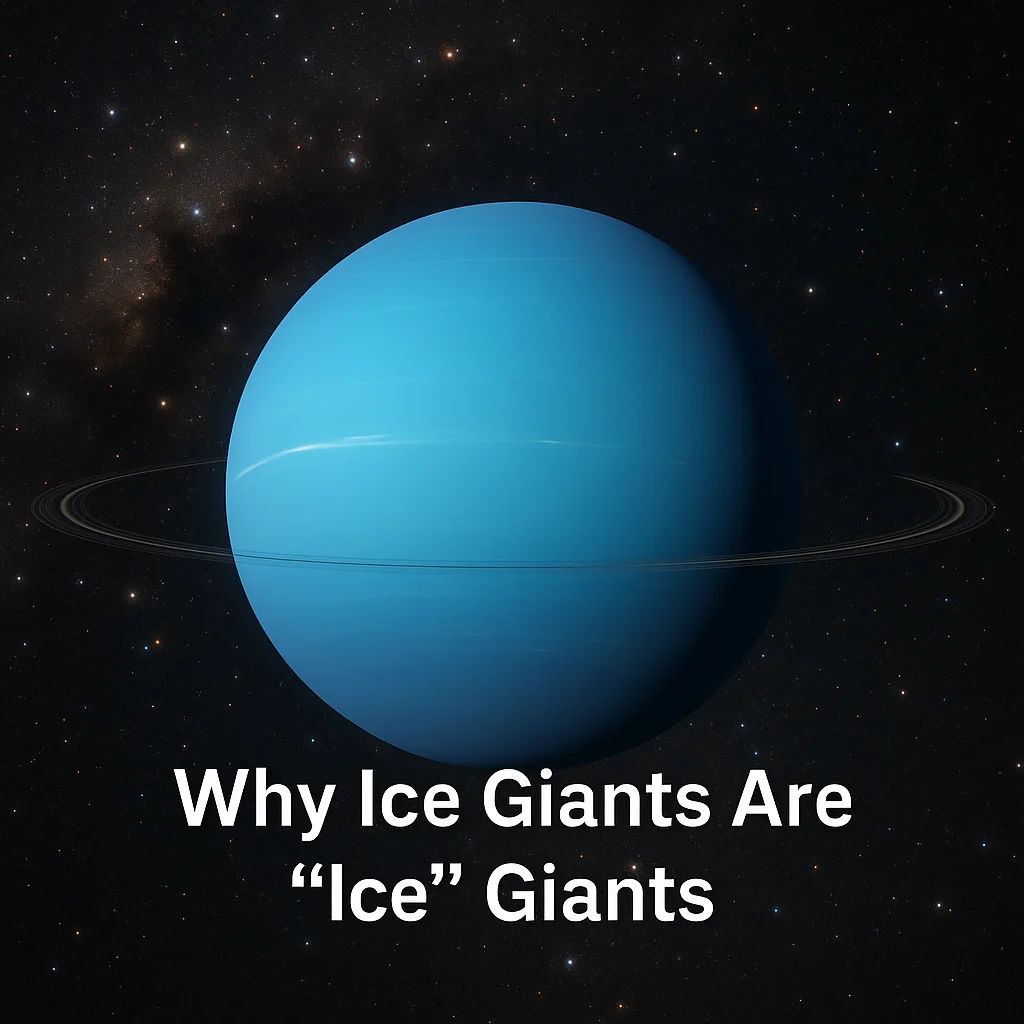
Planets like Uranus and Neptune are classified as ice giants. While they are enveloped by gaseous layers, their interiors consist of compounds that become ice under conditions of low temperature and high pressure. This unique composition distinguishes them from their gas giant relatives.
In this article, we will explore the characteristics that make ice giants unique. You will learn about their place in our Solar System, their physical properties, and the celestial phenomena they exhibit.
📍 Where It Is and How Far Away
Ice giants are located in the outer regions of our Solar System, beyond the asteroid belt and after Jupiter and Saturn. Uranus and Neptune are the two known ice giants, with Neptune being the furthest planet from the Sun. Their positions account for their colder temperatures compared to the inner planets.
The average distance from the Earth to Uranus is about 1.8 billion miles (approximately 2.9 billion kilometers), while Neptune is around 2.7 billion miles (approximately 4.3 billion kilometers) from Earth. To put this into perspective, light from the Sun takes about 2.7 hours to reach Uranus and around 4.2 hours to reach Neptune.
Given their significant distance from the Sun, they receive less sunlight than the inner planets. Thus, these planets are icy both in terms of composition and surface temperature, which influences many of their physical characteristics.
🧱 Size, Mass, and Gravity (Made Simple)
The size and mass of ice giants are intermediate between those of Earth and gas giants like Jupiter. Uranus and Neptune each have a diameter roughly four times that of Earth. Despite their large volume, their mass is only about 14.5 for Uranus and 17 times that of Earth for Neptune, respectively.
This combination of size and mass results in surface gravity on Uranus and Neptune that is relatively close to Earth’s gravity, making them unique among giant planets. However, because these planets do not have a solid surface, it is not possible to stand on them like one would on Earth.
Instead, “standing” on an ice giant would mean descending into thicker and denser layers of gas and ice as pressure and temperature increase drastically. This absence of a solid surface is typically what people find most curious about these distant worlds.
🌡️ Atmosphere and Weather
The atmospheres of ice giants are mostly composed of hydrogen and helium, with a higher concentration of water, ammonia, and methane than gas giants. Methane contributes to the striking blue color of these planets; it absorbs red light and reflects blue and green light, giving them their distinctive hue.
Weather on ice giants can be extreme due to their cold temperatures and rapid winds. For instance, Neptune has some of the fastest winds in the Solar System, reaching speeds of over 1,200 miles per hour. These winds create large storms and slightly offset bands of clouds in the atmosphere.
The reason for such intense weather patterns is still being studied. Scientists think the huge differences in temperature between different atmospheric layers, along with rapid rotations, play a critical role in these dynamic atmospheric systems.
🪨 Surface and Interior
Ice giants do not have a well-defined solid surface. Instead, as one moves through the outer layers, gases transition smoothly into a hot and dense liquid state. Beneath the thick atmospheres lies a massive icy layer rich in water, ammonia, and methane in a supercritical fluid form.
The interior is believed to have a rocky core surrounded by a mantle of water, ammonia, and methane ices. These layers increase in pressure and temperature as you move inward. This core-mantle structure is fundamentally different from the largely gaseous compositions found in gas giants.
The term “ice” specifically refers to substances that exist in a frozen state, even if they aren't solid like Earth’s typical ice. The understanding of these interiors comes from mathematical models and gravitational measurements, as probes haven't yet landed on these distant worlds.
🌀 Rotation, Orbit, and Seasons
Uranus and Neptune both have interesting rotations and orbits. Uranus rotates on its side with an axial tilt of about 98 degrees, resulting in extreme seasons. Each pole gets about 42 years of continuous sunlight followed by 42 years of darkness as the planet orbits the Sun.
Neptune, on the other hand, has a more typical axial tilt of about 28 degrees, similar to Earth’s, resulting in more moderate seasonal changes. A day on Uranus lasts about 17 hours, while on Neptune it's around 16 hours.
Both ice giants take a long time to orbit the Sun, with Uranus completing an orbit every 84 Earth years and Neptune every 164 Earth years. This lengthy journey around the Sun adds to the mystery and fascination surrounding these distant planets.
🧲 Magnetic Field and Radiation
Ice giants have unique magnetic fields compared to other planets. Uranus and Neptune’s magnetic fields are tilted relative to their rotational axes and offset from their centers, creating complex magnetospheres.
These magnetic fields are thought to originate from ionic motion in the deeper layers of the planets, possibly resulting from the movement of dissolved ammonia or water in the icy interiors.
The study of these magnetospheres is important for understanding space weather effects and protection needed for future spacecraft. The magnetic fields also cause auroras, though they are quite different than those on Earth due to the unusual magnetic configurations.
🌙 Moons, Rings, and Neighbors
Both Uranus and Neptune have systems of rings and moons that add to their allure. Uranus boasts 27 known moons, with names drawn from characters of Shakespeare and Pope, and its ring system consists of dark and faint rings.
Neptune has 14 known moons, the largest of which is Triton, an icy world that orbits in the opposite direction of Neptune’s rotation. Both planets have rings made primarily of ice particles mixed with darker dust, but these rings are not as prominent as those of Saturn.
The gravitational interactions between the moons and rings are important for understanding the stability and evolution of these systems over time. Their study also provides clues about the formation and history of the ice giants.
🔭 How We Know (Missions and Observations)
Our understanding of ice giants stems from both telescopic observations and spacecraft missions. Telescopes have provided images and spectroscopic data from afar, setting the stage for detailed study.
The Voyager 2 spacecraft made historic flybys of Uranus in 1986 and Neptune in 1989, providing valuable images and data about the planets’ atmospheres, magnetic fields, rings, and moons. This mission delivered the first close-up views and remains a cornerstone in ice giant research.
Ground-based observations and advancements in telescope technology continue to enhance our knowledge of these planets. Future missions are being planned to return close-up observations and to further uncover the mysteries held by these distant planets.
❓ Common Questions and Misconceptions
Is an ice giant a kind of star? No, ice giants are planets, not stars, as they do not emit their own light.
Can you stand on an ice giant? No, there's no solid surface, and thus no place to stand on an ice giant.
Are ice giants made of only ice? No, “ice” refers to heavier elements like water, ammonia, and methane in various states, not actual ice as found on Earth.
Why are these planets blue? The blue color is mainly due to methane in the atmosphere, which absorbs red light.
Are they habitable? Ice giants are not considered habitable due to their extreme temperatures and conditions.
Why do they have strong winds? Winds are driven by internal heat and atmospheric dynamics, not solely from solar energy.
Do they have rings like Saturn? Yes, but their rings are much fainter and composed of smaller particles.
📌 Summary
- Ice giants are giant planets primarily composed of heavier elements, classified separately from gas giants.
- Located far from the Sun, they receive less light, contributing to their cold temperatures.
- They are massive with a large volume, yet have a gravitational pull similar to Earth's due to their composition.
- Atmospheres contain hydrogen, helium, and methane, influencing their color and extreme weather patterns.
- Internally, they consist of layers transitioning from gas to slush-like layers and a rocky core.
- Their rotation and orbit contribute to distinct seasons, especially for tilted Uranus.
- Complex magnetic fields are important for understanding their internal structures and protecting spacecraft.
- Home to several moons and faint rings, with Triton being a notable moon of Neptune.
- Keenly studied through missions like Voyager 2 and ongoing telescope observations.
- A memorable fact: Uranus rotates on its side, leading to unusual seasonal patterns.