🪐 Why Uranus Spins on Its Side
🌌 What It Is
Uranus is one of the eight planets in our Solar System and is classified as an ice giant. It is the seventh planet from the Sun and is known for its unique tilt, which makes it spin almost completely on its side. Unlike rocky planets like Earth, Uranus is made mostly of gases and ices, and it has a blue-green color due to the methane in its atmosphere.
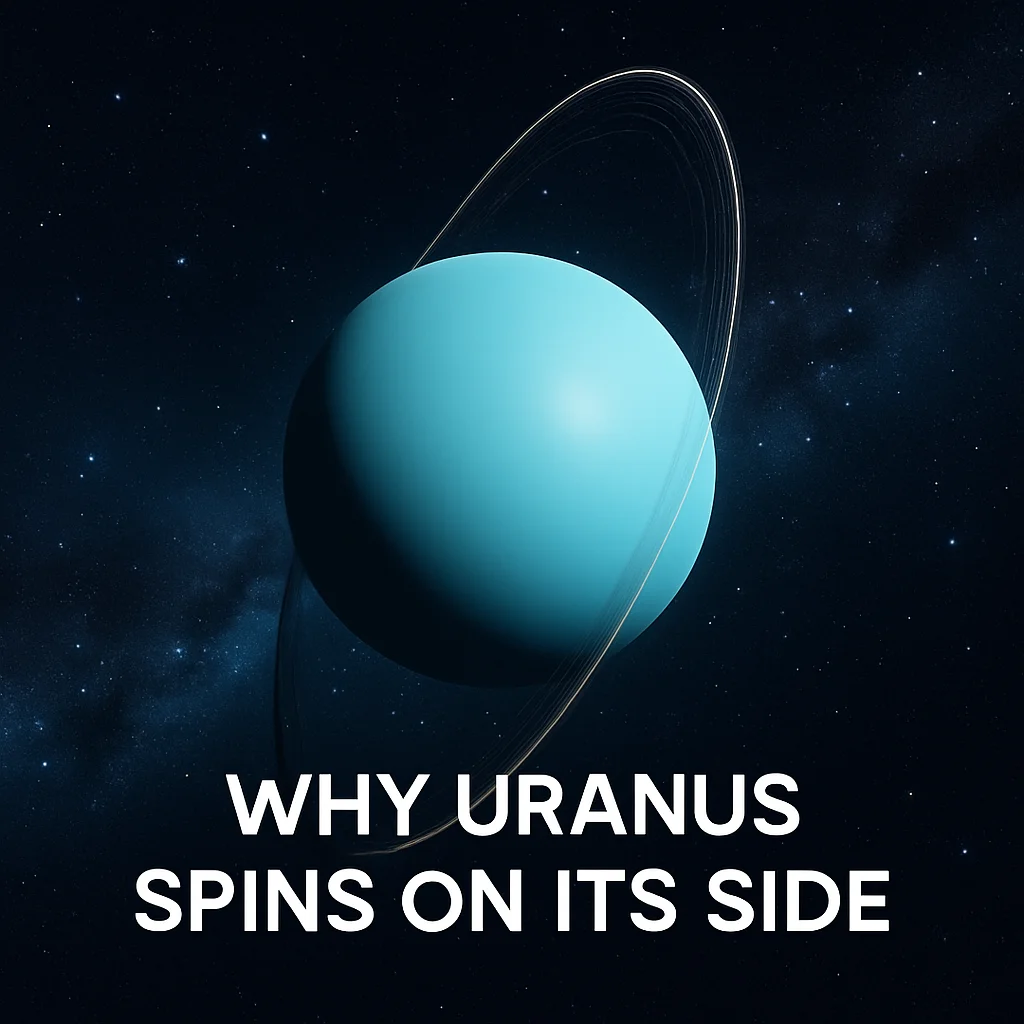
Planets are celestial bodies that orbit a star, and Uranus fits this definition as it orbits our Sun. It is part of the outer planets, which are the four gas and ice giants located beyond the asteroid belt. These giants differ from the smaller, rocky terrestrial planets closer to the Sun.
In this article, you will learn why Uranus spins on its side, along with its location, physical characteristics, atmosphere, and much more.
📍 Where It Is and How Far Away
Uranus is situated in the outer regions of the Solar System, making it the seventh planet from the Sun. It resides at an average distance of about 1.8 billion miles from our star. This distance causes it to receive significantly less sunlight compared to the inner planets, resulting in extremely low temperatures.
To put it into perspective, if the Earth were the size of a basketball floating a few feet from a spotlight representing the Sun, Uranus would be a smaller ball more than a half-mile away. It usually takes light from the Sun around 2.7 hours to reach Uranus.
Due to its far position from the Sun, Uranus experiences very cold temperatures, with an average around -224 degrees Celsius, making it one of the coldest planets in the Solar System.
🧱 Size, Mass, and Gravity (Made Simple)
Uranus is the third-largest planet in our Solar System by diameter, and it is about four times wider than Earth. Despite its large size, its density is low compared to terrestrial planets, as it is composed mostly of hydrogen, helium, and methane. This composition makes it about 14.5 times more massive than Earth.
The gravity on Uranus is roughly 90% of that on Earth. This means that if you could stand on Uranus (ignoring its gaseous nature), you would feel slightly lighter than you do on Earth. However, since Uranus does not have a solid surface, standing on this planet is not possible.
The concept of surface gravity on a gas giant like Uranus is still relevant, even though there is no actual surface. When we say "gravity," we refer to the force you would feel in the upper atmosphere, where a hypothetical cloud top might exist.
🌡️ Atmosphere and Weather
Uranus's atmosphere is composed mainly of hydrogen and helium, with a small amount of methane. This methane absorbs red wavelengths of light, giving the planet its distinct blue-green hue.
The weather on Uranus is characterized by extremely cold temperatures and dim sunlight. Its atmosphere is known for its high wind speeds that can reach up to 560 miles per hour. Although Uranus appears calm at first glance, these winds can drive storm systems across the entire planet.
The methane in the atmosphere not only contributes to its color but also plays a role in its unique climate patterns. The weather on Uranus can be affected by its extreme axial tilt, leading to unusual seasonal variations.
🪨 Surface and Interior
Unlike rocky planets, Uranus does not have a solid surface. What we perceive as the "surface" is just the outermost layer of its thick atmosphere. Beneath this layer, the planet transitions into a dense mixture of water, ammonia, and methane ices.
Scientists believe that Uranus has a rocky core, surrounded by a dense slushy mantle of ices. The core is relatively small compared to the entire planet and may be about the size of Earth.
This lack of a firm surface means that traditional geological features like mountains or valleys do not exist on Uranus. Instead, studying this planet involves understanding its atmosphere and deeper internal layers.
🌀 Rotation, Orbit, and Seasons
Uranus has a rotation period of about 17 hours, meaning it completes one full spin on its axis in less than a day. However, what makes Uranus truly unique is its axial tilt, which is about 98 degrees. Essentially, Uranus rotates almost on its side compared to the other planets.
The orbit of Uranus around the Sun takes approximately 84 Earth years. This means that each pole gets around 42 years of continuous sunlight, followed by 42 years of darkness, contributing to extreme seasonal changes.
The unusual tilt of Uranus is a topic of much scientific interest, with theories suggesting that a massive collision early in the planet's history caused this unique orientation.
🧲 Magnetic Field and Radiation
Uranus possesses a magnetic field that is notably tilted compared to its rotational axis, at about 59 degrees. This dramatic tilt creates a complex and offset magnetic environment.
The magnetic field of Uranus generates auroras, much like those on Earth. However, due to the tilt, these auroras are not aligned near the poles as they are on Earth.
Understanding Uranus's magnetic field is important, as it can impact spacecraft traveling through or observing the planet. The radiation belts around Uranus can pose a challenge for future missions.
🌙 Moons, Rings, and Neighbors
Uranus has a system of rings and 27 known moons. The rings are less prominent than those of Saturn but are visible and were discovered relatively late, in 1977. These rings are made up of dark particles that are difficult to see from Earth.
Among its moons, the five largest are Miranda, Ariel, Umbriel, Titania, and Oberon. These moons exhibit a variety of geological features, like canyons and ridges, indicating past geological activity.
Uranus's gravitational influence affects its moons' orbits, creating complex interactions and resonances between them. The study of these moons and rings provides insight into the dynamics of Uranus’s broader system.
🔭 How We Know (Missions and Observations)
Much of what we know about Uranus comes from telescopic observations and the Voyager 2 spacecraft, which made a flyby in 1986. Voyager 2 provided our first close-up images and measurements of Uranus and its moons.
Telescopes on Earth and in space, like the Hubble Space Telescope, continue to observe Uranus, offering insights into its atmosphere and seasonal changes over time.
Observations from these missions provide valuable data on Uranus's composition, magnetic fields, and surrounding environment, helping scientists understand its role in the Solar System.
❓ Common Questions and Misconceptions
Is Uranus a star? No, Uranus is a planet, not a star. It does not produce light of its own but reflects sunlight.
Can you stand on Uranus? No, Uranus does not have a solid surface; it is mostly gas and ice.
Is Uranus habitable? Currently, Uranus cannot support life as we know it due to its extreme temperatures and non-solid surface.
Why is Uranus blue? The blue-green color comes from methane in the atmosphere absorbing red light from the sun.
Did Uranus always spin on its side? Scientists theorize a massive collision early in its formation caused its tilted rotation.
How long does a day last on Uranus? A day on Uranus lasts about 17 hours due to its rapid rotation.
What are the rings made of? Uranus's rings are composed of dark, tiny particles, primarily ice, and rock.
How many moons does Uranus have? Uranus has 27 known moons, each with unique features and compositions.
📌 Summary
- Uranus is an ice giant planet spinning on its side.
- It is the seventh planet from the Sun, located 1.8 billion miles away.
- The planet is massive with a relatively light gravity, having no solid surface.
- Its atmosphere is mainly hydrogen, helium, and methane, with strong winds.
- No solid surface; composed of gas and ice layers with a rocky core.
- Unusual 98-degree axial tilt, with very long seasonal cycles.
- Complex magnetic field tilted from its rotational axis, causing auroras.
- Uranus has faint rings and 27 known moons, including Miranda and Titania.
- Mainly explored by Voyager 2 flyby and telescopic observations.
- Uranus’s unique features make it an intriguing subject for study.