🪐 Mars Facts for Beginners
🌌 What It Is
Mars is a planet in our Solar System and is often referred to as the "Red Planet" due to its reddish appearance. It is the fourth planet from the Sun and is classified as a terrestrial planet, which means it has a solid, rocky surface much like Earth.
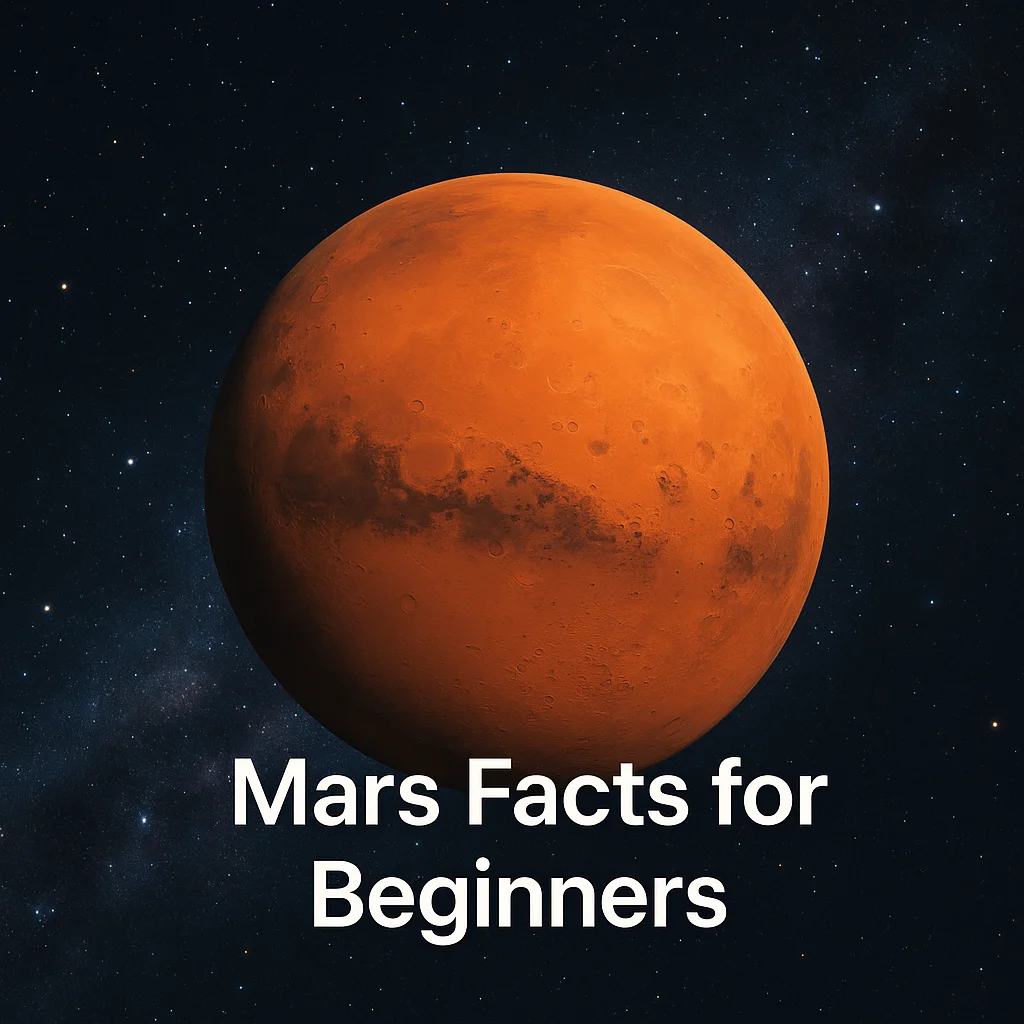
Being a terrestrial planet, Mars shares some similarities with Earth, such as having mountains, valleys, and polar ice caps, but it is also quite different in many ways. Understanding Mars provides clues about the formation and evolution of planets.
In this article, you'll learn about Mars' location, size, atmosphere, surface features, and much more. By the end, you'll have a clear understanding of why Mars captivates scientists and space enthusiasts alike.
📍 Where It Is and How Far Away
Mars is located in the inner part of the Solar System, being the fourth planet from the Sun, right after Earth. It is positioned between Earth and the asteroid belt, which separates the rocky planets from the outer gas giants.
The average distance from Mars to the Sun is about 142 million miles (approximately 228 million kilometers), which makes it around 1.5 astronomical units (AU) from the Sun. An astronomical unit is the distance from the Earth to the Sun, which helps explain large cosmic distances.
Because of its distance from the Sun, Mars receives less sunlight compared to Earth. This crucial factor affects its temperature, which is generally colder, making it a frigid desert world with large temperature swings from day to night.
🧱 Size, Mass, and Gravity (Made Simple)
In terms of size, Mars is approximately half the diameter of Earth, with a diameter of about 4,220 miles (6,790 kilometers). Despite its relatively smaller size, its surface area is similar to that of all Earth's continents combined.
The mass of Mars is about one-tenth that of Earth, which means it has significantly less gravity. Its surface gravity is about 38% of Earth's gravity, which means objects would weigh much less on Mars. For example, if you weigh 100 pounds on Earth, you would weigh only 38 pounds on Mars.
The difference in gravity affects everything, from the heights of mountains to the way dust settles after being blown by the wind, giving Mars its unique surface characteristics.
🌡️ Atmosphere and Weather
Mars has a very thin atmosphere composed mostly of carbon dioxide, with traces of nitrogen and argon. This thin atmosphere means that Mars cannot retain much heat, contributing to its cold climate.
The weather on Mars is known for its dramatic dust storms, some of which can encompass the entire planet. These storms are driven by the Sun's heating of the surface, which causes strong winds to lift dust into the atmosphere.
Temperature swings on Mars are extreme due to its thin atmosphere. Daytime temperatures can be relatively mild, but nighttime temperatures plummet, often dropping below minus 100 degrees Fahrenheit (minus 73 degrees Celsius).
🪨 Surface and Interior
The surface of Mars is characterized by vast deserts, tall volcanoes, deep canyons, and polar ice caps. Olympus Mons, the largest volcano in the Solar System, towers at about 13.6 miles (22 kilometers) high, nearly triple the height of Mount Everest.
Mars also features Valles Marineris, an extensive canyon system that stretches over 2,500 miles (4,000 kilometers). This gigantic canyon reveals much about the planet's geology and history of geological activity.
While the exact internal structure is not fully known, scientists believe Mars has a core composed of iron, nickel, and sulfur, surrounded by a rocky mantle and a crust rich in iron oxide, giving Mars its characteristic red color.
🌀 Rotation, Orbit, and Seasons
Mars takes about 24.6 hours to complete one rotation on its axis, making its day slightly longer than an Earth day. It's fascinatingly similar enough to Earth's day that it has led to many considerations for human exploration.
It takes Mars approximately 687 Earth days to orbit the Sun, which means a year on Mars is almost twice as long as an Earth year. The planet's orbit is more elliptical than Earth's, which impacts its seasons.
Much like Earth, Mars experiences seasons due to its axial tilt of approximately 25 degrees. However, because its year is longer, each season lasts about twice as long as those on Earth.
🧲 Magnetic Field and Radiation
Unlike Earth, Mars lacks a global magnetic field. Instead, it has remnants of ancient magnetic fields present in certain regions of the planet's crust. This affects how the planet interacts with solar winds and cosmic radiation.
Without the protection of a significant magnetic field and thick atmosphere, Mars is exposed to higher levels of radiation, which is a critical factor for future exploration and potential colonization by humans.
Spacecraft need to be designed with sufficient shielding to protect against this radiation, a challenge that scientists are actively addressing as they plan more missions to Mars.
🌙 Moons, Rings, and Neighbors
Mars has two small moons, Phobos and Deimos. These irregularly shaped moons are thought to be captured asteroids from the nearby asteroid belt. They orbit Mars closely and rapidly, with Phobos rising and setting twice a day.
Unlike the gas giants, Mars does not have rings around it. The absence of rings and its relatively small moons offer insights into the planet's formation and evolution within the Solar System.
The gravitational interaction with its moons, particularly Phobos, is interesting; it is gradually being pulled closer to Mars and is expected to either crash into the planet or break apart to form a ring in the distant future.
🔭 How We Know (Missions and Observations)
Mars has been extensively studied through both telescopes on Earth and a series of robotic spacecraft that have traveled to the planet. These include orbiters, landers, and rovers that have provided detailed images, measurements, and analysis.
Famous missions like NASA's Viking program, Pathfinder, Spirit and Opportunity rovers, and the recent Perseverance rover have all contributed to our understanding of Mars. Observations include stunning images, atmospheric data, and geological samples.
Telescopes have helped astronomers study seasonal changes, dust storms, and surface features over the years. Spacecraft have given us firsthand data, from the composition of Martian soil to evidence of past water activity.
❓ Common Questions and Misconceptions
Is Mars a star? No, Mars is a planet, which means it orbits the Sun and reflects sunlight rather than producing its own light.
Can you stand on Mars? Yes, Mars has a solid surface you could stand on, but the environment is harsh and requires protection from its thin atmosphere and radiation.
Is Mars habitable? Currently, Mars cannot support human life without technology because it's too cold, lacks breathable air, and experiences high radiation levels.
Why is Mars red? Mars appears red due to iron oxide, or rust, on its surface, which reflects sunlight, giving the planet its characteristic color.
Does Mars have liquid water? There is no liquid water on the surface today, but evidence suggests there was liquid water in the past. Some scientists believe there could be water in underground aquifers.
Are there Martians? There is no evidence of life, past or present, on Mars. However, the search for microbial life continues to be a significant focus of exploration.
📌 Summary
- Mars is the fourth planet from the Sun and is known as the "Red Planet."
- It is located approximately 1.5 astronomical units from the Sun.
- Mars is about half the diameter of Earth with significantly lower gravity.
- The thin atmosphere is mainly carbon dioxide, leading to extreme cold.
- Its surface features include volcanoes, canyons, and polar ice caps.
- A day is slightly longer than Earth's, and a year is nearly twice as long.
- Mars has no global magnetic field, resulting in higher radiation levels.
- The planet has two small moons, Phobos and Deimos, with no rings.
- Missions and observations have provided immense data on its geology and atmosphere.
- Memorable fact: Olympus Mons, on Mars, is the tallest volcano in the Solar System.