🪐 Mars: Water Evidence and What It Means
🌌 What It Is
Mars is the fourth planet from the Sun in our Solar System and is commonly referred to as the "Red Planet" due to its distinct reddish appearance. This coloration is due to iron oxide, or rust, on its surface. Mars is classified as a terrestrial planet, meaning it has a solid, rocky surface, similar to Earth and Venus, but smaller.
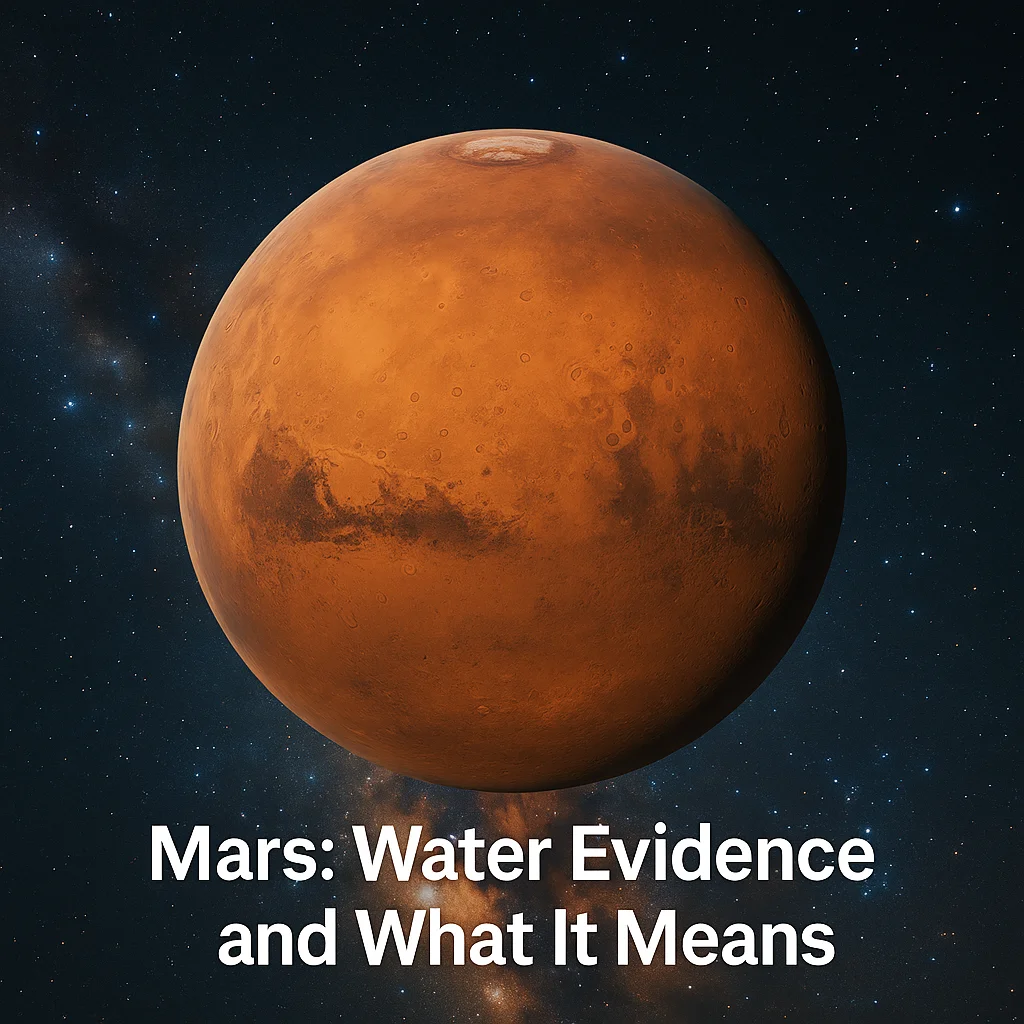
This article will explore Mars's location, size, and other fundamental traits. We'll delve into the evidence of water on Mars and its significance for science. If you ever wondered why Mars is a focal point in the search for extraterrestrial life, you're about to find out.
Understanding Mars's characteristics helps us learn about our own planet's past and what conditions might support life elsewhere in the universe. The information about water on Mars is crucial in this context, providing clues to past environments that might have been habitable.
📍 Where It Is and How Far Away
Mars is the fourth planet from the Sun, sandwiched between Earth and the asteroid belt. It's one of the inner planets, along with Mercury, Venus, and Earth. Unlike the gas giants, these planets have solid surfaces that we can study more directly.
The average distance from Mars to the Sun is about 142 million miles, which translates to approximately 1.5 astronomical units (AU). An astronomical unit is the average distance between Earth and the Sun. Light from the Sun takes a little over 12 minutes to reach Mars.
This distance results in less sunlight and heat reaching Mars compared to Earth, leading to cooler temperatures. Mars can be extremely cold, with average temperatures around minus 80 degrees Fahrenheit, varying significantly between day and night due to the thin atmosphere.
🧱 Size, Mass, and Gravity (Made Simple)
Mars is smaller than Earth, with a diameter of about 4,220 miles. Despite being larger than Mercury, Mars is less than half the size of Earth, making it the second smallest planet in our solar system.
The mass of Mars is about 10% of Earth's. Its smaller size and mass result in weaker gravity, about 38% of Earth's. This means you would feel much lighter on Mars; for example, if you weigh 100 pounds on Earth, you would weigh only 38 pounds on Mars.
The reduced gravity has implications for everything from how high one could jump on Mars to how the planet's surface and atmosphere behave.
🌡️ Atmosphere and Weather
Mars has a very thin atmosphere composed mostly of carbon dioxide, with traces of nitrogen and argon. Unlike Earth, Mars lacks a substantial atmosphere to trap heat, leading to its cold environment. Oxygen, essential for human life, is almost nonexistent.
Weather on Mars features dust storms, which can cover the entire planet and last for weeks. These storms are driven by solar heating and the planet's rotation. They can be so intense that they darken the sky and effectively obscure sight.
Temperatures on Mars fluctuate dramatically, partly due to its thin atmosphere and partly due to its elliptical orbit. Mars experiences seasons akin to Earth's but each season lasts about twice as long due to its longer orbit around the Sun.
🪨 Surface and Interior
Mars's surface is marked by ancient volcanoes, vast canyons, and impact craters. The largest volcano, Olympus Mons, is about three times taller than Mount Everest and is the tallest planetary mountain in the solar system. Valles Marineris, the most extensive canyon, stretches over 2,500 miles.
The planet is covered in a fine layer of iron oxide dust, which contributes to its reddish color. Evidence of past water flows, including river valleys and lake beds, suggests that Mars may have once had conditions to support life.
Inside, Mars has a solid core composed of iron, nickel, and sulfur, surrounded by a rocky mantle and crust. While Mars's interior is less active than Earth's, past volcanic activity and crustal movement have shaped its surface.
🌀 Rotation, Orbit, and Seasons
Mars has a day length similar to Earth's, lasting about 24 hours and 37 minutes. However, a Martian year is almost twice as long, at 687 Earth-days. This is because Mars's orbit around the Sun covers a greater distance than Earth's.
The axial tilt of Mars is about 25 degrees, close to Earth's 23.5 degrees. This tilt gives Mars its seasons, which are more extreme than Earth's due to its elliptical orbit. Summer and winter differ significantly in length and severity.
The planet's rotation also contributes to strange occurrences, like dust storms and temperature differences between the hemispheres. These factors create a dynamic environment despite the planet's barren appearance.
🧲 Magnetic Field and Radiation
Mars lacks a global magnetic field like Earth's, which means it doesn't have the same protection from solar and cosmic radiation. This exposure significantly impacts the surface and any potential for life as we understand it.
However, Mars does have localized magnetic fields in some regions, indicating that it might have had a global field in the past. These pockets of magnetism affect space weather and solar wind interaction with the atmosphere.
The lack of a magnetic field means the surface of Mars is constantly bombarded with radiation. This is a significant consideration for future human missions and potential colonization efforts.
🌙 Moons, Rings, and Neighbors
Mars has two small moons, Phobos and Deimos, thought to be captured asteroids. They are irregular in shape and much smaller compared to Earth's Moon. Phobos orbits very close to Mars and could crash into the planet or break apart due to gravitational forces in the distant future.
The gravitational interaction between Mars and its moons creates intriguing dynamics. Phobos's close proximity leads to rapid orbits, completing three in a single Martian day. Meanwhile, Deimos orbits more slowly.
Unlike the gas giants, Mars has no rings. The lack of rings is typical for terrestrial planets, but the influence of its moons and gravitational characteristics make Mars interesting for study.
🔭 How We Know (Missions and Observations)
Mars has been explored through a combination of telescopic observations and robotic spacecraft missions. Observatories on Earth and space telescopes like the Hubble Space Telescope have provided valuable imagery and data.
Numerous missions have reached Mars, including those by NASA's Mariner, Viking, and more recent rovers like Spirit, Opportunity, Curiosity, and Perseverance. These missions have provided unparalleled insight into Mars's geology and climate.
Data types collected include high-resolution images, soil samples, atmospheric readings, and magnetic field measurements. These findings have advanced our understanding of Mars significantly and continue to guide future exploration.
❓ Common Questions and Misconceptions
Is Mars a star? no, Mars is a planet. Stars generate light and heat through nuclear fusion, while planets, like Mars, orbit stars.
Can you stand on Mars? Yes, Mars has a solid surface, unlike gas giants where standing is impossible.
Is Mars habitable? Current conditions are not suitable for human life, but ancient Mars might have had habitable conditions.
Why is Mars red? Its surface is covered in iron oxide, giving it a rusty, red appearance.
Does Mars have water? Mars has frozen water at its poles and underground, and past evidence suggests liquid water once flowed there.
Why are Mars's days and years different? Mars's rotation is similar to Earth's, but its orbit around the Sun is much longer, making its year 687 Earth-days.
Does Mars have a thick atmosphere? No, Mars's atmosphere is very thin, composed mostly of carbon dioxide with little oxygen.
Are there Martian storms? Yes, Mars experiences dust storms that can be planetary in scale, affecting its surface and climate.
📌 Summary
- Mars is the fourth planet from the Sun, known for its red appearance.
- It is located in the inner Solar System, about 1.5 AU from the Sun.
- Smaller than Earth, Mars has weaker gravity; objects weigh 38% of their Earth weight.
- The thin atmosphere is mostly carbon dioxide, causing cold temperatures and dust storms.
- Mars's surface has huge volcanoes and canyons, with evidence of past water flows.
- A Martian day is similar to Earth's, but the year is nearly twice as long due to its orbit.
- No global magnetic field exists, increasing radiation exposure on its surface.
- Two small moons, Phobos and Deimos, have unique orbits influenced by Mars's gravity.
- Exploration includes telescopic observations and missions like the Mars rovers.
- Mars's evidence of past water raises questions about previous habitability.