🪐 Mercury Facts for Beginners
🌌 What It Is
Mercury is the smallest planet in our Solar System and the closest one to the Sun. It belongs to a group of planets known as terrestrial planets, which include Earth, Venus, and Mars. Terrestrial planets have solid, rocky surfaces.
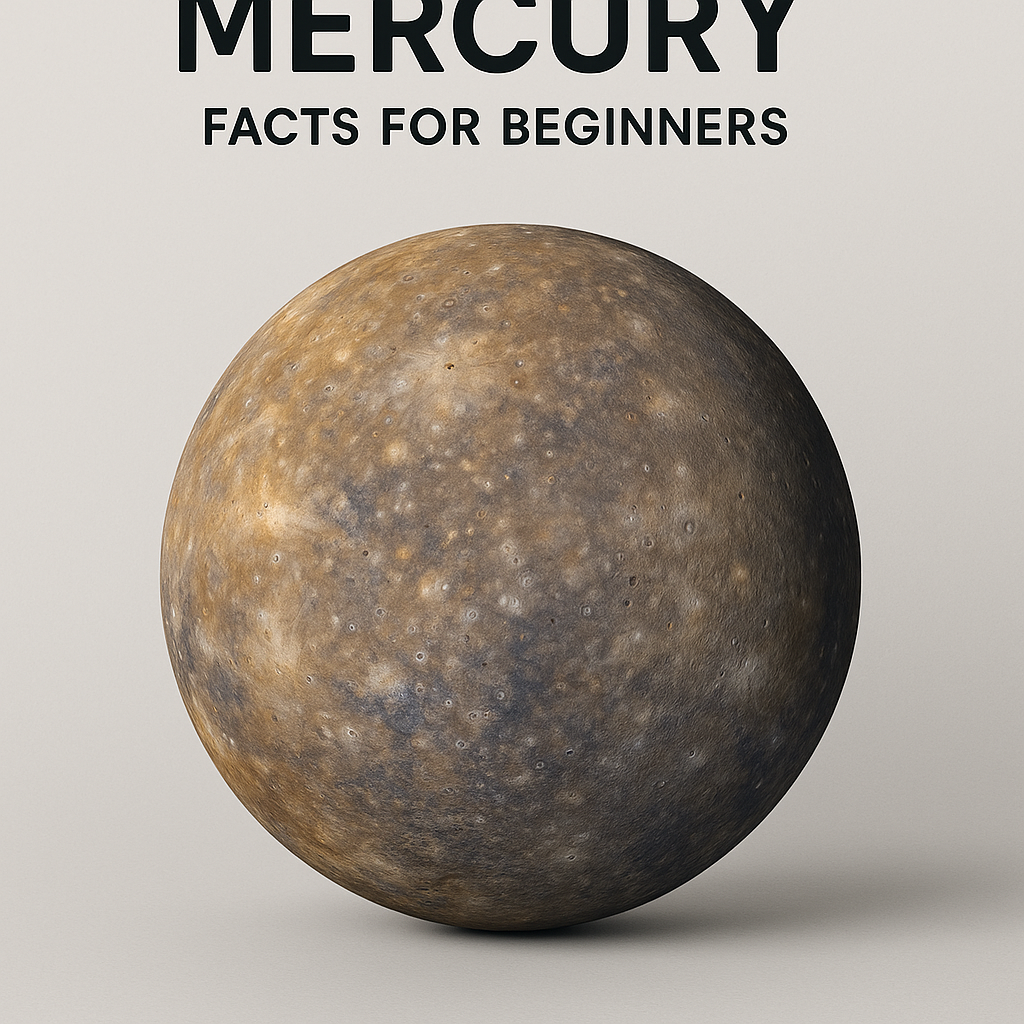
Despite being small, Mercury is fascinating for scientists and space enthusiasts alike. This article will help you understand what makes Mercury unique and what we know about it.
You will learn about Mercury's characteristics, including its size, location, rotation, and even the weather patterns on its surface. Let's delve into the intriguing world of Mercury.
📍 Where It Is and How Far Away
Mercury is the closest planet to the Sun, located in the innermost part of the Solar System. Its average distance from the Sun is about 36 million miles, or roughly one-third of the distance from Earth to the Sun. This is equivalent to 0.39 astronomical units (AU), where one AU is the average Earth-Sun distance.
Because of its proximity to the Sun, sunlight on Mercury is intense, and the position greatly influences its temperature extremes. When Mercury is on the side of the Sun towards us, it experiences very high temperatures, while the other side can be extremely cold.
Mercury's position in the Solar System means it moves quickly around the Sun, completing an orbit in just 88 Earth days. This rapid orbit makes it difficult to observe directly from Earth, as it is often lost in the Sun's glare.
🧱 Size, Mass, and Gravity (Made Simple)
Mercury is the smallest planet in the Solar System, with a diameter of about 3,032 miles. To put that into perspective, it's about a third the size of Earth. Despite its small size, it is quite dense, ranking second only to Earth in density among the planets.
In terms of mass, Mercury is about 5.5% of Earth's mass. Its gravity is about 38% of Earth's gravity, so if you weigh 100 pounds on Earth, you would weigh only 38 pounds on Mercury.
Because of its small mass and weak gravity compared to Earth, Mercury cannot hold onto a thick atmosphere, which affects its surface conditions and weather.
🌡️ Atmosphere and Weather
Mercury possesses a very thin atmosphere, known as an exosphere, which is composed mainly of oxygen, sodium, and hydrogen. This “atmosphere” is so sparse that it wouldn't be able to support weather systems like on Earth.
The lack of a significant atmosphere means Mercury does not have clouds, winds, or storms. However, the temperatures on Mercury's surface vary widely due to its proximity to the Sun and the inability of the thin atmosphere to retain heat.
During the day, temperatures can reach up to 800 degrees Fahrenheit, and at night, they can plummet to -290 degrees Fahrenheit. This extreme temperature variation is one of the most dramatic of any planet in the Solar System.
🪨 Surface and Interior
The surface of Mercury is rocky and resembles the Moon, marked by craters, ridges, and plains. The craters are primarily the result of past impacts with meteoroids and comets.
Icy areas exist near Mercury’s poles, discovered in permanently shadowed regions of craters where sunlight never reaches. This is surprising given its closeness to the Sun.
Inside, scientists believe Mercury has a large iron core making up about 85% of the planet by radius. This core is much larger than expected for such a small planet, influencing its magnetic field.
🌀 Rotation, Orbit, and Seasons
Mercury's rotation is unique; it rotates on its axis very slowly compared to its orbit around the Sun. A day on Mercury (a complete rotation) lasts about 59 Earth days, while its year (one full orbit around the Sun) only takes 88 Earth days.
This slow rotation, coupled with its fast orbit, means only one and a half Mercury days fit into a Mercury year. This leads to long days and nights on the planet's surface.
Mercury’s axial tilt is almost zero, meaning it has virtually no seasons. This small tilt prevents seasonal climate changes, unlike what we experience on Earth.
🧲 Magnetic Field and Radiation
Despite being a small planet, Mercury has a magnetic field, although it's only about 1% as strong as Earth's. This magnetic field is likely generated by its large iron core.
The presence of a magnetic field creates a magnetosphere, albeit a small one, which protects the surface from some of the solar wind’s effects. However, the intense solar radiation can still reach the surface, influencing Mercury's space weather.
The magnetic field affects charged particles around the planet, and studying this can provide insights into both Mercury's internal structure and the formation of other planetary magnetic fields.
🌙 Moons, Rings, and Neighbors
Mercury has no moons or ring systems. This lack of natural satellites is interesting as it stands out among the planets in the inner Solar System.
The absence of moons could be due to its proximity to the Sun, which creates strong gravitational forces. These forces could prevent Mercury from capturing or retaining any moons.
Being so close to Venus, its nearest planetary neighbor, Mercury shares some similarities in terms of atmospheric challenges and temperature extremes, but their differences provide clues to planetary evolution.
🔭 How We Know (Missions and Observations)
Our knowledge of Mercury comes from both Earth-based telescopes and space missions. Telescopes have provided basic information, but the real breakthroughs came with spacecraft.
The Mariner 10 mission was the first to visit Mercury, capturing key images and data. More recently, the MESSENGER spacecraft orbited Mercury, providing detailed observations of its surface and magnetic field.
These missions sent back valuable data such as images showing the full disk of Mercury, its composition, and its strange magnetic field. They enhanced our understanding of this innermost planet.
❓ Common Questions and Misconceptions
Is Mercury a star? No, Mercury is a planet, and stars are much larger and produce their own light.
Can you stand on Mercury? Technically yes, as it has a solid surface, but extreme temperatures and lack of oxygen make it inhospitable.
Is Mercury habitable? With its extreme temperatures and lack of atmosphere, Mercury is not habitable by Earth life standards.
Why is Mercury that color? Mercury’s grayish appearance is due to its rocky surface made up of silicate minerals and a lack of an atmosphere.
Does Mercury have seasons? Due to its nearly zero axial tilt, Mercury experiences no significant seasonal changes.
Why doesn’t Mercury have a thick atmosphere? Its small gravity and close proximity to the Sun result in any atmosphere escaping into space.
Could Mercury have once supported life? There is no evidence to suggest that Mercury could have supported life as we know it.
Does it have rings like Saturn? No, Mercury’s lack of moons and distance from large debris explain the absence of rings.
Why is it hard to study Mercury from Earth? It's close to the Sun, making it challenging to observe due to the Sun's glare.
📌 Summary
- Mercury is the smallest planet in the Solar System.
- Located closest to the Sun, about 0.39 AU away.
- Small size and weak gravity, 38% of Earth's gravity.
- Has a very thin atmosphere that doesn't support weather.
- Rocky surface similar to the Moon, with many craters.
- Long day-night cycle; short orbit of 88 Earth days.
- Has a weak magnetic field; influences by solar wind.
- No moons or ring systems are observed.
- Studied by telescopes and missions like Mariner 10 and MESSENGER.
- Known for extreme temperature variations and a lack of seasons.