🪐 Mercury: Surface, Craters, and Temperature Extremes
🌌 What It Is
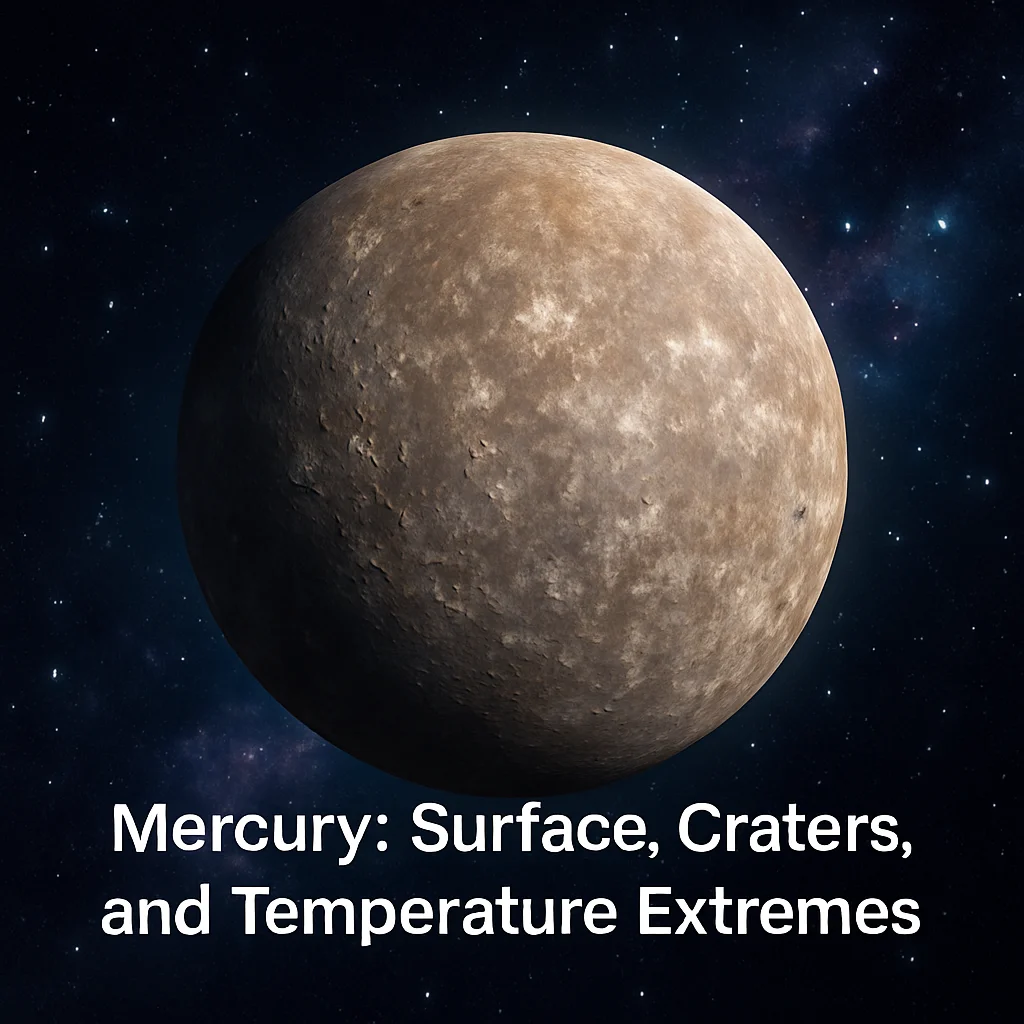
Mercury is the smallest planet in our Solar System and the one closest to the Sun. It's one of the four terrestrial planets, similar to Earth, Venus, and Mars, meaning it's primarily composed of rock and metal. This solid planet is known for having an exceedingly cratered surface, making it appear somewhat like our Moon.
In this article, you'll learn about the unique surface features of Mercury, the extreme temperature variations it experiences, and other fascinating aspects. By the end, you'll understand what makes Mercury a unique world among its planetary siblings.
As you explore Mercury, you'll also discover how scientists gather information about this distant world and the missions that have journeyed to provide us with invaluable insights.
📍 Where It Is and How Far Away
Mercury orbits the Sun at an average distance of about 36 million miles, which is approximately 0.39 astronomical units (AU). One AU is the average distance from the Earth to the Sun, about 93 million miles, making Mercury much closer to the Sun than we are. Because of its proximity to the Sun, it receives a significant amount of sunlight, contributing to its extreme surface temperatures.
Mercury's position near the Sun also makes it challenging to observe from Earth without the aid of telescopes, as it often gets lost in the Sun's glare. However, when it is visible, it appears as a bright spot near the horizon, either just after sunset or before sunrise. Due to its closeness to the Sun, Mercury never strays far from it in the sky.
This closeness impacts its environment in numerous ways, influencing the surface temperature extremes experienced by the planet, ranging from intensely hot to bitterly cold. Understanding the distances and sunlight effects provides context for the conditions found on Mercury.
🧱 Size, Mass, and Gravity (Made Simple)
Mercury is the smallest planet in the Solar System, with a diameter of about 3,031 miles. That's only slightly larger than our Moon. Despite its small size, Mercury is quite dense because it has a large iron core, accounting for a significant percentage of its volume.
In terms of mass, Mercury is lighter than any other planet except Pluto, which is now classified as a dwarf planet. Its surface gravity is about 38% that of Earth's. This means that if you weighed 100 pounds on Earth, you would weigh only about 38 pounds on Mercury.
This reduced gravity would make you feel much lighter on Mercury, but it doesn't change the fact that you would still need to contend with other challenging conditions, such as its severe temperature fluctuations and lack of breathable atmosphere.
🌡️ Atmosphere and Weather
Mercury has a very thin atmosphere, known as an exosphere, composed mostly of oxygen, sodium, hydrogen, helium, and potassium. This exosphere is not thick enough to retain heat, contributing to the planet's drastic temperature changes between day and night.
During the day, temperatures on Mercury's surface can soar to around 800 degrees Fahrenheit due to its proximity to the Sun. However, since there is no substantial atmosphere to trap heat, nighttime temperatures can plummet to about -290 degrees Fahrenheit.
The lack of a significant atmosphere means that Mercury does not experience weather as we know it on Earth—no clouds, rain, or wind occurs here. Instead, its surface is subjected to intense solar radiation and the effects of micrometeoroid impacts.
🪨 Surface and Interior
Mercury's surface is rocky and covered with numerous craters caused by asteroid and comet impacts over billions of years. The planet's most notable surface feature is the Caloris Basin, one of the largest impact craters in the Solar System, stretching about 960 miles in diameter.
The surface resembles that of the Moon, with a stark, gray appearance and vast plains caused by ancient volcanic activity. While volcanoes no longer erupt on Mercury, their past presence has helped shape the planet's terrain.
Inside, Mercury is believed to have a large metallic core. Scientists think this core makes up about 85% of the planet's radius. Above the core is a silicate mantle and crust, but these layers are relatively thin compared to the core.
🌀 Rotation, Orbit, and Seasons
Mercury has an unusual rotation and orbit. It takes 88 Earth days to complete an orbit around the Sun, meaning its year is shorter than its day, which lasts about 59 Earth days.
This slow rotation, combined with its close orbit, results in a phenomenon called spin-orbit resonance, where Mercury rotates three times on its axis for every two orbits around the Sun. This means a single day on Mercury, from sunrise to sunrise, lasts about 176 Earth days.
Mercury's axial tilt is negligible, less than 1 degree, so the planet doesn't experience seasons like Earth. Instead, temperature variations are entirely due to its day-night cycle.
🧲 Magnetic Field and Radiation
Despite its small size and slow rotation, Mercury has a global magnetic field, though it's about 1% the strength of Earth's. This magnetic field creates a magnetosphere, which deflects solar wind particles away from the planet.
The presence of this magnetic field is intriguing due to Mercury's slow rotation and size, and scientists suggest it might be the result of its large, molten iron core.
Radiation is a significant concern near Mercury due to its proximity to the Sun. The intense solar radiation and high-energy particles can be hazardous to spacecraft and, in theory, any future missions that may land on Mercury.
🌙 Moons, Rings, and Neighbors
Mercury does not have any moons or rings. Its gravity is not strong enough to retain a satellite, and its close proximity to the Sun likely contributes to this lack, as any potential moons might have been destabilized by the Sun's powerful gravitational pull.
This absence of moons and rings makes Mercury somewhat singular among the planets. However, studying this characteristic can help scientists understand more about planetary formation and the effects of solar proximity.
Venus is Mercury's closest planetary neighbor. However, despite this proximity, the two planets have very distinct environments and characteristics, largely governed by their different positions relative to the Sun.
🔭 How We Know (Missions and Observations)
Our understanding of Mercury has been significantly enhanced by spacecraft such as Mariner 10 and MESSENGER, which provided detailed images and measurements of the planet's surface and environment.
Mariner 10 was the first spacecraft to visit Mercury in the 1970s, capturing the first up-close images of its cratered surface. Later, the MESSENGER mission orbited Mercury from 2011 to 2015, offering an even more comprehensive view of its geology, composition, and magnetic field.
These missions gathered data on Mercury's surface features, magnetic field, and exosphere via cameras and instruments that measured magnetic and gravitational properties, and collected spectral data.
❓ Common Questions and Misconceptions
Is Mercury a star? No, Mercury is a planet. It reflects sunlight and therefore shines brightly, but it produces no light of its own like a star.
Can you stand on Mercury? While Mercury has a solid surface, standing on it would be hazardous due to extreme temperatures and lack of atmosphere.
Is Mercury habitable? Mercury’s extreme temperature variations and lack of atmosphere make it uninhabitable by life as we know it.
Why is Mercury that color? Mercury's dull gray color is due to its surface composition of rocky, silicate materials mixed with metal.
Does Mercury have ice? Surprisingly, some water ice may exist in permanently shadowed craters at Mercury's poles, shielded from the Sun’s heat.
How long is a year on Mercury? A year on Mercury is only 88 Earth days, due to its close orbit around the Sun.
Why doesn’t Mercury have moons? Mercury's proximity to the Sun and its low gravity likely prevent it from capturing or retaining moons.
What is Mercury made of? Mercury is primarily composed of a large iron core surrounded by a rocky mantle and crust.
Why is Mercury hard to see? Mercury is close to the Sun, making it often lost in the Sun’s glare and visible only around sunrise or sunset.
Does Mercury have rings? Mercury does not have rings. Its small size and proximity to the Sun make it unlikely to support a ring system.
📌 Summary
- Mercury is the smallest planet in our Solar System.
- It orbits closest to the Sun, about 0.39 AU from it.
- With a diameter of 3,031 miles, its gravity is 38% of Earth's.
- Mercury has a thin exosphere; no traditional weather occurs.
- Its surface is heavily cratered with a large iron core inside.
- Mercury has a unique spin-orbit resonance and no true seasons.
- The planet has a magnetic field; radiation levels are high.
- It lacks moons or rings; proximity to the Sun is a factor.
- Missions like MESSENGER have significantly enhanced our knowledge.
- Mercury’s large temperature variation is perhaps its most memorable attribute.