🪐 The Inner Planets Compared: Size, Gravity, and Atmosphere
🌌 What It Is
The inner planets of our Solar System comprise Mercury, Venus, Earth, and Mars. These planets, often referred to as terrestrial planets, are composed primarily of rock and metal. This composition is in contrast to the outer planets, which consist mostly of gas and ice. The inner planets are situated closer to the Sun and have solid surfaces with atmospheres that vary greatly in composition and density.
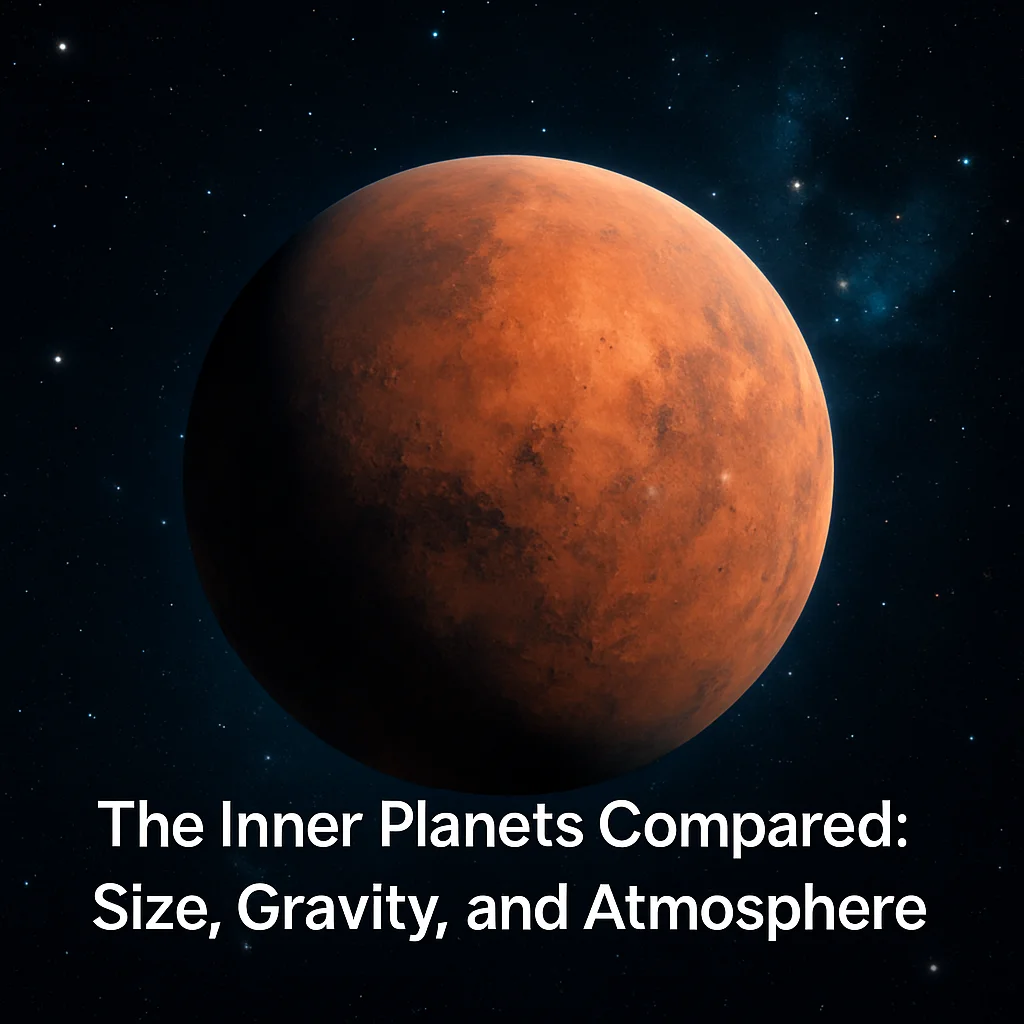
Understanding the characteristics of these planets is crucial for several reasons. Not only do they offer insights into Earth’s own formation and geology, but they also help astronomers infer details about rocky planets around other stars. In this article, we will explore their size, gravity, and atmosphere to help you understand what makes each of these planets unique.
By comparing these planets, you will gain a basic understanding of their individual attributes, and how they interact within the larger context of the Solar System. This foundation will enhance your appreciation of both our planet and the cosmos at large.
📍 Where It Is and How Far Away
Positioned closest to the Sun, the inner planets are separated from the outer planets by the asteroid belt. Mercury, the nearest to the Sun, orbits at an average distance of about 36 million miles (58 million kilometers), while Mars, the farthest inner planet, is about 142 million miles (228 million kilometers) away. The varying distances of these planets from the Sun result in vastly different temperatures and sunlight exposure.
For a clearer perspective on these distances, astronomers often use Astronomical Units (AU), where 1 AU represents the average distance from the Earth to the Sun. Mercury is approximately 0.39 AU from the Sun, making it the most sunbathed, while Mars is about 1.52 AU away, which gives it cooler temperatures.
The positions of these planets also influence their atmospheres and weather systems, which we will explore later. Their proximity to the Sun affects everything from the length of their years to the intensity of their seasons.
🧱 Size, Mass, and Gravity (Made Simple)
The inner planets vary significantly in size and mass. Earth is the largest, with a diameter of about 7,917 miles (12,742 kilometers), while Mercury, the smallest, is only 3,031 miles (4,878 kilometers) across. Even though Venus is roughly the same size as Earth, its harsh conditions make it vastly different.
Surface gravity on these planets also varies. Earth's gravity provides the baseline at which we experience weight. On Mercury and Mars, gravity is much weaker, making objects feel lighter than they do on Earth. Conversely, Venus, with its similar size to Earth, has gravity nearly equivalent to our own.
If you could stand on the surface of these rocky worlds, you would weigh less on Mercury and Mars, while your weight on Venus would feel almost the same as on Earth. This variance in gravity affects everything from atmospheric density to potential for hosting life.
🌡️ Atmosphere and Weather
The atmospheres of the inner planets are as varied as their surfaces. Mercury has a thin, almost negligible atmosphere, primarily composed of oxygen, sodium, and hydrogen. This lack means there is little weather and drastic temperature changes from day to night.
Venus, shrouded in thick clouds of carbon dioxide and sulfuric acid, experiences temperatures hot enough to melt lead due to a runaway greenhouse effect. Its atmosphere is about 90 times denser than Earth's, and it supports thick clouds and high-speed winds.
Earth's atmosphere, shared by all known life, is unique with its nitrogen and oxygen composition. This balance not only supports life but also regulates temperature and weather patterns through cloud formation and precipitation.
Mars has a thin atmosphere, mostly carbon dioxide, and also hosts dust storms, some of the largest in the Solar System. The thin atmosphere means that temperatures can be extremely cold, with little insulation against the chill of space.
🪨 Surface and Interior
Surfaces of these planets each tell a different story. Mercury's heavily cratered surface bears witness to a distant past of impacts, similar in appearance to our Moon. Without significant geological activity, these features have remained largely unchanged for billions of years.
Venus has a volcanic landscape, with vast plains and mountain ranges formed by past eruptions. Its surface, young compared to other inner planets, is regularly refreshed by volcanic activity, though the thick atmosphere obscures much of it from view.
Earth's surface is dynamic, with continuous movement of tectonic plates creating mountains, earthquakes, and volcanoes. The presence of liquid water has also shaped its terrain through erosion and deposition.
Mars hosts the tallest volcano and the deepest canyon in the Solar System. Evidence suggests it once had watery surfaces, though now its dry, dusty desert conditions dominate.
🌀 Rotation, Orbit, and Seasons
The rotation and orbit of each inner planet affect its day, year, and seasons. Mercury rotates slowly, taking 59 Earth days to complete one rotation but orbits the Sun every 88 days, creating long days and nights.
Venus rotates in the opposite direction to most planets and has a slow rotation. One day on Venus (one rotation) is longer than its year (one orbit around the Sun). This, combined with its lack of a significant axial tilt, means Venus has little to no seasons.
Earth's 24-hour rotation cycle and 365-day orbit create familiar patterns of day and night along with the seasons, facilitated by an axial tilt of about 23.5 degrees.
Mars has a rotation and axial tilt similar to Earth's, resulting in days just slightly longer and similar seasonal changes, though each season lasts about twice as long due to its extended orbit.
🧲 Magnetic Field and Radiation
Mercury possesses a weak magnetic field, thought to be a remnant of its geological past. Its magnetic field is only about 1% as strong as Earth's but plays a role in interacting with solar wind.
Venus lacks a significant magnetic field, possibly due to the planet's slow rotation. Without protection from radiation, its atmosphere faces intense pressure from solar wind.
Earth's magnetic field, generated by its molten outer core, shields the planet from harmful solar and cosmic radiation. This shield is crucial for maintaining an atmosphere and preventing the loss of water and other important gases.
Mars, with its weak and patchy magnetic fields, offers little protection from solar radiation. This lack has contributed to the thin and eroded state of its atmosphere.
🌙 Moons, Rings, and Neighbors
Mercury and Venus have no natural satellites. This absence may be due to their proximity to the Sun, where solar tides can strip away or prevent the capture of moons.
Earth boasts one large moon, which affects tides and stabilizes the planet’s axial tilt over long periods, contributing to a stable climate. The Moon is a familiar celestial neighbor that has inspired human exploration.
Mars has two small moons, Phobos and Deimos, thought to be captured asteroids. Their irregular shapes and orbital characteristics add intrigue to Mars' story, sparking interest in their origins and fate.
🔭 How We Know (Missions and Observations)
Much of what we know about the inner planets comes from a combination of telescope observations and space missions. Telescopes allow us to measure planetary orbits, determine surface conditions, and analyze atmospheric compositions.
Historical missions like Mariner 10 have provided the first close-up images of Mercury, while the Magellan mission mapped Venus’ surface with radar. Earth-based observations continue to offer new insights into these worlds.
For Mars, a fleet of orbiters, landers, and rovers have revolutionized our understanding of its geology, climate, and potential for past life. These missions have given us data on surface conditions, weather patterns, and atmospheric chemistry.
The detailed images, spectral data, and gravity measurements gathered by these missions help piece together the complex histories and current states of our inner solar neighbors.
❓ Common Questions and Misconceptions
Is Mercury the hottest planet? No, Venus is hotter due to its thick, greenhouse gas-laden atmosphere.
Can you stand on Venus? While it has a solid surface, the extreme heat and pressure make it inhospitable for standing.
Is Earth the only habitable planet? As far as we know, Earth is currently the only planet with conditions suitable for human life.
Why does Mars look red? Mars' surface is covered with iron oxide, or rust, which gives it a reddish appearance.
Does Venus have many volcanoes? Yes, Venus is dotted with numerous volcanoes and large volcanic regions.
Mars' weather: does it rain? There is no liquid water on Mars' surface today, so rain as we know it doesn't occur there.
Is Earth's size typical? Among the inner planets, Earth is the largest; however, sizes vary significantly across all planets in the Solar System.
Does Mercury have an atmosphere? It has a very thin one, not dense enough to support weather or breathable air.
Are all inner planets rocky? Yes, this is a defining feature, setting them apart from the gas and ice giants beyond the asteroid belt.
Is Mars' day similar to Earth's? Yes, a day on Mars, called a sol, is just about 24.6 hours, nearly the same as our day.
📌 Summary
- 💡 The inner planets are Mercury, Venus, Earth, and Mars, all terrestrial with rocky surfaces.
- 🔭 Located in proximity to the Sun, ranging from about 0.39 AU (Mercury) to 1.52 AU (Mars).
- ⚖️ Gravity varies widely, with Mercury and Mars having weaker gravity than Earth and Venus.
- 🌥️ Atmospheres vary: Mercury's is thin, Venus’ is thick and hot, Earth's is life-supporting, and Mars' is thin and cold.
- 🪨 Surfaces are diverse; Mercury is heavily cratered, Venus volcanic, Earth dynamic, Mars dusty with evidence of ancient water.
- 🌀 Rotation periods create varying days; Venus rotates backward, Mercury has long days and nights.
- 🧲 Mars' weak magnetic field vs. Earth's strong, protective field; Venus lacks a significant field entirely.
- 🌙 Moons and rings are minimal; Earth has one moon, Mars two small moons, Mercury and Venus have none.
- 🔭 Knowledge comes from spacecraft missions, landers, rovers, and telescope observations.
- 🤔 Memorable fact: Mars has the tallest volcano and deepest canyon found in the Solar System.