🪐 Venus Facts for Beginners
🌌 What It Is
Venus is the second planet from the Sun in our Solar System. It's known as one of the terrestrial planets, which means it is a rocky body like Earth and Mars.
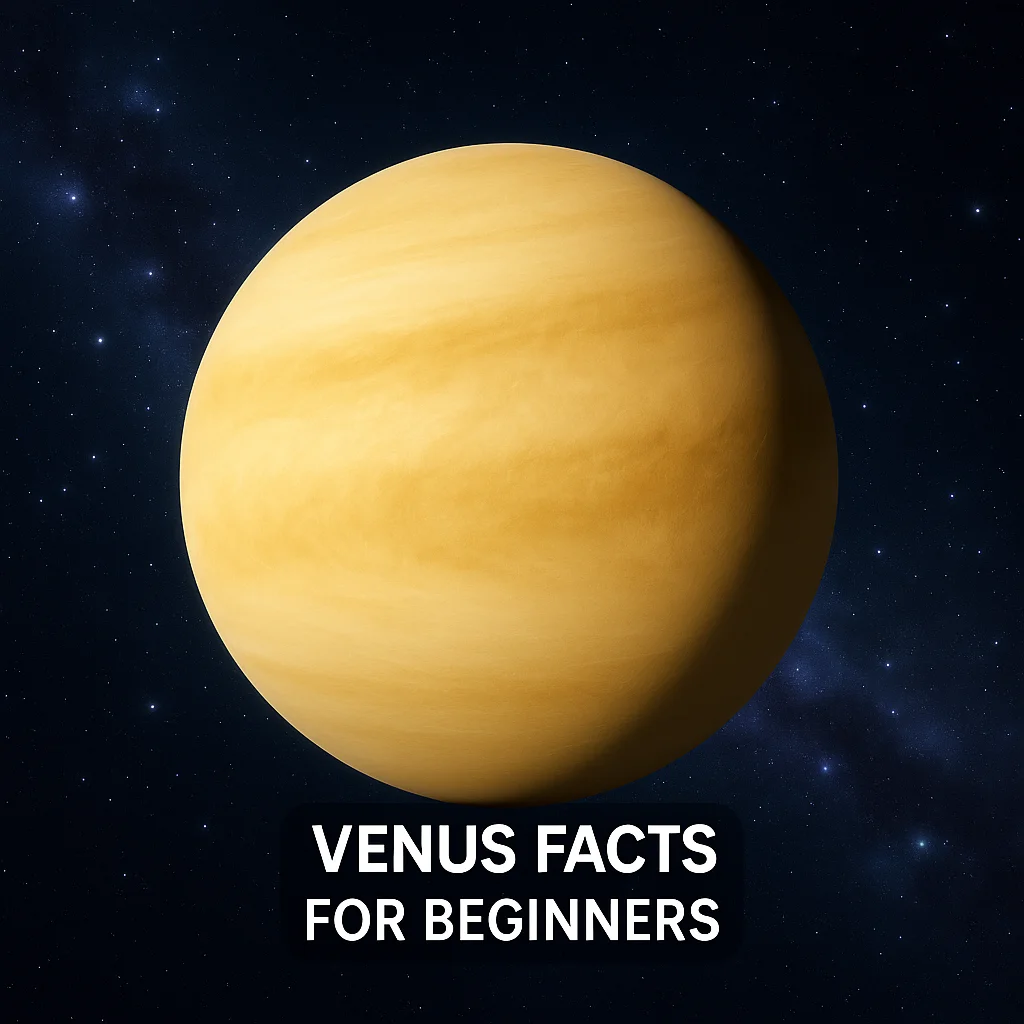
This planet is similar in size and structure to Earth, earning it the nickname "Earth's twin." However, its conditions are vastly different.
In this article, you'll learn about Venus's location, size, atmosphere, surface, rotation, and more. We'll also touch on its magnetic field and how scientists study it.
📍 Where It Is and How Far Away
Venus is located between Mercury and Earth, making it the second planet from the Sun. It is part of the inner Solar System, which includes the terrestrial planets.
The average distance from Earth to Venus is about 41 million kilometers. To give you a sense of scale, it's roughly 100 times the distance from New York to Los Angeles.
This proximity to the Sun means Venus receives a lot of sunlight. However, its thick atmosphere traps heat, making it one of the hottest planets in the Solar System.
🧱 Size, Mass, and Gravity (Made Simple)
Venus is nearly the same size as Earth, with a diameter of about 12,104 kilometers. This means if Earth were a basketball, Venus would be approximately the same size.
In terms of mass, Venus is about 81% of Earth's mass. This similarity in size and mass gives Venus a surface gravity that's 90% that of Earth, so you'd feel somewhat familiar weight-wise.
Despite its surface gravity, the thick atmosphere compresses and exerts pressure, making standing on Venus unlike anything experienced on Earth.
🌡️ Atmosphere and Weather
Venus's atmosphere is dense and consists mostly of carbon dioxide, with clouds of sulfuric acid. This composition creates a greenhouse effect that heats the surface.
The weather on Venus includes strong winds and high temperatures reaching 475 degrees Celsius, which is hot enough to melt lead.
The lack of water vapor and its slow rotation contribute to a rather stable, but hostile, atmospheric environment.
🪨 Surface and Interior
The surface of Venus is rocky, with vast plains, highland regions, and numerous volcanoes. Unlike Earth, these features suggest a history of intense volcanic activity but no tectonic plate movement.
Venus's surface is young geologically, and features like craters show it has been resurfaced multiple times by lava.
Inside Venus, scientists believe there is a core made mostly of iron and nickel, surrounded by a mantle of silicate rock, akin to Earth’s internal structure.
🌀 Rotation, Orbit, and Seasons
Venus has a unique rotation, spinning very slowly on its axis, taking about 243 Earth days to complete one rotation. Interestingly, it rotates in the opposite direction to its orbit.
Its year, or the time it takes to orbit the Sun, is about 225 Earth days. Therefore, a day on Venus is longer than a Venusian year.
This retrograde rotation means the Sun rises in the west and sets in the east, unlike on Earth.
🧲 Magnetic Field and Radiation
Unlike Earth, Venus has no significant magnetic field created by its core. This absence means solar wind impacts its atmosphere more directly.
Despite the Sun's influence, thick clouds and atmospheric pressure protect Venus's surface from being stripped away.
This interaction with solar radiation presents challenges for any spacecraft visiting Venus due to potential damage from solar particles.
🌙 Moons, Rings, and Neighbors
Venus is intriguing because it has no moons or rings. Its lack of moons sets it apart from Earth, and scientists are interested in why this is the case.
The gravitational influences between Earth and Venus, along with potential past events, might explain this absence.
As Earth's closest planetary neighbor, Venus sometimes appears as the brightest object in our night sky, earning it the name "Evening Star" or "Morning Star."
🔭 How We Know (Missions and Observations)
Our understanding of Venus comes from a combination of telescope observations and spacecraft missions. Telescopes help us study Venus's orbit and brightness changes.
Famous missions to Venus include NASA's Magellan, which mapped its surface, and the Soviet Venera missions that landed probes.
These missions provide images, surface temperature readings, and data on atmospheric composition, offering insights into its environment.
❓ Common Questions and Misconceptions
Is Venus a star? No, Venus is a planet and shines brightly because it reflects sunlight.
Can you stand on Venus? Technically yes, but the extreme pressure and temperature make it deadly for humans without advanced protection.
Is Venus habitable? Venus is currently too hot and toxic for human life.
Why is Venus so hot? Dense clouds trap solar heat in a severe greenhouse effect.
Is Venus brighter than stars? Yes, it's often brighter than most stars due to its proximity to Earth and the Sun.
Why does Venus rotate backward? Its retrograde rotation is a mystery, possibly due to massive past collisions.
Does Venus have polar ice caps? No, Venus is too hot for ice, with no known water on its surface.
Is Venus' surface visible from Earth? No, its dense clouds block the surface from view.
📌 Summary
- Venus is the second planet from the Sun, similar in size to Earth.
- It is part of our inner Solar System, roughly 41 million kilometers from Earth.
- Similar in mass to Earth but with 90% of Earth's gravity.
- Dense atmosphere with clouds of sulfuric acid and high temperatures.
- Surface is rocky with volcanic features and no tectonic plates.
- Has retrograde rotation, with a day longer than its year.
- No significant magnetic field; solar winds affect the atmosphere.
- No moons or rings, known for brightness in our sky.
- Studied through telescopes and spacecraft missions like Magellan and Venera.
- Retains mysteries like its slow rotation and thick atmosphere.