🪐 Venus vs Earth: Why One Became Hellish
🌌 What It Is
Venus and Earth are often called sister planets because of their similar size and composition. Both are rocky worlds located in the inner part of the Solar System. Despite these similarities, they have evolved very differently. In this article, we will explore why Venus is a hot, crushing environment, while Earth is a thriving home to life.
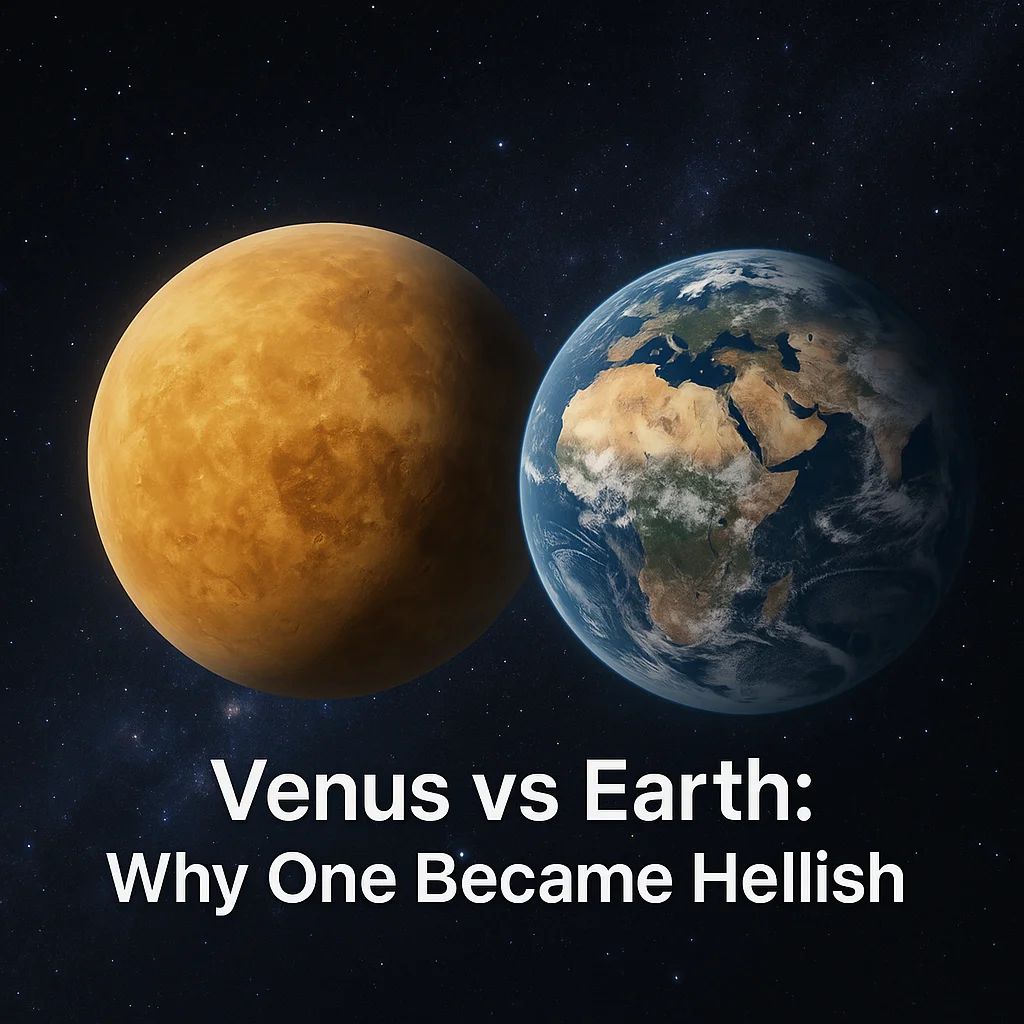
Venus is classified as a terrestrial planet, which means it is composed primarily of rock and metal. Like Earth, it has a solid surface on which a spacecraft could, in theory, land. However, the conditions on Venus are extreme, making it an inhospitable place for human life.
This article will guide you through the fascinating worlds of Venus and Earth, revealing the mysteries of their surfaces, atmospheres, and the processes that sculpt them. By understanding these two planets, we can learn more about the fate of worlds in our Solar System and beyond.
📍 Where It Is and How Far Away
Venus, the second planet from the Sun, is located about 0.72 astronomical units (AU) away from it, making it Earth's closest planetary neighbor. One AU is the average distance from Earth to the Sun, roughly 93 million miles or 150 million kilometers. This proximity to the Sun has a significant impact on Venus's climate and atmospheric conditions.
Because Venus is closer to the Sun than Earth, it receives more sunlight and solar energy. However, its thick cloud cover reflects much of this sunlight, which creates a unique energy balance and influences its surface temperature.
Despite the vast distance between Venus and Earth, advances in space exploration have allowed us to study Venus in detail using telescopes and spacecraft. These observations have unraveled some of Venus's most intriguing mysteries, including its harsh climates and dynamic activities.
🧱 Size, Mass, and Gravity (Made Simple)
Venus is almost the same size as Earth, with a diameter of about 7,520 miles (12,104 kilometers), making it only slightly smaller. It's also the closest in mass to Earth among all the planets, which means its gravitational pull is comparable. Gravity on Venus is around 90% of that on Earth, so if you could stand on Venus, you would feel nearly as heavy as you do on Earth.
While the surface of Venus is hot and hostile, its mass and gravitational force have essential roles in maintaining its dense atmosphere. This atmosphere is much thicker than Earth's, contributing to the severe surface conditions experienced on Venus.
Understanding the size and gravity of Venus helps explain why it has such a dense atmosphere and contributes to our knowledge about how planets form and evolve over time in different parts of the Solar System.
🌡️ Atmosphere and Weather
The atmosphere of Venus is composed primarily of carbon dioxide, with clouds of sulfuric acid. This thick atmosphere creates a runaway greenhouse effect, trapping heat and causing surface temperatures to soar above 860 degrees Fahrenheit (460 degrees Celsius), hotter than the surface of Mercury, even though Venus is farther from the Sun.
The weather on Venus is unlike anything on Earth. Winds on Venus can reach speeds of over 220 miles per hour (360 kilometers per hour) in its upper atmosphere, much faster than the planet itself rotates. This creates fast-moving clouds that circle the planet in just a few Earth days.
Venus's high temperature and atmospheric pressure, which is over 90 times that of Earth's at sea level, make it an extreme and dangerous environment for any potential landers. By studying Venus's atmosphere, scientists hope to understand more about greenhouse effects and climate changes.
🪨 Surface and Interior
Venus has a rocky surface similar to Earth's, but it's hidden under thick clouds, complicating observation and exploration. The surface is dotted with craters, large volcanic mountains, and expansive lava plains. Volcanism appears to have played a significant role in shaping the planet's surface.
The surface of Venus is relatively young, geologically speaking, with features suggesting that lava flows have resurfaced large portions of the planet. Unlike Earth, Venus shows no sign of plate tectonics, which has significant implications for its volcanic and geologic activity.
Below the surface, Venus is believed to have a core, mantle, and crust; however, its interior structure remains less understood than that of Earth. Insights into Venus's interior can help explain its volcanic history and long-term surface changes.
🌀 Rotation, Orbit, and Seasons
Venus has a slow and unusual rotation. It takes about 243 Earth days to complete one rotation on its axis, and it rotates in the opposite direction to most planets in the Solar System, including Earth. This means that on Venus, the Sun rises in the west and sets in the east.
Despite this slow rotation, Venus orbits the Sun in roughly 225 Earth days. This makes a Venusian day longer than its year. The planet’s axial tilt is very minimal, meaning that Venus experiences little to no seasonal changes, unlike Earth.
Understanding Venus's rotation and orbit helps us grasp the dynamics of planetary systems and the impact these factors have on a planet's climate and environment.
🧲 Magnetic Field and Radiation
Unlike Earth, Venus does not have a significant magnetic field. This absence affects how the solar wind—a stream of charged particles from the Sun—interacts with Venus's atmosphere. Instead of being deflected by a magnetic field, the solar wind directly interacts with Venus's upper atmosphere, stripping particles away into space.
This interaction with the solar wind can produce phenomena similar to auroras, but unlike the bright auroras seen on Earth, those on Venus are much weaker and occur all over the planet rather than at the poles.
The lack of a strong magnetic field and the stripping of the atmosphere are key factors in understanding why Venus's surface and atmospheric conditions are so extreme, contributing to our knowledge of planetary magnetism.
🌙 Moons, Rings, and Neighbors
Unlike Earth, Venus has no natural satellites or moons. This absence of moons is somewhat puzzling, as even small planets or dwarf planets often have moons. Scientists are still exploring why Venus ended up without moons, and what this lack might mean for the planet's past.
Venus's position as the second planet from the Sun places it between Mercury and Earth, making it Earth's nearest planetary neighbor. Its lack of moons and nearby position offers a unique opportunity to study another terrestrial planet up close.
🔭 How We Know (Missions and Observations)
Our understanding of Venus has been greatly enhanced by both telescopic observations and direct exploration by spacecraft. Ground-based telescopes can observe Venus's phases and its thick atmosphere, but spacecraft have provided more detailed data.
Past missions to Venus, such as NASA's Magellan orbiter, have mapped the surface and studied the planet's geology. Recent missions, like the European Space Agency's Venus Express, focused on atmospheric studies and climate dynamics.
These missions use a variety of tools to gather information, including radar imaging to see through clouds, spectrometers to analyze atmospheric composition, and gravity measurements to study Venus's interior. These data help us understand the planet's conditions and history.
❓ Common Questions and Misconceptions
Is Venus a star? No, Venus is a planet. Its bright appearance in the sky often leads to it being mistaken for a star.
Can you stand on Venus? Technically, yes, Venus has a solid surface, but the extreme pressure and temperature make standing on Venus impossible with current technology.
Is Venus habitable? Venus's surface conditions are too extreme for life as we know it, with high temperatures and pressures. However, some scientists investigate the possibility of microbial life in the upper clouds.
Why is Venus that color? Venus appears yellowish-white due to its thick sulfuric acid clouds reflecting sunlight.
Why no seasons on Venus? Its minimal axial tilt means there are no significant seasonal variations.
How does Venus's rotation affect days there? Venus's retrograde rotation means a day is longer than a year, and the Sun rises in the west.
📌 Summary
- Venus is a terrestrial planet known as Earth’s sister, with similar size and makeup.
- Located second from the Sun, it sits approximately 0.72 AU away.
- It is slightly smaller than Earth, with gravity about 90% of Earth's.
- Venus's thick carbon dioxide atmosphere leads to a scorching greenhouse effect.
- The surface is shaped by volcanism without signs of tectonic activity.
- A day on Venus is longer than its year due to slow, retrograde rotation.
- There is no significant magnetic field, affecting atmospheric retention.
- Venus has no moons, a unique feature among terrestrial planets.
- Spacecraft like Magellan and Venus Express have provided crucial data on its climate and geology.
- Despite its challenges, Venus remains a key subject in understanding planetary climates and evolution.