🪐 Earth vs Mars: What’s Really Different?
🌌 What It Is
Earth and Mars are both planets in our Solar System. Earth is our home planet and is classified as an inner, terrestrial planet, meaning it is rocky and located closer to the Sun. Mars, also a terrestrial planet, is often called the "Red Planet" because of its reddish appearance.
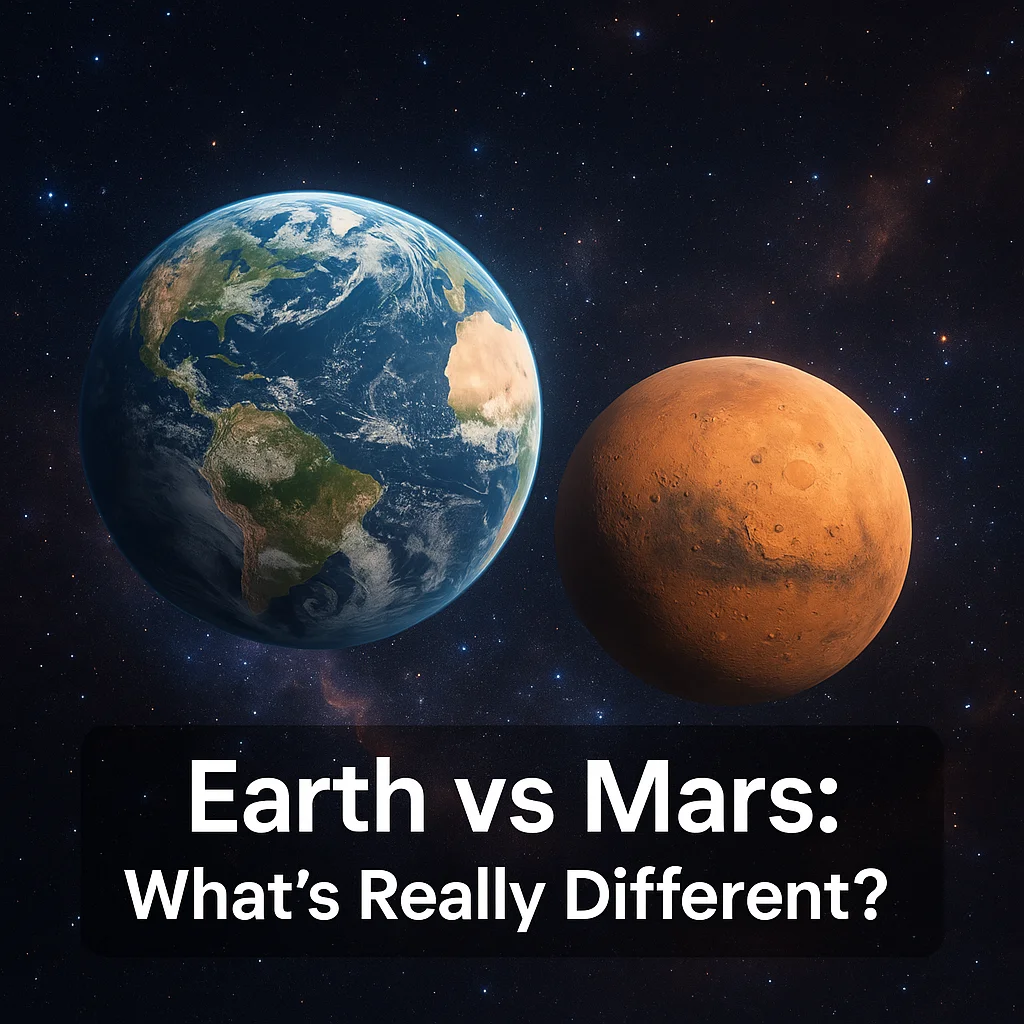
In this article, you will learn how Earth and Mars compare with each other in various aspects such as size, atmosphere, surface features, and more. We'll see how these planets are unique in their own ways and what makes them fascinating to study.
Understanding these differences helps us appreciate what makes Earth suitable for life and why Mars is a primary target for exploration in the search for past or present life.
📍 Where It Is and How Far Away
Earth is the third planet from the Sun, positioned between Venus and Mars. It is located about 93 million miles (150 million kilometers) from the Sun, which equals about 1 astronomical unit (AU). This distance places Earth in what is known as the habitable zone, where conditions are just right for liquid water to exist.
Mars is the fourth planet from the Sun, situated beyond Earth. Its average distance from the Sun is about 142 million miles (228 million kilometers), or roughly 1.5 AU. This increase in distance means Mars receives less sunlight, contributing to its generally colder temperatures compared to Earth.
The relative positions of Earth and Mars significantly impact their climates and the amount of sunlight they receive, hence influencing each planet's weather and temperature variations.
🧱 Size, Mass, and Gravity (Made Simple)
Earth is the largest of the terrestrial planets, with a diameter of about 7,917 miles (12,742 kilometers). Its mass is sufficient to exert a gravitational force that keeps our atmosphere and oceans in place. Earth's gravity is strong enough that objects fall toward the surface with a noticeable pull.
Mars is smaller than Earth, with a diameter of about 4,212 miles (6,779 kilometers). It has less mass than Earth, which means its gravity is weaker. On Mars, you would weigh only about 38% of what you do on Earth, making you feel lighter and able to jump higher.
This difference in gravity affects everything from the thickness of the atmosphere to how much weight future colonists might need to adjust to when they visit or live on Mars.
🌡️ Atmosphere and Weather
Earth's atmosphere is rich in nitrogen and oxygen, which supports life. Weather patterns on Earth feature a variety of phenomena, including rain, snow, storms, and clear skies. These are driven by the Sun's energy, the planet's rotation, and the presence of water in its liquid form.
Mars, in contrast, has a very thin atmosphere, composed mostly of carbon dioxide, with traces of nitrogen and argon. The lack of a dense atmosphere means Mars experiences extreme temperature variations and can host powerful dust storms that sometimes cover the entire planet.
The weather on Mars is cold and dry, with temperatures often dropping well below freezing. The thin atmosphere also means less protection from solar radiation.
🪨 Surface and Interior
Earth has a dynamic surface with mountains, oceans, rivers, and plate tectonics that constantly reshape the landscape. The planet's interior consists of a crust, mantle, and core, which drive geological activity.
Mars features a surface marked by dusty red rocks, canyons, and extinct volcanoes. Olympus Mons, the tallest volcano in the Solar System, is located on Mars, illustrating the planet's volcanic past. Mars lacks active plate tectonics today, contributing to its more static surface geology.
The interior of Mars is thought to be similarly layered with a crust, mantle, and core, but it is less geologically active than Earth.
🌀 Rotation, Orbit, and Seasons
Earth rotates on its axis every 24 hours, creating the cycle of day and night. It orbits the Sun once every 365.25 days, giving us a year. The axial tilt of about 23.5 degrees results in the changing seasons as different parts of the planet receive varying amounts of sunlight throughout the year.
Mars also rotates once approximately every 24.6 hours, so a day on Mars, known as a “sol,” is just slightly longer than an Earth day. Mars orbits the Sun in about 687 Earth days. Its axial tilt at about 25 degrees leads to seasonal changes, though they differ in intensity and duration from those on Earth.
The length of a year and the strength of seasons vary between the planets due to their respective distances from the Sun and axial tilts.
🧲 Magnetic Field and Radiation
Earth has a strong magnetic field generated by its molten core. This field creates a protective bubble, known as the magnetosphere, which shields the planet from harmful solar and cosmic radiation. The interactions between charged particles and Earth’s magnetic field also cause auroras near the poles.
Mars does not have a global magnetic field like Earth’s, but there are localized magnetic fields in some regions of its crust. Without a strong magnetic shield, Mars is more susceptible to solar and cosmic radiation, which poses challenges for potential human inhabitants.
The presence or absence of a magnetic field is crucial for any planet's ability to protect its atmosphere and support life as we know it.
🌙 Moons, Rings, and Neighbors
Earth has one moon, which influences our tides and stabilizes the planet’s axial tilt over long periods. The Moon is an important factor in the development of Earth's climate and conditions conducive to life.
Mars has two small moons, Phobos and Deimos, which are thought to be captured asteroids. These moons are irregularly shaped and much smaller than Earth's moon, affecting the surface with their gravitational pull but in more subtle ways.
Neither Earth nor Mars has rings, but studying their moons provides valuable insights into planetary formation and gravitational interactions.
🔭 How We Know (Missions and Observations)
Our understanding of Earth has been built over centuries through telescopic observations and, more recently, satellites that provide comprehensive data on weather, climate, and geology. Space missions to Mars have provided a wealth of information about the Red Planet.
Notable Mars missions include NASA's rovers like Spirit, Opportunity, Curiosity, and Perseverance, which explore the surface and analyze rocks and soil. Orbital missions like Mars Reconnaissance Orbiter have mapped the planet in detail.
Telescopes allow us to observe planets from Earth, while spacecraft can provide close-up views, analyze soil and atmosphere, and send back images and data that help piece together the story of these fascinating worlds.
❓ Common Questions and Misconceptions
Is Mars a star? No, Mars is a planet in our Solar System, not a star.
Can you stand on Mars? Yes, Mars has a solid, rocky surface you can stand on, unlike the gas giants.
Is Mars habitable? Currently, Mars is not habitable without life-supporting technology due to its thin atmosphere and harsh conditions.
Why is Mars red? Mars appears red because of iron oxide, or rust, on its surface.
Does Mars have liquid water? Mars currently has no liquid water on the surface, but evidence suggests water existed in the past.
Will Mars collide with Earth? No, the orbits of Mars and Earth are stable, and there is no risk of collision.
Does Mars have life? As of now, there is no direct evidence of life on Mars, but scientists continue to explore this possibility.
Can humans live on Mars? With current technology, humans cannot live on Mars, but efforts are ongoing to develop habitats that could support life.
📌 Summary
- Earth and Mars are rocky planets in the inner Solar System.
- Earth is closer to the Sun, resulting in a warmer climate than Mars.
- Mars is smaller than Earth, leading to less gravity.
- Earth has a thick atmosphere with oxygen; Mars has a thin atmosphere predominantly carbon dioxide.
- Earth's surface is dynamic, while Mars has a static landscape with dormant volcanoes.
- Both planets have similar day lengths but differ significantly in year lengths.
- Earth has a strong magnetic field; Mars does not, affecting radiation protection.
- Earth has one moon; Mars has two small moons, Phobos and Deimos.
- Our knowledge comes from telescopic observations and numerous space missions.
- Mars remains a prime candidate for the search for extraterrestrial life due to evidence of past water.